
Executive Protection Advance Work: The Complete Operational Guide
Master executive protection advance work with this operational guide covering the five-phase process, intelligence-led planning, checklists, route analysis, and tools used by professional EP teams.
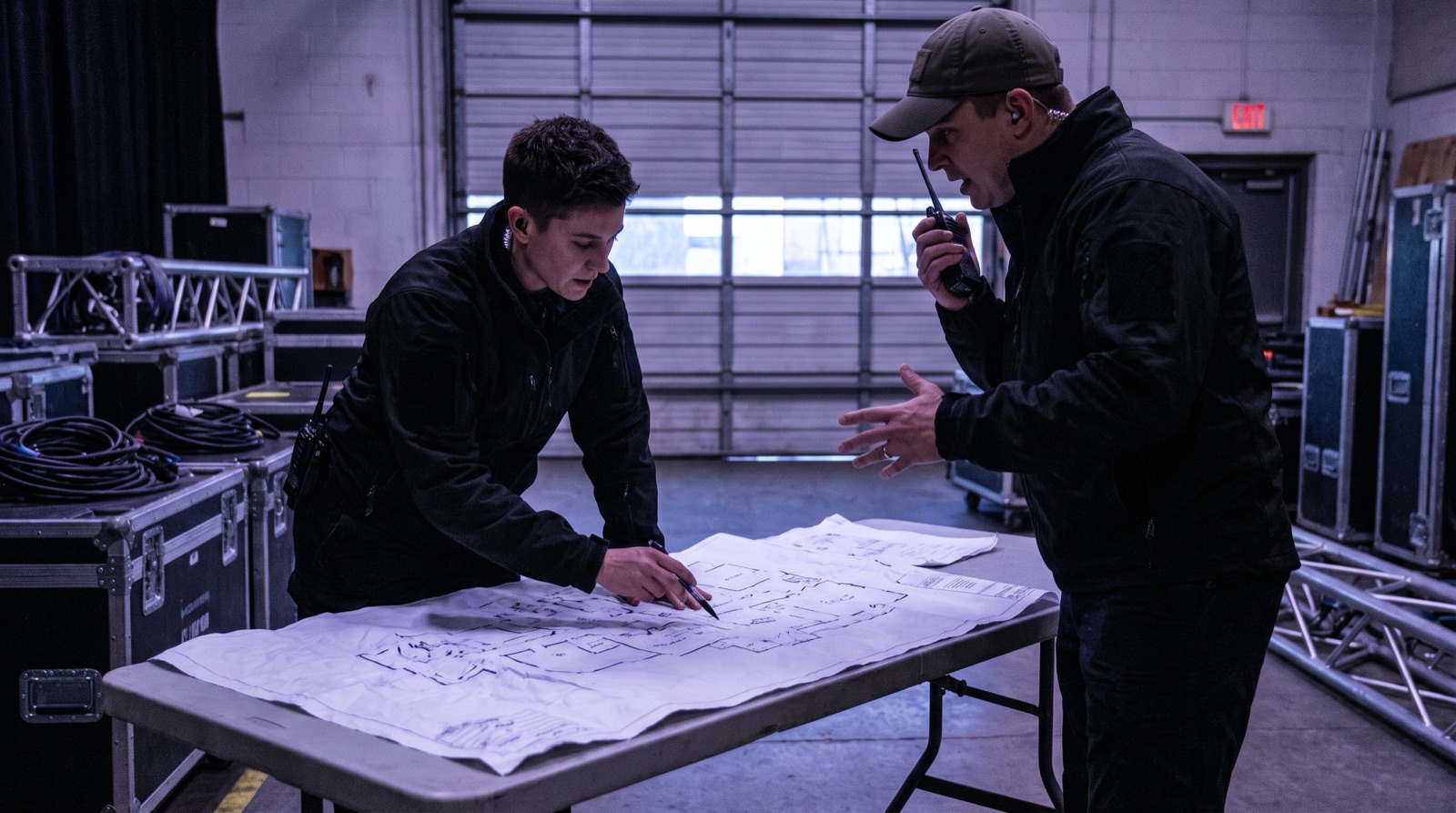
Executive protection advance work is the systematic pre-visit reconnaissance and planning process conducted before a principal arrives at any location. It converts environmental unknowns, from unfamiliar venues to unmapped routes, into documented, rehearsed plans that a protective detail can execute with confidence. Unlike reactive security, which responds to threats as they surface, advance work identifies and mitigates risk before the principal ever sets foot on site. The methodology traces back to the U.S. Secret Service, whose advance protocols remain the gold standard against which every corporate and private-sector protective program is measured. This guide covers the full advance work process: the five-phase operational framework, a domain-by-domain checklist, how intelligence tools change the process, and the international and legal considerations that separate routine domestic advances from high-risk global operations.
What Is Executive Protection Advance Work?
Executive protection advance work is the pre-visit planning discipline that separates professional protective operations from ad hoc bodyguarding. It combines intelligence collection, physical reconnaissance, and contingency planning into a single documented process completed before the principal arrives.
Advance Work vs. Reactive Security: The Critical Distinction
Reactive security responds to incidents after they happen. Advance work exists to make that response unnecessary. A protective detail that has walked the venue, timed the routes, and identified the nearest Level I trauma center is prepared for contingencies before they occur, not scrambling to improvise once something goes wrong. The U.S. Secret Service's near-zero use-of-force record on protective details is frequently cited as proof that prevention, not intervention, defines elite protection. Protective intelligence is the ongoing collection and analysis of threat data that feeds the advance planning process. It is what turns a generic venue walkthrough into a threat-informed operation.
Who Conducts the Advance?
An advance agent is the EP professional who conducts the advance, distinct from the close protection agent who executes the protective detail. The advance agent's job ends once the principal arrives; the close protection agent's job begins there. Advance agents typically hold or work toward EP-specific credentials, including the ASIS International Certified Protection Professional (CPP) designation, Executive Security International (ESI) programs, and the ANSI/EP2 standard published by the Board of Executive Protection Professionals. Team structure scales with the mission: a single agent can handle routine domestic travel to a familiar city, while complex or international itineraries require a multi-team approach. The leapfrog technique is the multi-team advance method used for complex itineraries where one team advances the next location while the principal is still at the current site. This keeps the detail perpetually one step ahead rather than racing to catch up between stops.
Why Advance Work Is the Foundation of Executive Protection
Proactive Risk Mitigation
Every location a principal visits carries a threat profile, whether anyone has documented it or not. Advance work makes that profile visible and actionable. Instead of discovering a blind loading dock or an unsecured stairwell during the visit, the advance team identifies it days or weeks ahead and builds a contingency around it. The difference between a threat that is known and planned for and one that is unknown is the difference between a controlled response and an incident.
Operational Continuity and Communication
An advance that lives only in one agent's head is a liability. The findings need to be documented, shareable, and amendable across the entire team, because protective operations rarely have a single decision-maker. Security teams supporting large organizations routinely report that documentation has to serve multiple layers of approval at once. A security leader at a Fortune 500 financial services company described the pattern directly: "Even if I were able to do this, I would still be asked, well, what about this, this, and this?" Comprehensive documentation that anticipates those questions, rather than a summary that invites them, is what keeps an advance package useful across an organization's chain of approval.
Legal and Liability Reduction
A documented advance is evidence of due diligence. If an incident occurs despite thorough planning, the advance package (site survey notes, route timing, medical contingencies, stakeholder sign-offs) demonstrates that the protective team acted on a reasonable standard of care. That documentation protects both the EP provider and the client organization if the response is ever scrutinized in a legal or insurance context.
Data as a Strategic Asset
Each completed advance adds to an organization's institutional knowledge base. A venue surveyed once becomes a known quantity the next time the principal visits; a route timed in rush-hour traffic becomes a reusable data point. That accumulated intelligence does more than improve future operations. It gives security leaders a way to justify budget and demonstrate value in terms the business understands. A campus security manager at a Fortune 500 technology company put it plainly when describing how the team uses location data to weigh in on real estate decisions: "We're trying to sign a lease, and we're trying to say, does security... are we saying this one's our preference versus this one?" Security teams that can answer that question with data are participating in business decisions, not just responding to them. Base Operations customers report a similar shift: one Fortune 500 travel company's security program moved from a reactive, cost-center function to a proactive concierge service once it had street-level intelligence to back its recommendations, rather than relying on ad hoc research for every trip.
The Five Phases of a Professional Advance Operation
A professional advance operation runs through five distinct phases, each producing a deliverable the next phase depends on.
Phase 1: Pre-Advance Intelligence Collection
The advance begins before anyone leaves the office. The team collects open-source intelligence, reviews proprietary threat feeds, and builds or updates the principal's threat profile against the specific destination. OSINT, or open-source intelligence, refers to threat-relevant information collected from publicly available sources including media reports, social platforms, government databases, and commercial data feeds. This phase also produces a geopolitical risk score for the destination, drawing on resources like the Overseas Security Advisory Council (OSAC) and commercial platforms.
This is where a location intelligence platform earns its place in the process. Base Operations' location intelligence platform enables advance teams to build venue and route threat profiles using global risk data (25,000+ sources aggregated into risk scoring across 5,000+ cities), replacing hours of manual OSINT research with persistent, street-level threat landscape intelligence updated on a regular monthly cadence. That is a different function from an event-driven alerting platform like Dataminr, which flags breaking incidents as they surface in the news cycle; the two are complementary, not substitutes for one another.
The time savings compound. One pharmacy retail giant's EP team reported completing intelligence assessments over three times faster after standardizing on a location intelligence platform, saving more than 37 hours during a 45-day trial period alone, hours that went directly back into deeper analysis rather than repetitive manual research. A leading AI provider's protective intelligence program saw an even larger shift: assessment time dropped by 75% once the team moved from ad hoc research to a standardized intelligence architecture, while threat coverage per assessment roughly tripled.
Phase 2: Site Survey and Venue Reconnaissance
The physical walkthrough is where the advance team confirms or corrects what the intelligence phase suggested. Two complementary methodologies structure the survey: an inside-out approach, which starts at the principal's expected position and works outward through the venue, and an outside-in approach, which starts at the property perimeter and works inward. Both matter. The team maps every entry and exit point, identifies CCTV coverage and its blind spots, flags chokepoints where movement narrows and threats concentrate, and confirms the location and access protocol for safe rooms. Crowd flow patterns and sightlines get documented for any space where the principal will be visible to the public.
Geographic context shapes how far this survey needs to extend. As a security leader at a major financial institution described it, threat radius is not a fixed number: "In New York, it's a couple of blocks in every direction. Outside that, you might as well be in a different city." A suburban venue with fewer transit options and lower foot traffic often requires the survey to extend a mile or more from the site itself, while a dense urban venue's relevant threat radius may be a few square blocks. This is one reason street-level, rather than city-level, risk data matters for site surveys: a citywide crime average tells an advance team almost nothing useful about the specific two blocks the principal will actually occupy.
Time-to-completion matters here too. A Fortune 500 corporate security team managing 10 or more major events annually cut per-location site diligence from two to three days down to six to eight hours once they replaced manual spreadsheet research with a standardized risk platform, freeing the team to survey more venues in the same planning window instead of triaging which venues get a full review.
Phase 3: Route Planning and Movement Mapping
Every advance produces a primary route, at least one alternate, and a dedicated emergency or evacuation route, each timed at the time of day the principal will actually travel it. Traffic patterns shift meaningfully between a 7 a.m. departure and a 5 p.m. one, and an advance that only times the route once risks planning around conditions that will not exist on the actual travel day. The route package also documents choke points and potential ambush zones (bridges, narrow underpasses, single-lane exits) and identifies staging areas along the route where support vehicles or medical resources can position without blocking movement. The leapfrog technique, introduced above, becomes essential here for multi-stop itineraries: the second team is already timing and surveying the next route while the principal is still at the first location.
AI-assisted route analysis is an emerging tool in this phase, not a replacement for it. A global third-party logistics provider scaled its route security analysis capacity fourfold after adopting automated threat assessment across a 5-mile radius at each stop on its network, giving planners far more granular alternative routing options for safer driver directions than manual review could produce at the same speed. Research from a retail loss-prevention research consortium backs the same conclusion from the buyer's side. As the organization's Director of Research put it: "If I can find a better route and use data for the dynamic decision making, those are things that we can begin to see a return on investment much earlier." Dynamic routing decisions, in other words, tend to justify their cost faster than static, one-time location scoring.
Phase 4: Stakeholder Liaison and Logistics
An advance is only as good as the coordination behind it. This phase covers outreach to local law enforcement, the venue's own security director, on-call EMS resources, and, for international travel, the embassy or consulate Regional Security Officer (RSO). It also covers private medical providers, ground transportation vendors, credentialing requirements, radio frequency assignments, and the overall communications architecture that will connect every party during the visit. A financial services security leader's observation about documentation applies just as directly to stakeholder liaison: every layer of the organization involved will ask what was considered and what was excluded, so the liaison phase has to produce a record, not just a series of phone calls.
Phase 5: Contingency Planning and Advance Package Delivery
The final phase assembles everything into a single advance package: annotated venue and route maps, a complete contact sheet, a threat matrix, evacuation procedures, routes to the nearest appropriate medical facility, and briefing materials for the full protective team. A post-operation debrief closes the loop, capturing what worked and what needs to change before the next advance at a similar venue. Base Operations customers who run this workflow through the platform generate advance documentation, including heat maps, route maps, briefing materials, and security protocols, as a direct output of the pre-advance intelligence and route analysis work completed in Phases 1 and 3, rather than assembling it manually from separate sources after the fact.
The Executive Protection Advance Work Checklist
A checklist does not replace judgment, but it prevents the advance team from discovering a gap on-site that should have been caught during planning. The checklist below is organized by the seven domains a complete advance package needs to cover.
Intelligence and Threat Landscape Checklist
- Country/city threat matrix completed
- Historical incident analysis for destination
- Hostile actor profiles reviewed
- Principal-specific media/political sensitivity assessed
- Cyber threat landscape for destination evaluated
- OSAC/government travel advisories checked
- Location intelligence report generated for the destination
Site Survey Checklist
- Physical walkthrough completed (inside-out and outside-in)
- Entry/exit points mapped and photographed
- Safe rooms identified and access confirmed
- CCTV coverage assessed (including blind spots)
- Chokepoint analysis completed
- Lockdown procedure verified with venue management
- Crowd flow patterns documented
Route Planning Checklist
- Primary route planned and timed (multiple times of day)
- Alternate route planned and timed
- Emergency/evacuation route planned
- Traffic timing and congestion patterns documented
- Protest zone / demonstration history mapped
- Law enforcement escort coordination confirmed (if applicable)
- Staging areas identified along all routes
Communications and Technology Checklist
- Radio coverage confirmed at all locations
- Cellular coverage tested at all locations
- Encryption verified for all comms channels
- Command post location and setup confirmed
- Fallback communications plan documented
- Team notification tree established and tested
Medical and Emergency Response Checklist
- Level I Trauma Center identified and route timed
- On-site medical kit positioned and stocked
- Medevac availability confirmed
- Medical pre-notification protocol established with receiving facility
- Principal medical information accessible to detail leader
A Level I Trauma Center is the highest-capability emergency medical facility, providing 24-hour in-house coverage by all major surgical and medical specialties, and serves as the primary medical planning anchor in advance work.
Accommodation and Lodging Checklist
- Floor plan obtained and reviewed
- Elevator and stairwell security assessed
- Safe room designated within accommodation
- Staff vetting confirmed with hotel security
- Room pre-clearance protocol established
Team Coordination and Post-Mission Checklist
- Role assignments documented and distributed
- Shift handover protocol established
- After-action review scheduled
- Lessons-learned capture format confirmed
- Advance package archived for institutional knowledge
Intelligence-Led Advance Work: How Protective Intelligence Changes the Process
From Manual Research to Continuous Intelligence Feeds
The traditional advance relied on static OSAC reports and one-off manual database checks, refreshed only when someone remembered to pull new data. Intelligence-led advance work replaces that with continuously updated threat feeds and platforms purpose-built for protective intelligence. Dataminr, for example, surfaces breaking incident alerts an estimated 45 to 60 minutes ahead of mainstream media coverage, valuable for event-driven situational awareness once the team is on the ground. Ontic offers a unified protective intelligence dashboard that can auto-generate location dossiers, consolidating what used to require pulling data from several separate sources by hand.
The shift shows up directly in customer outcomes. One Fortune 500 travel company's EP program moved from reactive after-the-fact reporting to proactive travel advisory once it had street-level intelligence covering the airports, lodging, offices, and dining locations its principals actually use. A pharmacy retail giant's team described the old process bluntly: manual intelligence gathering created a bottleneck ahead of every C-suite trip. After adopting a standardized platform, the team not only completed assessments more than three times faster, it also closed gaps in crime-pattern coverage near locations that manual research had previously missed.
Cyber and Digital Advance Work
Physical reconnaissance no longer covers the full threat surface. A thorough modern advance includes a parallel digital track: scanning for Wi-Fi vulnerabilities at the venue, conducting RF sweeps to check for unauthorized listening devices in sensitive meeting spaces, assessing the principal's digital footprint for location-specific exposure, monitoring social media for chatter tied to the visit, and hardening communications with temporary VPN configurations where the venue's network cannot be trusted. This discipline is still maturing across the industry, and few protective programs have formalized it into a standard checklist the way physical reconnaissance has been standardized for decades. Treating it as a required advance work track, rather than an optional add-on, closes a gap that a purely physical survey will always miss.
How Base Operations Supports Intelligence-Led Advance Planning
Where does a platform like Base Operations fit into this process? It is not a replacement for any single phase of the advance; it is the location intelligence layer that supports several phases at once. In Phase 1, it replaces manual OSINT compilation with persistent, street-level threat landscape scoring across the destination. In Phase 2, it gives the site survey team a quantified starting point (a BaseScore™ for the specific venue and its surrounding radius) before anyone sets foot on-site. In Phase 3, it supports route analysis with granular, block-by-block risk data rather than city-wide averages. And in Phase 5, it generates the maps, heat maps, and briefing materials that go directly into the final advance package.
It is worth being precise about what this looks like in practice, because the category gets conflated with real-time alerting tools. Base Operations does not push live alerts when an incident occurs; the platform is built for on-demand analytics and monthly risk scoring updates, not event-driven notification. Teams that also want alerting for breaking incidents typically pair it with a platform like Dataminr, using the location intelligence platform for persistent threat landscape context and the alerting platform for speed on live events. The results speak to the intelligence side of that pairing: a leading AI provider's EP team cut assessment time by 75% and roughly tripled threat coverage per assessment, and a Fortune 500 security team running 10 or more major events a year implemented a location intelligence platform in under 24 hours and cut analyst time on event risk assessment by 70%.
For EP teams evaluating how location intelligence fits into an existing advance work process, Base Operations offers a product tour that walks through the venue and route intelligence workflows described above.
Selecting Intelligence Tools for Your Advance Operation
No single platform covers every advance work function. The right combination depends on the operation's scale and environment.
Common Advance Work Mistakes and How to Avoid Them
- Over-reliance on outdated intelligence. Threat landscapes change daily; a threat profile pulled three months ago is a starting point, not a current picture.
- Failure to rehearse contingencies. A paper plan that has never been walked through fails the first time it meets reality.
- Treating the advance as a one-person job. A minimum of two agents is recommended for anything beyond the most routine domestic trip, so no single point of failure exists in the planning.
- No post-operation debrief. Skipping the debrief means the next advance starts from zero instead of building on institutional knowledge.
- Underestimating logistics timing. International advances generally require one full working day of advance per mission day; compressing that timeline compresses the quality of the work.
- Inadequate cultural or language support. A local liaison who understands regional customs and language catches risks an outside team will miss entirely.
- Siloing information from the broader detail. An advance kept in one agent's notes instead of shared through the team's communications architecture defeats the purpose of documenting it.
- Overconfidence in familiar routes. A route that was safe six months ago may not be safe today; threat conditions change between visits even to the same location.
High-Risk and International Advance Work: What Changes
Advance Timeline for International Operations
The standard rule of thumb, one working day of advance per mission day, still applies internationally, but complexity scales the requirement quickly. A multi-leg international itinerary typically needs the leapfrog technique described earlier, with separate teams advancing consecutive stops in parallel. International advances also add embassy coordination, vetted local partners who understand the operating environment, and counter-surveillance integration that domestic advances rarely require. Medical evacuation planning becomes more involved in austere environments, where the nearest Level I trauma center may be hours rather than minutes away, requiring the advance to identify medevac resources as a primary contingency rather than a backup one.
Legal and Jurisdictional Considerations
International advance work introduces a legal layer that domestic operations mostly avoid. Private security licensing requirements vary by country, and operating without proper local licensing can expose both the EP provider and the client to legal risk. Weapons permitting is jurisdiction-specific and frequently restrictive; assumptions from a domestic operation do not transfer across borders. Communications equipment can also be a legal issue: encrypted radios and satellite phones are restricted or require import permits in a number of countries, and bringing standard team equipment into the wrong jurisdiction unannounced can create problems before the advance even begins. Credential transferability is another gap; a domestic security license or certification often carries no legal standing abroad. The embassy or consulate RSO is typically the most reliable primary liaison for navigating these requirements in unfamiliar jurisdictions, and engaging that office early in the advance timeline is standard practice for any EP program operating internationally.
What Executive Protection Agents Should Do During Advance Work
An advance agent's job during this phase covers six core functions: collecting intelligence on the destination and principal-specific threats, physically reconnoitering the venue and routes, coordinating with every relevant stakeholder from local law enforcement to venue security, documenting every finding in a format the full team can use, rehearsing contingencies rather than just writing them down, and briefing the close protection team before the principal arrives. None of this requires being in the room with the principal. That is precisely the point: advance competency, not physical presence or intimidating size, is what separates a professional EP agent from an untrained bodyguard. The advance is where the actual protective work happens; the visible detail on the day of the visit is the execution of a plan that was built days or weeks earlier.
How Does Executive Protection Work? The Role of Advance Operations
Executive protection follows a four-part operational model: Plan, Advance, Execute, Review. Planning establishes the mission parameters, the principal's risk profile, and the overall protective strategy. Advance work, covered throughout this guide, is Phases 1 and 2 of that model in practice: converting the plan into a validated, site-specific operation through intelligence collection and physical reconnaissance. Execution is the visible phase, where the close protection team implements the advance team's findings during the actual visit. Review closes the loop with a debrief that feeds back into the next Plan phase. The quality of the advance work phase determines the quality of everything downstream. A detail can execute flawlessly and still fail if the advance missed a chokepoint, misjudged a route, or failed to identify the nearest trauma center; execution can only be as good as the plan it is built on.
Is It Hard to Get Into Executive Protection?
Getting into executive protection is achievable through a few well-established paths, but it is not a casual career choice. Most agents enter through a military or law enforcement background, bringing tactical training and operational discipline that transfers directly to EP work, or through dedicated EP certification programs for candidates without that background. Recognized credentials include the ASIS International CPP designation, Executive Security International (ESI) training programs, and the ANSI/EP2 standard from the Board of Executive Protection Professionals; industry frameworks like ISO 31030 (travel risk management) and ASIS PSC.1 (private security company standards) also shape how serious protective programs are structured and evaluated. What separates entry-level candidates from hireable ones is rarely physical presence. It is advance work competency: the ability to run a systematic planning process, document it clearly, and hand off a package the rest of the team can execute against. Physical intimidation is not the job. Systematic planning discipline is.
Building an Advance Work Culture Across Your EP Team
Advance discipline has to be embedded into a team's standard operating procedures and training cadence, not treated as something only the most senior agents know how to do well. Every advance should end with a post-op review, because that review is the actual learning mechanism: it is where a near-miss on one operation becomes a checklist item that prevents a real incident on the next one. Over time, an institutional knowledge system emerges. Each documented advance makes the next one faster and more accurate, whether that is a venue the team has surveyed before or a city where the team already has a route library. One Fortune 500 travel company's security program illustrates the endpoint of this shift: by treating each advance as a data point rather than a one-off task, the team's role evolved from a reactive cost center into a strategic advisor the business consults before travel decisions get made, not after something goes wrong.
Frequently Asked Questions About Executive Protection Advance Work
What is the difference between advance work and site survey?
A site survey is one component within the broader advance work process: the physical walkthrough of a venue to map entry points, chokepoints, and safe rooms. Advance work is the full intelligence cycle that includes the site survey along with pre-visit research, route planning, stakeholder coordination, and contingency documentation. A completed advance package covers far more ground than a site survey alone.
How long before a visit should advance work begin?
The standard rule of thumb is one working day of advance work per mission day for domestic travel. That window should be extended for international travel, high-threat environments, or venues the team has not previously assessed, since each of those factors adds research, coordination, and rehearsal time the standard timeline does not account for.
Can one person conduct a full advance?
A minimum of two agents is generally recommended so the advance is not dependent on a single point of failure. A single agent can handle a routine domestic trip to a low-threat, familiar location. Complex itineraries, high-profile principals, or hostile operating environments call for a full multi-team advance, often using the leapfrog technique across multiple stops.
What should an advance work checklist include?
A complete advance work checklist spans 7 domains: intelligence and threat landscape, site survey, route planning, communications and technology, medical and emergency response, accommodation and lodging, and team coordination. Each domain has its own set of verification items, detailed in the checklist section above, that the advance team confirms before the principal arrives.
What technology platforms support executive protection advance work?
EP advance work is supported by several categories of technology: location intelligence platforms like Base Operations for venue and route threat profiling, real-time alerting platforms like Dataminr for event-driven incident notification, protective intelligence dashboards like Ontic for consolidated dossiers, digital checklist tools like iAuditor (SafetyCulture) for documenting site surveys, and satellite communications devices like Garmin inReach for connectivity in low-coverage environments. No single platform covers every function; most mature programs combine tools from two or three of these categories.
How does digital/cyber advance work differ from physical reconnaissance?
Digital advance work is a distinct discipline that runs parallel to physical reconnaissance rather than replacing it. It includes Wi-Fi vulnerability scans at the venue, RF sweeps for unauthorized listening devices, assessment of the principal's digital footprint for location-specific exposure, monitoring for location-tagged social media threats, and hardening communications equipment before the visit. Physical reconnaissance covers the venue itself; digital advance work covers the threat surface that physical walkthroughs cannot see.
What makes advance work intelligence-led vs. traditional?
Traditional advance work relies on boots-on-ground reconnaissance combined with static reports and manual research pulled together by hand. Intelligence-led advance work adds continuous data feeds, event-driven alerting, and platform-integrated analysis to that foundation. Both approaches have a role: physical reconnaissance is irreplaceable, but intelligence-led methods scale to more locations and more frequent travel while enabling more proactive, rather than purely reactive, planning.
What are the legal requirements for conducting advance work internationally?
International advance work is subject to jurisdiction-specific legal requirements that vary by country. Weapons permits differ significantly by jurisdiction and often restrict what a domestic team can carry. Private security licensing is required in most countries for anyone conducting protective work commercially. Communications equipment, including encrypted radios and satellite phones, may require import permits. Embassy or consulate coordination through the Regional Security Officer is standard practice for navigating these requirements before the advance begins.
For EP teams looking to integrate intelligence-led planning into their advance operations, the platform decisions covered in this guide (location intelligence, real-time alerting, digital checklist tools) are not competing choices but complementary layers of a modern advance process. Base Operations supports the intelligence layer of that process with street-level risk scoring and advance documentation built for exactly the workflow described above.
Takeaways
Join 1100+ security leaders getting new ideas on how to better protect their people and assets.



-web.jpg)