The Online-to-Offline Threat Pipeline: How Digital Signals Become Physical Risks for Executives
Learn how the online-to-offline (O2O) threat pipeline converts digital signals into physical risks for executives. Four-stage framework, vendor comparison, and implementation guide for corporate security teams.

What Is the Online-to-Offline Threat Pipeline?
An online-to-offline (O2O) threat pipeline targeting executives is a sequential escalation pathway in which digital signals, including social media posts, forum grievances, dark-web reconnaissance, and doxxed personal data, are collected, amplified, and converted into physical security risks against a specific individual. The pipeline moves through four stages: digital targeting, aggregation and doxxing, amplification, and physical manifestation. Each stage narrows the distance between a grievance posted online and a threat delivered in person.
The December 2024 killing of UnitedHealthcare CEO Brian Thompson made the O2O pipeline a board-level concern rather than a theoretical security exercise. Investigators traced the attack to a documented period of online grievance and reconnaissance that preceded the physical act, a pattern security researchers had described for years but that most corporate security programs had not built formal detection processes around.
For corporate security teams, understanding the O2O pipeline changes where detection effort belongs. The earlier a security team identifies Stage 1 or Stage 2 activity, the more intervention options remain. By the time a threat reaches Stage 4, physical manifestation, most of those options have closed.
Why Executives Are Now the Primary Target of O2O Threat Pipelines
Four structural conditions make executives disproportionately exposed to O2O threat pipelines compared to the general employee population.
First, public attribution. Executive names are permanently linked to corporate decisions, from layoffs to pricing changes to litigation outcomes, in a way most employees never experience. A single unpopular decision can generate a durable digital paper trail connecting a name to a grievance community.
Second, digital footprint vulnerability. Property records, LinkedIn profiles, conference RSVPs, and data broker aggregation combine to expose an executive's home address, travel patterns, and family details with far less effort than it takes to research a private citizen.
Third, asymmetric pressure. A single credible threat against one executive creates disproportionate organizational pressure. It can trigger emergency security spending, delay travel, disrupt succession planning, and force public statements, regardless of whether the threat is ultimately carried out.
Fourth, the UnitedHealthcare precedent. The December 2024 assassination did not just claim a life. It reset the baseline threat calculus for every public-facing executive and triggered a wave of copycat ideation across online grievance communities.
The UnitedHealthcare Effect: How One Incident Accelerated the Threat Landscape
Security vendors describe a measurable, recurring pattern following high-profile executive attacks: a spike in inbound security requests followed by stalled implementation once the initial urgency fades. An executive protection firm that works with Base Operations described this pattern directly. A prospective client "contacted us and said, look, [we need a] security program [given the] UnitedHealthcare situation," but months later had still not moved forward, a stall the firm attributed to the executive's own reluctance to accept a visible security posture.
This is the UnitedHealthcare Effect: demand spikes after a tragedy, then decays as memory fades and the perceived probability of a repeat event drops, even though the underlying online grievance dynamics that produced the first incident have not gone away. Programs built during a spike and abandoned before implementation leave the same detection gaps that existed before the triggering event.
The Exposure Surface Most Executives Don't Know They Have
Most executives underestimate how much of their physical exposure originates from data they never intended to make public. Conference registrations, location-enabled fitness and social apps, and family members' social posts routinely reveal an executive's home neighborhood, daily routine, and travel schedule to anyone willing to search for it, a digital breadcrumb trail that accumulates well before any single executive doxxing incident forces the issue.
Base Operations worked with a Fortune 500 travel company preparing a new CEO residence in Seattle. Location intelligence identified a cluster of residential burglaries within 0.5 miles of the property, a pattern invisible in a standard background check but directly relevant to a physical security decision. That finding informed the addition of glass break sensors on upper floors and enhanced perimeter gate access before the executive moved in, not after an incident forced the issue.
Separately, a Base Operations executive protection travel risk demonstration comparing hotel options in Philadelphia found 189 simple assaults, 58 aggravated assaults, 45 robberies, and 9 homicides within a 0.25-mile radius of one option near the Hyatt Centric, information that changes a lodging decision when it is available before travel, not after.
The Four Stages of the Online-to-Offline Threat Pipeline
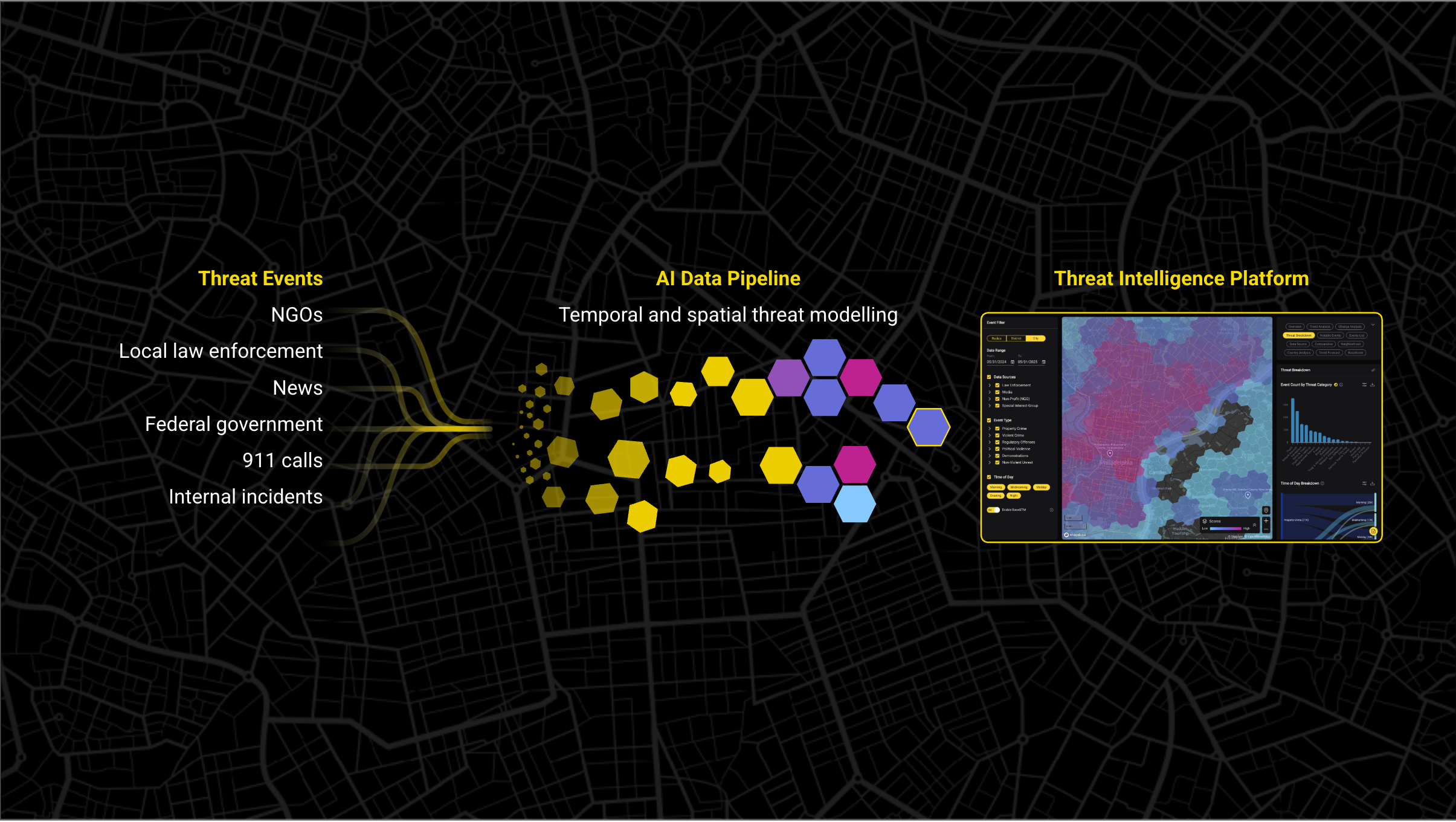
A four-stage process-flow visual, Digital Targeting to Aggregation and Doxxing to Amplification to Physical Manifestation, supports this section.
Stage 1, Digital Targeting: How Threat Actors Identify and Select Executive Victims
The first stage is reconnaissance. Threat actors monitor social media for executive names attached to controversial decisions, scan forum activity on Reddit, Telegram, 4chan, and Discord for emerging grievance communities, and query dark-web data broker listings for personal information already circulating for sale. This stage requires no technical sophistication, only patience and a search bar. Anyone willing to spend an afternoon on public records, social media, and data broker sites can build a preliminary profile of a named executive, which is precisely why open source intelligence executive protection and OSINT executive security practices matter as an early detection layer, not just a post-incident forensic tool. Some actors extend this reconnaissance into dark web executive monitoring of closed marketplaces where aggregated personal data is bought and sold.
Stage 2, Aggregation and Doxxing: Building the Intelligence File on a Target
Stage 2 converts scattered signals into a structured intelligence file. Threat actors compile personally identifiable information from data broker sites such as Whitepages, Spokeo, and BeenVerified, then layer in OSINT and social graph mapping that extends beyond the executive to spouses, children, assistants, and drivers.
This methodology has a name: pattern of life analysis, the systematic mapping of where a target lives, works, travels, and spends time, and with whom. Security teams use pattern of life analysis defensively; threat actors use the identical methodology offensively. Because data brokers continuously re-aggregate scraped and purchased data, a single privacy cleanup service run once is not sufficient. New digital breadcrumbs executive data accumulates every time a family member posts, a new data broker enters the market, or an old breach resurfaces in a new compilation, making executive doxxing an ongoing exposure rather than a one-time event.
Stage 3, Amplification: When Individual Grievance Becomes a Coordinated Campaign
Stage 3 is where an individual grievance becomes a shared cause. Aggregated data gets shared across platforms to multiply exposure, coordinated harassment campaigns such as review bombing and email flooding emerge, and isolated actors find each other inside grievance communities, accelerating radicalization through repeated reinforcement.
Research published in Corporate Compliance Insights identifies a specific behavioral signal at this stage: a shift from what researchers describe as theatrical venting toward calm deliberation, paired with migration from public platforms to closed, invite-only forums. This migration is also where most corporate monitoring programs lose visibility. An executive protection firm working with Base Operations described the fragmented vendor landscape behind this gap: programs typically "partner with different companies depending on what it is that we want... we put the physical agents out, but then we partner with this other company and they're monitoring everything for us," leaving no single vendor with full visibility across the amplification stage.
Stage 4, Physical Manifestation: When the Pipeline Delivers Real-World Harm
Stage 4 is the outcome the first three stages were building toward: swatting, physical surveillance, direct confrontation, mail or package threats, stalking, kidnapping, home invasion, or direct assault. This is not a new phenomenon. The 2003 kidnapping of hedge fund investor and retail executive Eddie Lampert demonstrated the same online-to-offline pattern more than two decades before the UnitedHealthcare case brought it back into board-level focus.
The Seattle CEO residence case is the physical endpoint this framework is built to prevent: a cluster of nearby burglaries, identified through location intelligence before a move-in date, represents the exact kind of physical vulnerability that Stage 4 converts into an incident when it goes undetected.
By Stage 4, the window for intervention has closed. Detection must happen at Stages 1 and 2, while a threat actor is still building an intelligence file rather than executing on one. That is where this threat escalation pathway creates the greatest opportunity for physical threat convergence to be interrupted rather than absorbed.
The Warning Signals That Precede Physical Escalation
Every O2O pipeline shares a set of behavioral indicators that precede physical escalation, drawn from research on executive threat cases published in Corporate Compliance Insights. Security consultant Felix Cook and researchers at S-RM identify four recurring signals: a shift from theatrical venting to calm, deliberate language; migration from public posts to closed or private forums; new engagement with like-minded actors inside grievance communities; and, in the most concerning cases, a sudden disappearance from platforms where the actor was previously active.
When Threats Go Dark: The Paradox of Modern Threat Detection
Modern threat detection faces a paradox. AI-assisted analysis has made credible threats easier to identify against the noise of ordinary online venting, yet the same actors that reach the amplification stage are increasingly hard to track once they migrate to closed, fragmented, and pseudonymous spaces. Social media platforms have also tightened data access over the past several years, narrowing the analysis pathways that online threat monitoring C-suite programs and GSOC teams once relied on. Reconciling those two forces, better detection tools against a shrinking field of view, is now the central operational challenge for GSOC threat workflow design.
Linguistic Fingerprints and Cross-Platform Attribution
Connecting a pseudonymous handle on one platform to a real identity requires linguistic fingerprinting: comparing posting timestamps, recycled grievances, word choice, and behavioral patterns across accounts that never explicitly identify their owner. As S-RM's research puts it, "most threat actors are not truly anonymous; they are pseudonymous," meaning the connective tissue for threat actor attribution usually exists in the data, even when a name does not. Geo-contextual location intelligence adds value on top of linguistic analysis here: correlating a pseudonymous account's claimed or inferred location against physical-world risk data narrows the field of plausible actors and helps GSOC teams prioritize which pseudonymous threats warrant escalation.
Building the Online-to-Offline Threat Pipeline: The Six Functional Layers
Most published research on executive threats describes the problem. Far fewer describe the solution architecture: what a corporate security program actually needs to build, layer by layer, to detect and respond to an O2O pipeline before it reaches Stage 4. Six functional layers make up a complete executive protection intelligence program.
Layer 1, Collection: Casting the Intelligence Net
Collection pulls from open-source social platforms, closed Telegram and Discord channels, dark-web forums, data broker databases, geotagged content, mobile ad-ID and location-data providers, breached-data repositories, and news coverage. Collection breadth determines detection opportunity: a program that monitors only public social platforms will miss the closed-forum migration described in Stage 3. As one Big Four professional services firm working with Base Operations put it, for any location-based threat assessment, "the first thing you have to do is go find the data... go to the local law enforcement... [and] do a lot of Googling," a manual process that consumes most of an analyst's time before analysis even begins.
Layer 2, Entity Resolution and Attribution
Entity resolution matches an executive's names, aliases, and handles across sources, and extends that matching to family members, assistants, and drivers whose exposure often exceeds the executive's own. Visual matching, using face or logo recognition to connect an image posted in one place to an identity confirmed elsewhere, is a supporting capability. Programs that rely on exact-name-match monitoring alone miss both pseudonymous threats and family-member exposure, precisely where most grievance escalation actually originates. A global pharmaceutical company working with Base Operations captured the operating principle well: risk assessment should drive the scope of monitoring, not the reverse. As the company put it, "this is why we don't have a global approach" to applying identical monitoring rules everywhere.
Layer 3, Natural Language Processing and Risk Scoring
NLP threat classifiers score sentiment, intent, and violent-threat language to separate credible signals from noise. Multilingual coverage matters for any executive who travels internationally; platforms like Babel Street benchmark this capability at 200-plus languages. A credible threat combines specific intent, means, and a plausible timeline; noise is venting without those elements. Getting this classification wrong in either direction has an operational cost. False positives create alert fatigue that leads security teams to abandon monitoring programs, while false negatives let real threats pass as noise.
Layer 4, Geo-Contextualization and Pattern-of-Life Correlation
A digital threat's physical relevance depends on geographic proximity to where an executive actually is or will be. Geofencing around an executive's residence, office, travel itinerary, and event venues converts an abstract online signal into a physical-world risk score. A Fortune 500 CRM provider working with Base Operations used 0.3-mile radius analysis around event venues to convert general threat awareness into venue-specific risk decisions, the same geographic logic applied at the 0.5-mile radius around the Seattle CEO residence described earlier in this article.
This is the layer where Base Operations' street-level threat intelligence adds the most direct value: BaseScore™ analysis at a 0.1- to 5-mile radius, with H3 hex-level precision, gives security teams a standardized way to answer the question a digital alert alone cannot: whether a given signal is physically relevant to where an executive will actually be.
Most executive protection teams are not short on digital signals. They are short on a reliable way to determine which of those signals matter for a specific residence, route, or venue. See how Base Operations supports executive protection travel risk assessment programs with standardized, radius-based risk scoring.
Layer 5, Workflow and Dispatch: From Alert to Action
Detection without a dispatch layer has no operational value. A functioning pipeline moves a signal through ticket generation, GSOC PSIM or incident-management systems, and escalation to law enforcement or on-ground contractors, with an industry benchmark target of under 10 minutes from digital alert to human acknowledgment. A global travel technology company working with Base Operations described the manual version of this workflow before consolidation: their team compiled executive protection briefs "from other sources... querying [threat] data and producing reports" for a specific location, hotel, or meeting site, one request at a time. An executive protection firm working with Base Operations summarized why this fragmentation persists industry-wide: "protective intelligence and web monitoring and cybersecurity, there's so many different areas of it, different partnerships, because not everybody does everything."
Layer 6, Audit, Analytics, and Board-Level Reporting
The final layer turns individual incidents into program-level insight: post-incident forensics, trend analysis, and standardized reporting a CSO can bring to the board to demonstrate program return on investment. The right metrics for this layer are mean-time-to-respond and credible threats disrupted, not raw alert volume, which rewards noisy monitoring over effective detection. A leading AI provider working with Base Operations integrated AI-enhanced analysis into this layer and measured a 25% increase in analytical insights compared to traditional analyst assessment alone, while standardizing executive protection memos across residential, travel, and commute security for stakeholder reporting.
Vendor Landscape: Comparing Online-to-Offline Threat Intelligence Platforms
No single platform covers all six layers of the O2O pipeline today. Programs typically combine two or three platforms to get full coverage, which makes understanding each platform's primary layer, and its honest limitations, a prerequisite for building a complete program.
Ontic vs. Base Operations: Protective Intelligence Platform Comparison
Ontic and Base Operations solve different problems and are frequently used together rather than as substitutes. Ontic is a case-management platform: it centralizes an online-to-offline investigative dossier per individual, tracking case notes, access-control integration, and coordination across a protective intelligence team as a threat moves from identification to resolution.
Base Operations does not manage cases. It provides the street-level location intelligence, 0.1- to 5-mile radius BaseScore analysis backed by AI/ML spatial-temporal modeling, that determines how physically relevant a threat is to a specific residence, route, or venue, and automates the reporting a case manager needs to document that determination. A pharmacy retail giant working with Base Operations standardized threat assessments across 73 locations using this approach, cutting manual assessment work while keeping every location on a consistent scoring methodology. Ontic owns the case; Base Operations informs the physical-world risk judgment inside it. The two platforms are complementary, not competitive.
Flashpoint vs. Base Operations: Dark Web and Closed-Community Coverage
Flashpoint specializes in human intelligence from dark-web forums and invite-only Telegram and Discord channels, exactly the closed-community spaces where Stage 3 amplification activity concentrates, with particular strength in kidnapping, extortion, and insider-threat chatter.
Base Operations does not monitor the dark web or closed messaging platforms; that is a distinct capability outside its product. What Base Operations provides is the physical-world context that determines whether a digital threat Flashpoint surfaces is geographically actionable: whether the source of a dark-web threat, or the executive's planned travel, sits within a radius that changes the physical risk calculation. Flashpoint answers whether something is a credible digital threat; Base Operations answers whether that threat's geography makes it physically relevant right now. A Flashpoint alert paired with Base Operations geo-context is closer to decision-grade intelligence than either signal alone.
Turning Online Intelligence Into Actionable Legal Evidence
Attribution unlocks legal options that raw monitoring does not: cease-and-desist letters, platform injunctions, and law enforcement referrals all require evidence that will hold up outside a security team's internal dashboard. A legally defensible threat file needs screenshots with verified timestamps, underlying metadata, cross-linked aliases connecting a pseudonymous account to other confirmed identifiers, platform activity logs, and a documented escalation narrative showing how a threat moved from Stage 1 to its current stage.
S-RM's research frames the standard clearly: "chain of custody matters, metadata matters, and the logic of the escalation matters." A security team that can only say a threatening post appeared has an alert. A security team that can produce a timestamped, cross-referenced escalation narrative has intelligence a prosecutor or platform trust-and-safety team can act on. A leading AI provider working with Base Operations built this discipline into standardized executive protection memos covering residential, travel, and commute security, giving stakeholders documented, exportable, timestamped assessments rather than one-off alerts. A Fortune 500 travel company applied the same standard to produce stakeholder-ready assessments for its board and legal counsel.
Reducing Executive Attack Surface: The Defensive Half of the Pipeline
Detection is only half the pipeline. Research from ASIS International and ZeroFox on executive exposure identifies five defensive practices every program should implement: continuous online monitoring paired with data removal from broker sites, unifying physical and cyber security under integrated leadership rather than separate reporting lines, educating executives and family members on how routine online activity enables physical targeting, varying routines to limit predictability, and conducting recurring vulnerability assessments using the same OSINT methods a threat actor would use.
The Executive Digital Footprint Audit: What Security Teams Must Review
A practitioner-level digital footprint audit should cover seven areas: presence in data broker databases such as Whitepages, Spokeo, and BeenVerified; social media privacy settings and posting habits; family member exposure across all platforms; device security for home networks, smart devices, and phones; conference registration and public RSVP exposure; historic presence in breached databases; and professional bio information that reveals schedule or location patterns.
Hyperlocal crime analysis is a component of this audit that most checklists omit. The Seattle CEO residence case identified a nearby residential break-in cluster that a standard background check would never surface, because it required location intelligence at the block level rather than a citywide crime statistic. An audit that stops at data broker removal misses the physical vulnerability sitting one property line away.
Family Member Exposure: The Most Underestimated Vector
ASIS and ZeroFox research makes a specific point security teams underweight: families generate exposure at a far greater rate than executives themselves. A spouse's post of the home exterior, a child tagging a school location in a photo, or a casual travel update from a family member routinely does more damage to an executive's physical security than anything the executive posts directly.
A global travel technology company working with Base Operations addressed this by building monthly reporting into its program covering residential risk and proximate risk for each executive, treating family and residence exposure as an ongoing metric rather than a one-time assessment.
Implementing a Threat Assessment Program as Operational Rhythm
Research published in Corporate Compliance Insights identifies the pattern that separates effective programs from reactive ones: "the organizations that fare best are the ones that build threat assessment into their operating rhythm." That means defined cadence, clear ownership, GSOC integration, and governance reporting that runs whether or not a specific threat is active, not a program that only activates after an incident triggers it.
The Under-10-Minute SLA Standard
An under-10-minute service-level agreement from digital alert to human acknowledgment is an emerging industry benchmark for programs with a staffed GSOC. The gap between a 45-minute delay and a 90-second catch is not a matter of degree; it represents fundamentally different risk postures, because the intervention options available at minute two are not the same ones available at minute forty-five. Meeting this standard requires staffing coverage across time zones, technology that routes alerts without manual triage, and a pre-defined escalation protocol so responders are not deciding process in the moment. A Fortune 500 CRM provider working with Base Operations cut assessment delivery time by 72 hours through this kind of standardized workflow, and a leading AI provider achieved 3x faster executive protection report generation using the same principle: remove manual steps from the path between signal and response.
Red Team Drills: Testing the Pipeline End-to-End
A quarterly red team drill tests the full pipeline rather than any single layer in isolation: a seeded social-media threat scenario should be detectable, attributable, and escalated to a physical-world executive protection detail intercept within the program's defined SLA. A complete drill framework defines the scenario, assigns participant roles across the GSOC and EP detail, sets success metrics tied to detection time and escalation accuracy, and includes a structured post-exercise review. Few competitors publish this level of operational detail, in part because it requires an honest look at where a program's real gaps are. The reactive alternative is common: one national healthcare provider working with Base Operations described a routine team discussion "about geopolitical events impacting the world and how that might impact us... we're obviously concerned about executive protection travel. It seems never fails. The constant state of turmoil is evolving." A rehearsed drill framework replaces that ad hoc weekly scan with a tested response protocol.
Frequently Asked Questions
What is an online-to-offline threat pipeline targeting executives?
An online-to-offline (O2O) threat pipeline is a sequential escalation pathway in which digital signals, including social media posts, forum activity, and doxxed personal data, are collected, aggregated, amplified, and converted into physical security risks against a specific executive. It moves through four stages: digital targeting, aggregation and doxxing, amplification, and physical manifestation. Corporate security programs use this framework to identify where detection effort belongs before a threat reaches its physical endpoint.
Where do most cyber and physical threats against executives begin?
Most O2O threats begin with open digital reconnaissance: social media monitoring, activity on forums like Reddit, Telegram, 4chan, and Discord, and data broker queries that surface an executive's home address, family members, and daily routine. This reconnaissance requires no special access or technical skill, only patience and publicly available or purchasable information, which is why an executive's digital footprint is the earliest and most controllable point in the pipeline.
What are the stages of an executive threat escalation?
An executive threat escalation moves through four stages: Stage 1, digital targeting, where threat actors identify and research a target; Stage 2, aggregation and doxxing, where scattered data becomes a structured intelligence file; Stage 3, amplification, where individual grievance becomes a coordinated campaign inside closed forums; and Stage 4, physical manifestation, where the pipeline produces real-world harm such as stalking, confrontation, or assault. Detection is most effective at Stages 1 and 2, before the window for intervention closes.
What is pattern-of-life analysis in executive protection?
Pattern-of-life analysis is the systematic mapping of where a target lives, works, travels, and spends time, and with whom, used to understand routine and predict physical exposure. Security teams use pattern-of-life analysis defensively to identify vulnerabilities in an executive's routine, such as predictable routes or unprotected residences, while threat actors use the identical methodology offensively to plan physical targeting. Geo-contextual data, such as radius-based crime analysis around a residence or venue, is a core input to this methodology.
How do security teams detect threats before they go offline?
Security teams detect pre-physical threats by watching for specific behavioral signals: a shift from theatrical venting to calm, deliberate language; migration from public posts to closed or invite-only forums; new engagement with grievance communities; and sudden disappearance from platforms where an actor was previously active. Cross-platform attribution, using linguistic fingerprints, timestamps, and recycled grievances to connect pseudonymous accounts, extends visibility once actors move to closed spaces. Consistent monitoring across the collection, entity resolution, and classification layers of the pipeline supports this detection.
What should a digital footprint audit for executives include?
An executive digital footprint audit should review seven areas: data broker database presence, social media privacy settings and posting habits, family member exposure across platforms, device and home network security, conference registration and public RSVP exposure, historic presence in breached databases, and professional bio information that reveals schedule or location patterns. Hyperlocal crime analysis around the executive's residence and frequent locations should supplement this audit, since it surfaces physical vulnerabilities a standard background check misses.
How do online-to-offline threats differ from traditional cybersecurity threats?
Traditional cybersecurity threats target digital assets, data, credentials, and systems, with the harm remaining inside the digital environment. Online-to-offline threats use digital channels purely as reconnaissance and coordination infrastructure; the intended harm is physical, directed at a person's body, residence, or family. This distinction matters operationally because O2O threats require geographic and physical-world context, such as proximity to a residence or venue, that standard cybersecurity monitoring tools are not built to evaluate.
What metrics should executive protection programs use to measure threat pipeline effectiveness?
Effective executive protection programs measure mean-time-to-respond, the number of credible threats disrupted before escalation, false-positive rate, service-level agreement compliance from digital alert to human acknowledgment, and time-to-attribution for pseudonymous threat actors. Raw alert volume is a poor metric because it rewards noisy monitoring rather than accurate detection; a program generating fewer, more credible alerts with faster response times is outperforming one that generates more total alerts.
What is the difference between a threat alert and actionable threat intelligence for executive protection?
A threat alert simply flags that something occurred, such as a post mentioning an executive's name in a hostile context. Actionable threat intelligence adds the analysis a security team needs to respond: who is likely behind it, how credible the threat is based on specific intent and behavioral signals, what physical-world relevance it has given the executive's location and schedule, and what response the situation warrants. The gap between the two is the difference between a notification and a decision a CSO can act on.
The online-to-offline threat pipeline rewards security programs that can convert digital signals into physical-world risk decisions quickly and consistently. Base Operations provides the street-level threat intelligence, BaseScore risk analysis at 0.1- to 5-mile granularity, and automated reporting that turns a location question into a documented answer in minutes rather than hours. Schedule a demo to see how Base Operations fits into your executive protection program's geo-contextualization and reporting layers.
Takeaways

Join 1100+ security leaders getting new ideas on how to better protect their people and assets.