
Global Apparel Retailer Builds Data-Driven Risk Program with Base Fusion to Target $1M+ in Annual Savings
A global apparel company with 1,200+ owned retail stores across 110 countries is deploying Base Fusion to replace qualitative risk assessments with a data-driven framework across 300 US and Canada stores, targeting $1M+ in annual security savings through optimized guard deployment, security technology investment, and audit prioritization.
$1M+ targeted annual savings
300 stores risk-scored
40 of 300 stores
Challenge
The company's security team relied on qualitative assessments to allocate resources across 300 US and Canada retail stores — deploying guards, cameras, and EAS tagging based on intuition rather than evidence. With incident, shrink, and facility data siloed across separate systems, the team had no unified view of store risk and no way to prioritize a portfolio too large to physically audit.
Solution
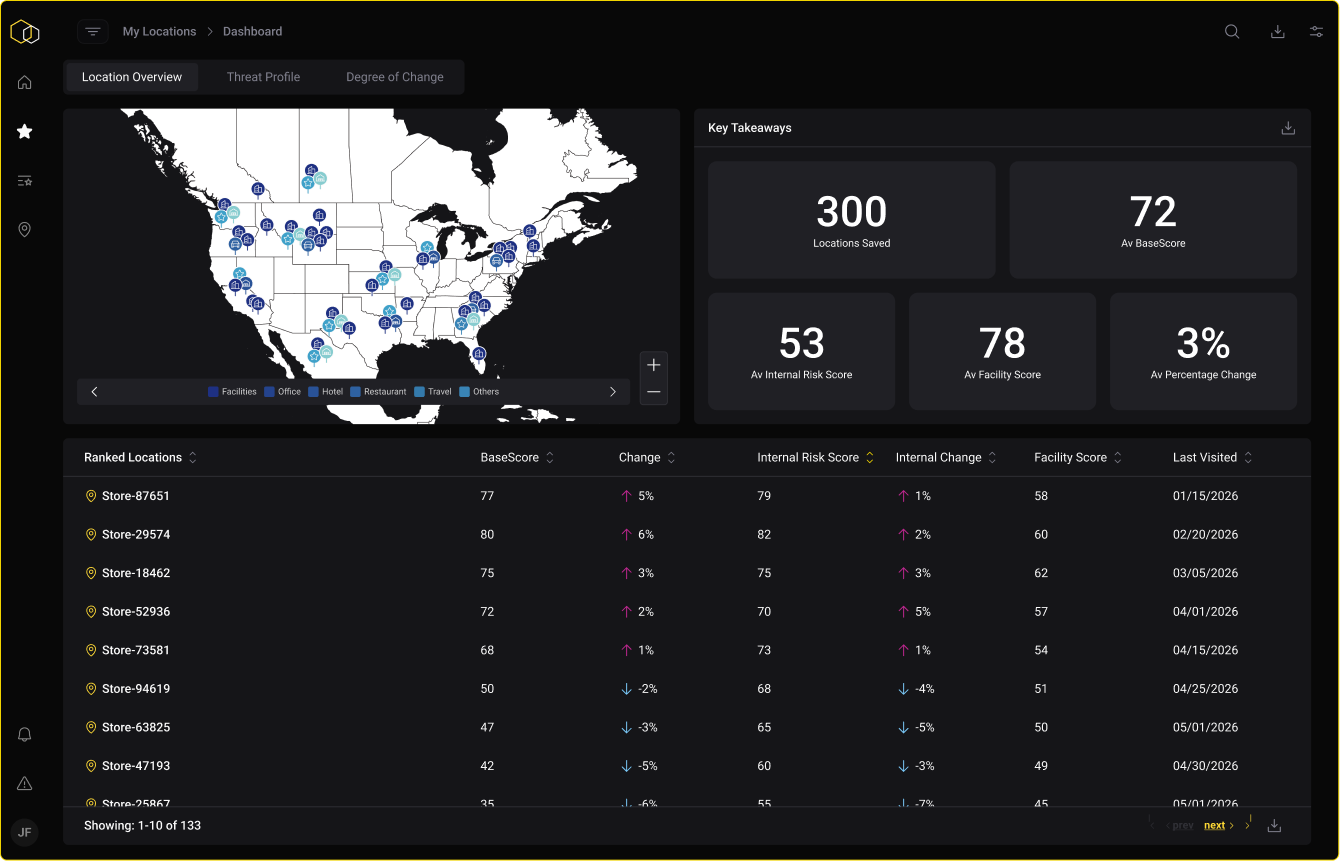
The company deployed Base Fusion to blend Base Operations' external threat intelligence with internal incident reports, shrink data, and facility attributes into a single risk score per store. This unified framework enables risk-tiered decisions on guard deployment, security technology investment, field audit prioritization, and new store site selection. It replaces qualitative judgment with a repeatable, data-driven process.
Results
- $1M+ targeted annual savings through optimized security resource deployment across 300 stores
- 300 stores risk-scored within 90 days — from zero data-scored locations to full portfolio risk tiering
- Field audit focus narrowed from 300 to 40 stores using blended Base Fusion risk data
- Phase 2 planned: expansion to 1,000+ international locations across Europe, Latin America, and Asia-Pacific
When a global apparel company's VP and Chief Security Officer describes how his team made risk decisions across 300 retail locations, he doesn't hedge: "Right now, we're using qualitative assessments to determine where those resources are needed most." For a company investing $1.5 to $2 million annually on guard forces alone, at just six of those 300 stores, the gap between intuition and evidence had become a business problem.
That gap was about to get wider. The company was in the middle of a strategic transformation from a wholesale-first business to a direct-to-consumer retailer, and the security infrastructure built for department store distribution wasn't designed for the demands of operating 1,200+ owned stores across 110 countries.
A Wholesale Security Model in a DTC World
For most of its history, the company sold primarily through wholesale partners including major department stores and mass retailers. Physical security at those locations was someone else's responsibility. But as the company shifted to majority direct-to-consumer revenue, the security team inherited a problem they weren't staffed or equipped to solve: managing risk across a rapidly growing portfolio of owned retail locations.
"We weren't set up process-wise. We weren't set up operationally," said the Sr. Director of Enterprise Resilience. "We were a huge wholesale company. So it's a huge lift and shift to really focus and do all of those things sort of best in class like other retailers do."
New hires from career retailers arrived expecting the kind of data-driven risk programs they'd used at other companies. But the company had no unified view of store risk. Incident data lived in one system. Shrink numbers sat in accounting. Facility attributes — which stores had cameras, alarms, EAS tagging — were tracked separately. No single system connected external threat data with internal performance metrics.
"We have a lot of different data. We have nowhere that it's aggregated," said the Sr. Director of Enterprise Resilience. "We have nowhere where we have sort of one single point of view that can give us the information to say, this is where we should be focusing our time, and here's why. Today, it's more like, we think."
The Cost of Guessing
Without a data-driven framework, every security investment decision carried uncertainty. Guard forces were deployed at six stores based on qualitative judgment, costing $1.5 to $2 million annually — but no data validated whether those were the right six stores. Camera packages followed a standard template regardless of location risk. EAS tagging decisions were ad hoc.
"You can't get to 300 stores in a year to go out and visit them once or twice," said the CSO. "You should focus on these 40. That's what we're trying to get at with this."
The problem extended beyond retail operations. When the real estate team scouted new store locations, security was typically consulted after the lease was signed. "We've already signed the lease, and now we have all these problems," said the Sr. Director of Enterprise Resilience. "We should've come to security."
And like many corporate security organizations, the team faced a narrative challenge. Without quantified risk data, security investments looked like pure cost to the business. As the Sr. Director of Enterprise Resilience put it: "Make it so that it's not only from a security lens either. If we were to say, you can use those cameras to do all these things in operational excellence, and then oh, by the way, it also does these things for security — that is the better sell to the business any day."
Base Fusion: Blending External Intelligence with Internal Data
The company selected Base Operations and its Base Fusion product to build a unified, data-driven risk program across its US and Canada store portfolio. Base Fusion combines Base Operations' external threat intelligence — crime and unrest data from 25,000+ global sources, scored at sub-mile resolution — with the company's internal data: incident reports, shrink figures, and facility attributes.
The result is a blended risk score for every store location, enabling the company to rank its entire portfolio by relative risk and make resource allocation decisions based on evidence.
"Based on the risk, we're gonna say we need 4 cameras or we need 6 cameras," said the CSO. "Based on the risk, we're gonna say we need a security officer."
The implementation follows a phased approach. The company began with flat-file uploads of internal data on a quarterly cadence, with an API integration planned. Within 90 days of kick-off, the team targets having all 300 US and Canada stores scored, ranked, and organized into risk tiers that drive technology deployment, guard allocation, and audit prioritization.
"I don't wanna go the Moneyball route where we're completely foregoing people's expert analysis," said the CSO, "but we want a better blend of expert analysis and quantitative analysis."
Targeting $1M+ in Annual Security Savings
The company has set clear targets for the program. The security team aims to reduce annual operating expenses by over $1 million through data-driven optimization of guard deployment, security technology investments, and field audit efficiency.
The guard force, currently a $1.5 to $2 million annual investment across just six locations, will be evaluated against Base Fusion risk tiers to determine whether those deployments are justified, whether additional locations warrant coverage, or whether alternative measures would be more effective. Camera packages, EAS tagging, and alarm contracts will follow the same risk-tiered framework rather than being deployed on a one-size-fits-all basis.
Field audit efficiency is another target. Instead of attempting to visit all 300 stores, an impossibility for a lean team, Base Fusion enables the team to identify and prioritize the top 40 highest-risk locations for on-site visits annually, ensuring that limited field resources are directed where they have the greatest impact.
For the CSO, the ambition goes beyond cost savings. "Base Operations need to be built into our baseline budget every single year. My goal is that this ends up in the nondiscretionary bucket."
Building Toward Global Scale
The US and Canada deployment is phase one. The company plans to expand the program internationally, with a target of 1,000+ locations across Europe, Latin America, and Asia-Pacific. Additional use cases are already scoped: supply chain security for cargo movements in Latin America, executive protection and event security, new store site selection due diligence, and integration of health and safety data into the blended risk score.
"Longer term, we'd wanna understand what it would look like for us to bring in all of our stores — the 1,200 stores, the 50 or so offices — and then we're shifting our distribution center model," said the CSO.
For a company with a nearly 200 year history of reinvention, the shift from qualitative security to a data-driven risk program represents the latest transformation. As the CSO put it: "Tactical intelligence shouldn't be an analyst anymore. It's a software subscription."