BC Place Stadium (Vancouver, Canada) FIFA World Cup 26 Threat Assessment
Security threat assessment for matches hosted at BC Place Stadium (Vancouver, Canada) during the FIFA World Cup 26. Threat assessment based on two years of historical crime and unrest data within 1.5 miles of venue and 0.5 miles of nearby transit hub.
Overview
- Date Assessment Prepared: November 10, 2025
- Data Coverage Period: September 2023 – September 2025
- Stadium Location: BC Place Stadium
- Transit Hub Location: Stadium-Chinatown Station
- Host City: Vancouver, Canada
Methodology Disclaimer This assessment integrates Base Operations quantitative threat data with qualitative intelligence from open sources collected via deep research AI agents. Confidence levels reflect source reliability: High (government/Base Operations verified data), Medium (multiple corroborating sources), Low (single source/extrapolated). AI agents can provide incorrect or misleading information. To ensure up to date accuracy of stadium threat assessment, analyze the latest data in Base Operations.
Executive Summary
BC Place Stadium and the adjacent Stadium-Chinatown transit hub present a HIGH to VERY HIGH threat environment for FIFA World Cup 2026 attendees based on historical crime density and specific event vectors. Base Operations validated threat intelligence indicates persistent property crime activity in both locations. While the stadium perimeter registers a HIGH BaseScore (77), the transit hub represents a critical chokepoint with a VERY HIGH BaseScore (82).
Key Threat Rankings:
- Property Crime & Opportunistic Threats (HIGH CONFIDENCE): Theft incidents dominate the landscape, with 75,621 recorded events within 1.5 miles of the stadium. Evening hours (6 PM – Midnight) concentrate 39% of all property crime, coinciding directly with match egress.
- Ideologically Motivated Violent Extremism (HIGH CONFIDENCE): The Vancouver-based entity Samidoun presents a documented threat to corporate and government officials, with specific anti-capitalist targeting intent.
- Environmental Disruption (HIGH CONFIDENCE): Wildfire smoke represents the highest-probability environmental threat during June-July dates.
- Cyber Espionage (HIGH CONFIDENCE): State-sponsored actors are assessed as likely to target high-profile attendees for intelligence collection.
Corporate security directors must prioritize pre-event reconnaissance and establish hardened transportation protocols that strictly avoid the Stadium-Chinatown transit hub.
Base Operations Key Findings:
- BC Place Stadium: BaseScore 77 (HIGH Risk Tier).
- Stadium-Chinatown Station: BaseScore 82 (VERY HIGH Risk Tier).
1. Event Snapshot
Venue Details BC Place Stadium (Capacity: 54,500) will host seven matches, including two Canada national team matches (June 18 and 24) and knockout rounds in early July. Expected attendance approximates 350,000 visitors across the five-week period.
VIP Profile Attendees include government officials, heads of delegations, FIFA leadership, and corporate representatives. These individuals represent symbolic targets for anti-capitalist and anti-colonial ideologies explicitly promoted by local designated terrorist entities.
Match Schedule
- Group Stage: June 13, 18 (Canada), 21, 24 (Canada), 26.
- Round of 32: July 2.
- Round of 16: July 7.
2. Area & Infrastructure Overview
Geographic Context BC Place occupies a complex downtown location on the north shore of False Creek. The venue sits adjacent to the Downtown Eastside (DTES), an area recognized for persistent social disorder, creating sustained exposure risk for VIP movements. The stadium operates on unceded traditional territories of First Nations, ensuring elevated activist interest during July 2026, which marks significant anniversaries for Indigenous sovereignty movements.
Critical Infrastructure Assessment
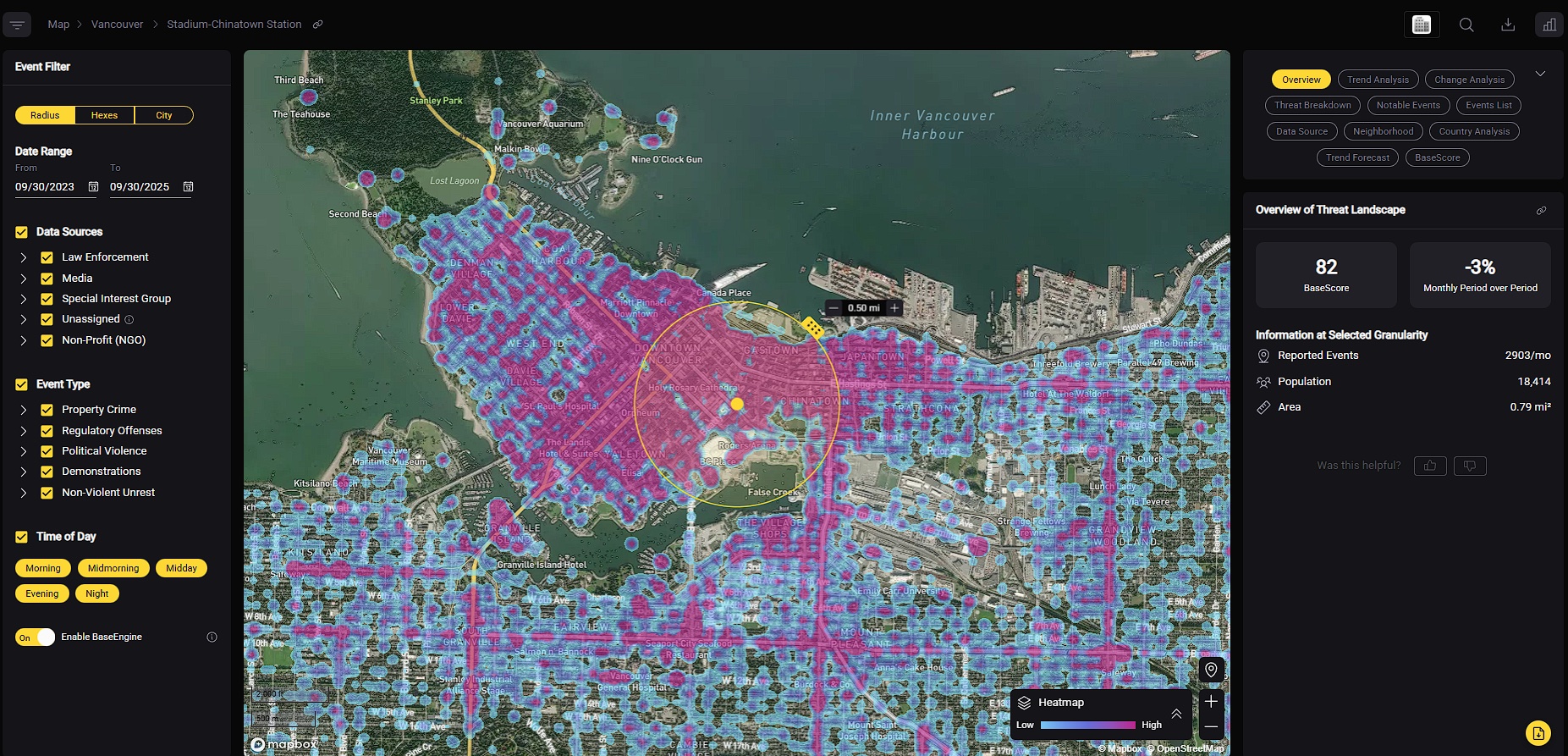
- Transportation: Stadium-Chinatown Station is located approximately 200 meters from the venue. It experiences significantly elevated threat metrics compared to the stadium perimeter.
- Accommodation: Metro Vancouver faces a deficit of approximately 70,000 hotel room-nights. VIP protection details must anticipate dispersed lodging across Richmond, Burnaby, Surrey, and Vancouver Island, extending exposure across regional transportation networks vulnerable to activist blockades.
- Egress: BC Place’s peninsula location creates constrained evacuation corridors. Historical incidents document crowd density failures at east exits, forcing dangerous conditions that increase opportunistic crime risk.
3. Historical Incident Review
2010 Vancouver Winter Olympics While the event concluded without major security incidents, anti-Olympics protesters vandalized downtown businesses during the opening weekend. This precedent confirms activist exploitation of mega-event media exposure and the challenge of balancing free assembly with VIP security.
2011 Stanley Cup Riot Following a championship loss, downtown Vancouver experienced a five-hour riot characterized by vehicle fires and mass looting. Police were initially overwhelmed. This incident highlights that disappointing match outcomes combined with alcohol can rapidly transform crowds into destructive mobs—a relevant risk for the Canada national team matches.
BC Place Venue-Specific Incidents
- Flare Incident: An attendee successfully smuggled and ignited a flare inside the stadium despite screening, causing injuries. This confirms that motivated actors possess the capability to defeat standard perimeter security.
- Egress Failure: Historical documentation confirms dangerous crowd density failures at east exits. While the operating corporation acknowledged deficiencies, system resilience under World Cup peak loads remains unproven.
4. Current Threat Landscape
4.1 Crime Trends & Opportunistic Threats
Base Operations validated threat data from September 2023 through September 2025 provides standardized intelligence for the area.
BC Place Stadium (1.5-Mile Radius)
- BaseScore: 77 (HIGH Risk Tier).
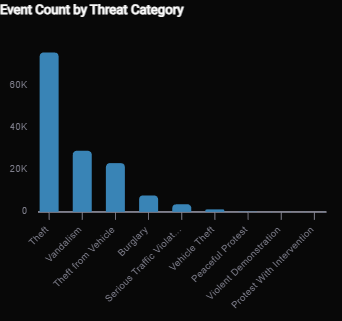
- Dominant Threat: Theft (75,621 events).
- Secondary Threats: Vandalism (28,980 events) and Theft from Vehicle (23,129 events).
Stadium-Chinatown Station (0.5-Mile Radius)
- BaseScore: 82 (VERY HIGH Risk Tier).
- Threat Concentration: This location registers a BaseScore five points higher than the stadium perimeter.
- Volume: The station recorded 30,559 theft incidents and 12,588 theft-from-vehicle events.
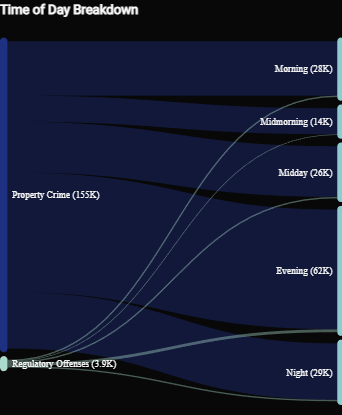
Temporal Analysis Evening hours (6 PM – Midnight) concentrate 39% of all property crime activity. All seven BC Place matches schedule evening kick-offs, creating direct temporal overlap with peak threat periods. July registers as the highest-threat month, averaging 6,274 monthly events.
4.2 Terrorism & Extremism
Samidoun (Palestinian Prisoner Solidarity Network) Headquartered in Vancouver and designated as a terrorist entity by Canada in October 2024, Samidoun poses a HIGH confidence threat. The group holds an anti-capitalist, anti-colonial ideology and explicitly targets "colonial states" and corporate sponsors.
- Tactics: Aggressive demonstrations, potential vehicle blockades, and coordinated harassment of executives.
- Risk: Samidoun views FIFA and attending government officials as legitimate symbolic targets.
4.3 Activist & Protest Activity
Indigenous Sovereignty Groups July 2026 marks the 150th anniversaries of the Indian Act and Treaty 6. This timing creates unprecedented motivation for high-impact demonstrations by groups focused on Indigenous sovereignty and environmental protection.
- Capabilities: Infrastructure blockade experience (highways, rail lines, ports) and mass mobilization.
- Tactics: Highway blockades (Lions Gate Bridge, Highway 1) and ferry terminal disruptions are assessed as HIGH probability. Physical violence against individuals is assessed as LOW probability.
4.4 Cyber & Information Risks
State-sponsored cyber threat actors are assessed as likely to target high-profile attendees for persistent intelligence collection. Risks include phishing campaigns targeting executive travel, hotel WiFi compromises, and social engineering against support staff.
4.5 Environmental Risks
Wildfire smoke represents the highest-probability environmental threat during the tournament. June and July fall within the peak wildfire season. Poor air quality may impact outdoor operations and health of attendees.
5. Threat Actor Profiles
Samidoun
- Headquarters: Vancouver, BC.
- Designation: Canada-listed terrorist entity; U.S. sanctioned.
- Intent: High.
- Activity: Aggressive protests, targeting of community centers, international fundraising.
- Mitigation: Counter-surveillance protocols and route diversification.
Regional Indigenous Coalitions
- Affiliation: Wet'suwet'en solidarity networks, coastal Indigenous nations.
- Intent: Medium (Disruption over violence).
- Activity: Systematic blockades of critical infrastructure.
- Mitigation: Multiple pre-cleared alternate routes and extended timeline buffers.
6. Key Takeaways
6.1 Corporate Security Director
BC Place Stadium and the transit hub operate within a validated HIGH to VERY HIGH property crime environment. The overlap of evening crime peaks (39% of incidents) with match schedules creates a specific window of vulnerability.
Actionable Intelligence:
- Transit Avoidance: The Stadium-Chinatown Station (BaseScore 82) must be strictly avoided. Use dedicated vehicle-based transport.
- Route Reconnaissance: Conduct advance surveys 72 hours prior to arrival. Identify minimum three alternate routes.
- Egress Segregation: Coordinate dedicated VIP egress routes independent of mass pedestrian flows. Avoid east exits due to historical congestion failures.
- Digital Hardening: Issue hardened devices to principals. Prohibit public WiFi usage.
6.2 Security Analyst
Intelligence Integration:
- Monitoring: Establish continuous monitoring of Samidoun social media channels and Indigenous activist networks, particularly regarding July anniversary organizing.
- Environmental: Daily review of Air Quality Health Index and wildfire status.
- Cyber: Coordinate with IT regarding phishing detection and network security at accommodations.
- Updates: Incorporate Base Operations validated intelligence for the June-July 2026 period to detect percentage change indicators suggesting escalation.
7. Appendices
Appendix A: Acronyms
- BC: British Columbia
- BEC: Business Email Compromise
- CBSA: Canada Border Services Agency
- CSIS: Canadian Security Intelligence Service
- DDoS: Distributed Denial-of-Service
- DTES: Downtown Eastside
- EMS: Emergency Medical Services
- FIFA: Fédération Internationale de Football Association
- HEPA: High-Efficiency Particulate Air
- IMVE: Ideologically Motivated Violent Extremism
- ISSU: Integrated Safety & Security Unit
- NORAD: North American Aerospace Defense Command
- PFLP: Popular Front for the Liberation of Palestine
- RCMP: Royal Canadian Mounted Police
- USMCA: United States-Mexico-Canada Agreement
- VIP: Very Important Person
- VPD: Vancouver Police Department
- YVR: Vancouver International Airport
Appendix B: Key Contacts
- Emergency Services: Police/Fire/Ambulance (911)
- Vancouver Police Department: Non-Emergency Line
- Tournament Security: Vancouver Integrated Safety & Security Unit
- Operations: FIFA World Cup 2026 Vancouver Operations
- Transportation: TransLink Customer Service, BC Ferries, Vancouver International Airport
- Environmental: BC Wildfire Service, Environment Canada Weather
- Medical: Vancouver General Hospital, St. Paul's Hospital, BC Poison Control
Appendix C: Methodology
This threat assessment integrates three primary intelligence sources:
- Base Operations Validated Threat Data: Standardized, actionable threat intelligence derived from official law enforcement data sources covering September 2023 through September 2025. Data includes BaseScore assessments, event counts, and temporal analysis.
- Research Reports: Contextual analysis synthesizing open-source intelligence on strategic threat landscapes, historical security incidents, and infrastructure vulnerabilities.
- Geospatial & Temporal Analysis: Evaluation of threat intensity at defined distances (1.5-mile and 0.5-mile radii) and analysis of peak threat periods.
Appendix D: Data Limitations
Base Operations data current Data Coverage Period dates. Cyber threats not captured in Base Operations metrics. Private security incidents may be underreported. Historical patterns may not predict novel threat vectors. This assessment represents analysis current as of the Date Assessment Prepared. Threat conditions may evolve rapidly. Continuous monitoring through Base Operations and coordination with law enforcement partners is essential for maintaining situational awareness throughout the tournament period.
8. References
- Base Operations Data Sources:
- BC Place Stadium BaseScore Assessment (October 2023 - September 2025)
- Stadium-Chinatown Station BaseScore Assessment (October 2023 - September 2025)
- Event Count by Threat Category Analysis
- Time-of-Day Breakdown Analysis
- Monthly Event Trend Analysis
- Average Events by Month of Year Analysis
- Percent Change Trend Analysis
- Canadian Government Sources:
- Canadian Centre for Cyber Security: "Cyber Threat Bulletin - The cyber threat to major international sporting events"
- Government of Canada: "2026 - Anniversaries of significance in Canada"
- Canadian Security Intelligence Service: "Protecting National Security in Partnership with all Canadians"
- Global Affairs Canada: "Canadian policy on key issues in the Israeli-Palestinian conflict"
- City of Vancouver & Municipal Sources:
- City of Vancouver: "Vancouver Climate Change Adaptation Strategy 2024-25 Update"
- Vancouver Police Department: "Public Safety Indicators Report - 2024 Q2"
- FIFA World Cup 2026 Vancouver: "Event-Related Road Closures"
- FIFA World Cup 2026 Vancouver: "Matches - Save the Dates"
- News Media & Reporting:
- thebreaker.news (Bob Mackin): "Should Vancouver and Toronto worry about security at the 2026 World Cup?" (October 8, 2025)
- thebreaker.news (Bob Mackin): "Exclusive: Wildfires worry World Cup planners" (October 31, 2025)
- thebreaker.news (Bob Mackin): "Not your average Tuesday morning: World Cup security training above Vancouver" (October 29, 2025)
- thebreaker.news (Bob Mackin): "WATCH: One-year countdown to FIFA fraught with questions about costs, security and homelessness" (June 11, 2025)
- CTV News: "Vancouver short on hotel rooms, silent on safety costs for 2026 World Cup"
- Canadian Press (via CityNews Vancouver): "World Cup lodging shortfall in Vancouver predicted, Airbnb bids to loosen regulations" (October 1, 2025)
- CBC News: "BC Place reviews security after flare lit during game"
- CBC News: "Advocacy group calls on Canada Soccer to refuse to host World Cup if Israel plays"
- Global News: ""This was a different animal that night': Looking back at the 2011 Stanley Cup riot" (June 15, 2021)
- Global News: "BC Place revises safety plans after concerns over post-game crowding"
- The Guardian: "Winter Olympics was hit by cyber-attack, officials confirm" (February 11, 2018)
- Reuters (Daniel Trotta): "Filipino 'caring culture' hit hard by Canada truck-ramming that killed 11" (April 29, 2025)
- Reuters (Elias Biryabarema): "Five jailed for life in Uganda for al Shabaab World Cup bombings" (May 27, 2016)
- Reuters (Field Level Media): "FIFA: Safety, security of World Cup host cities is 'government' call" (October 15, 2025)
- Academic & Research Sources:
- NAADSN Policy Primer: "Land-Based Resistance, Civil Disobedience, and Resource Extraction in Canada" (January 2025)
- CSIS: "USMCA Review 2026"
- Louisiana State University NCBRT: "Past World Cup Threats" (2025)
- Allard Research Commons (UBC): "Security for the 2010 Olympics - The Gap in Police Powers under Canadian Law"
- Taylor & Francis Online: "Threats from within and threats from without: Wet'suwet'en protesters, irregular asylum seekers and on-going settler colonialism in Canada"
- International Organizations:
- Amnesty International: "World Cup: A year out, growing attacks on rights" (June 2025)
- FIFA: "Non-interference policy regarding protesters during World Cup"
- Venue & Facility Information:
- BC Place: "Guest Code of Conduct"
- BC Place: "Guest Policies"
- BC Place: "Clear Bag Policy"
- BC Place: "Sensory Room"
- Vancouver Whitecaps FC: "Security Policy"
- Additional References:
- Wikipedia: "Samidoun"
- Wikipedia: "1998 World Cup terror plot"
- Jewish Federation of Greater Vancouver: "Jewish Organizations Condemn Protests Targeting Jewish Community Centre"
- Vancouver Police Department: "Executive Team"
- AirX Aero: "World Cup 2026: Locations, Dates & Tips for Luxury Travellers"
Takeaways
Corporate Security Director
BC Place Stadium and the transit hub operate within a validated HIGH to VERY HIGH property crime environment. The overlap of evening crime peaks (39% of incidents) with match schedules creates a specific window of vulnerability.
Actionable Intelligence:
- Transit Avoidance: The Stadium-Chinatown Station (BaseScore 82) should be avoided. Use dedicated vehicle-based transport.
- Route Reconnaissance: Conduct advance surveys 72 hours prior to arrival. Identify minimum three alternate routes.
- Egress Segregation: Coordinate dedicated VIP egress routes independent of mass pedestrian flows. Avoid east exits due to historical congestion failures.
- Digital Hardening: Issue hardened devices to principals. Prohibit public WiFi usage.
6.2 Security Analyst
Intelligence Integration:
- Monitoring: Establish continuous monitoring of Samidoun social media channels and Indigenous activist networks, particularly regarding July anniversary organizing.
- Environmental: Daily review of Air Quality Health Index and wildfire status.
- Cyber: Coordinate with IT regarding phishing detection and network security at accommodations.
- Updates: Incorporate Base Operations validated intelligence for the June-July 2026 period to detect percentage change indicators suggesting escalation.