Estadio Azteca (Mexico City, Mexico) FIFA World Cup 26 Threat Assessment
Security threat assessment for matches hosted at Estadio Azteca (Mexico City, Mexico) during the FIFA World Cup 26. Threat assessment based on two years of historical crime and unrest data within 1.5 miles of venue and 0.5 miles of nearby transit hub.
1. Overview
- Date Assessment Prepared: November 5, 2025
- Data Coverage Period: September 2023 – September 2025
- Stadium Location: Estadio Azteca
- Transit Hub Location: Tasqueña Metro Station
- Host City: Mexico City, Mexico
Methodology: This assessment integrates Base Operations quantitative threat data with qualitative intelligence from open sources collected via deep research AI agents. Confidence levels reflect source reliability: High (government/Base Operations verified data), Medium (multiple corroborating sources), Low (single source/extrapolated). AI agents can provide incorrect or misleading information. To ensure up to date accuracy of stadium threat assessment, analyze the latest data in Base Operations.
2. Executive Summary
Estadio Azteca presents a Very High BaseScore Risk Tier (BaseScore 80) for the FIFA World Cup 2026 matches scheduled between June 11 and July 19, 2026. Base Operations validated, standardized, and actionable threat intelligence reveals elevated risk levels across multiple threat categories within 1.5 miles of the stadium (High Confidence).
The assessment identifies property crime, transportation vulnerabilities, and opportunistic targeting of high-net-worth individuals as primary concerns requiring immediate mitigation. Base Operations data indicates a total of 7,106 security incidents over the 24-month assessment period, with property crimes comprising the largest category at 3,957 incidents (56% of total events). The Tasqueña Metro Station, a critical transit node, presents a High BaseScore Risk Tier (BaseScore 79) and serves as a vulnerability chokepoint.
Strategic Takeaways:
- Persistent Threat Environment: Analysis of historical data indicates no seasonal reduction in criminal activity during June and July, the tournament months (High Confidence).
- Temporal Alignment: Peak threat periods (Evening: 6:00 PM - 10:00 PM) align directly with typical World Cup match times and egress windows (High Confidence).
- Crime Composition: Fraud, theft, and theft from vehicles represent the most frequent threat types, accounting for 48% of all incidents (High Confidence).
3. Event Snapshot
Venue Details Estadio Azteca, located in the Coyoacán borough, is the third-largest stadium globally with a capacity of 87,523. It is the only stadium to host two FIFA World Cup finals (1970 and 1986). The tournament will run from June 11 to July 19, 2026, with the stadium expected to host 5-7 matches, potentially including knockout rounds (Medium Confidence).
VIP Attendance The tournament's tri-national format (USA, Canada, Mexico) increases the likelihood of high-level diplomatic attendance, including heads of state and FIFA officials (Medium Confidence).
4. Area & Infrastructure Overview
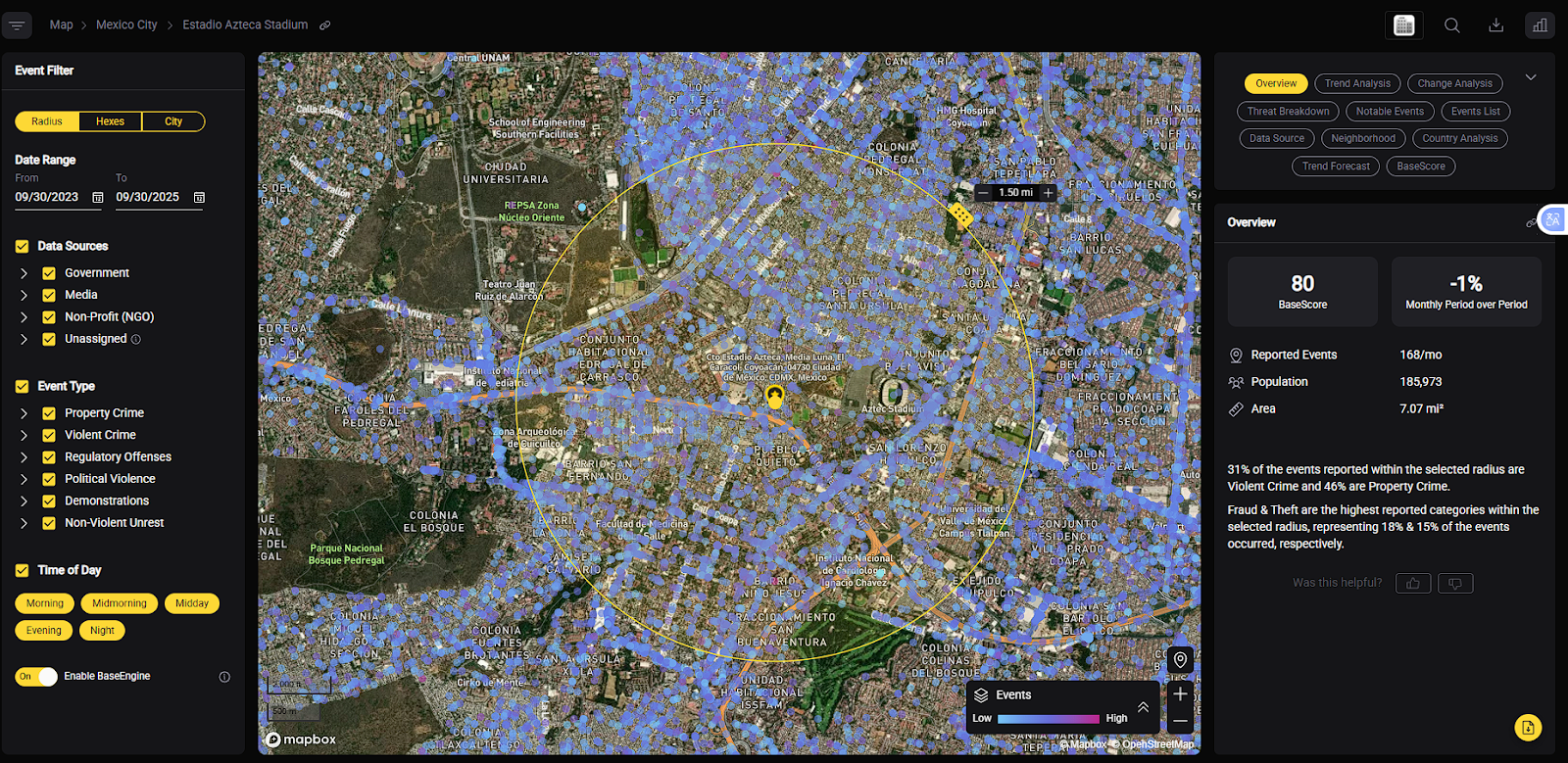
Geographic Context The stadium is situated 15 km south of the historic city center and 21 km from Felipe Ángeles International Airport. It occupies a densely populated urban environment surrounded by residential neighborhoods and commercial corridors along Calzada de Tlalpan (High Confidence).
Transportation Infrastructure Primary access routes include Calzada de Tlalpan and Periférico Sur, both subject to severe congestion. The Tasqueña Metro Station serves as a critical node but is identified as a high-threat environment:
- BaseScore: 79 (High Risk Tier).
- Incident Volume: 533 verified incidents over the assessment period.
- Dominant Threats: Fraud (153 incidents) and Theft (128 incidents).
- Capacity Stress: The station handles over 100,000 daily passengers, with World Cup surge capacity expected to create dense target environments for organized theft crews (High Confidence).
Critical Infrastructure Vulnerabilities Nearest major trauma centers are 6-7.5 km away. Road conditions and traffic congestion can extend emergency response times to 25-35 minutes, necessitating on-site advanced medical capabilities (Medium Confidence).
5. Historical Incident Review
Stadium-Specific Security Events Estadio Azteca has a history of security challenges. The venue sustained structural damage during the 1985 earthquake, highlighting seismic risk considerations (High Confidence). While the stadium has not experienced fatalities comparable to the 2022 Querétaro massacre, post-match violence between rival supporters occurs regularly, such as the 2016 América vs. Cruz Azul confrontation (Medium Confidence).
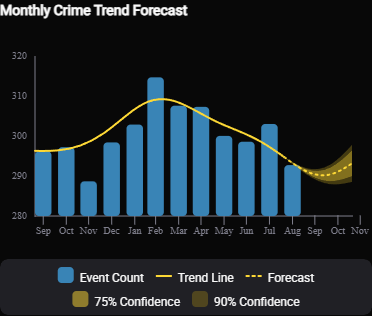
Base Operations Historical Crime Patterns Validated data reveals persistent crime activity with no significant seasonal reduction during the tournament months.
- June Average: 302 events.
- July Average: 301 events.
- Implication: Security planners cannot rely on criminal elements "standing down" during the tournament (High Confidence).
6. Current Threat Landscape
7.1 Crime Trends & Opportunistic Threats
Base Operations validated data identifies a Very High BaseScore Risk Tier (BaseScore 80) for the stadium area. The environment is dominated by property crime, which accounts for 56% of total events.
Key Threat Statistics (Oct 2023 - Sep 2025):
- Theft: 97 BaseScore (Maximum Severity).
- Theft from Vehicle: 97 BaseScore (Maximum Severity).
- Robbery: 97 BaseScore (Maximum Severity).
- Fraud: 1,307 total incidents (18.4% of total).
Temporal Threat Analysis Time-of-day analysis reveals distinct risk periods that complicate World Cup logistics.
- Violent Crime: Peak risk occurs in the evening (6:00 PM - 10:00 PM) with 419 incidents (34% of violent total).
- Property Crime: High activity in the evening (6:00 PM - 10:00 PM) with 445 incidents (25% of property total) and morning (4:00 AM - 10:00 AM) with 463 incidents.
- Tactical Risk: The evening spike coincides with post-match egress, creating a compound risk environment (High Confidence).
[Placeholder: Image of Monthly Crime Trend Forecast from Page 9] [Placeholder: Image of Time of Day Breakdown from Page 11]
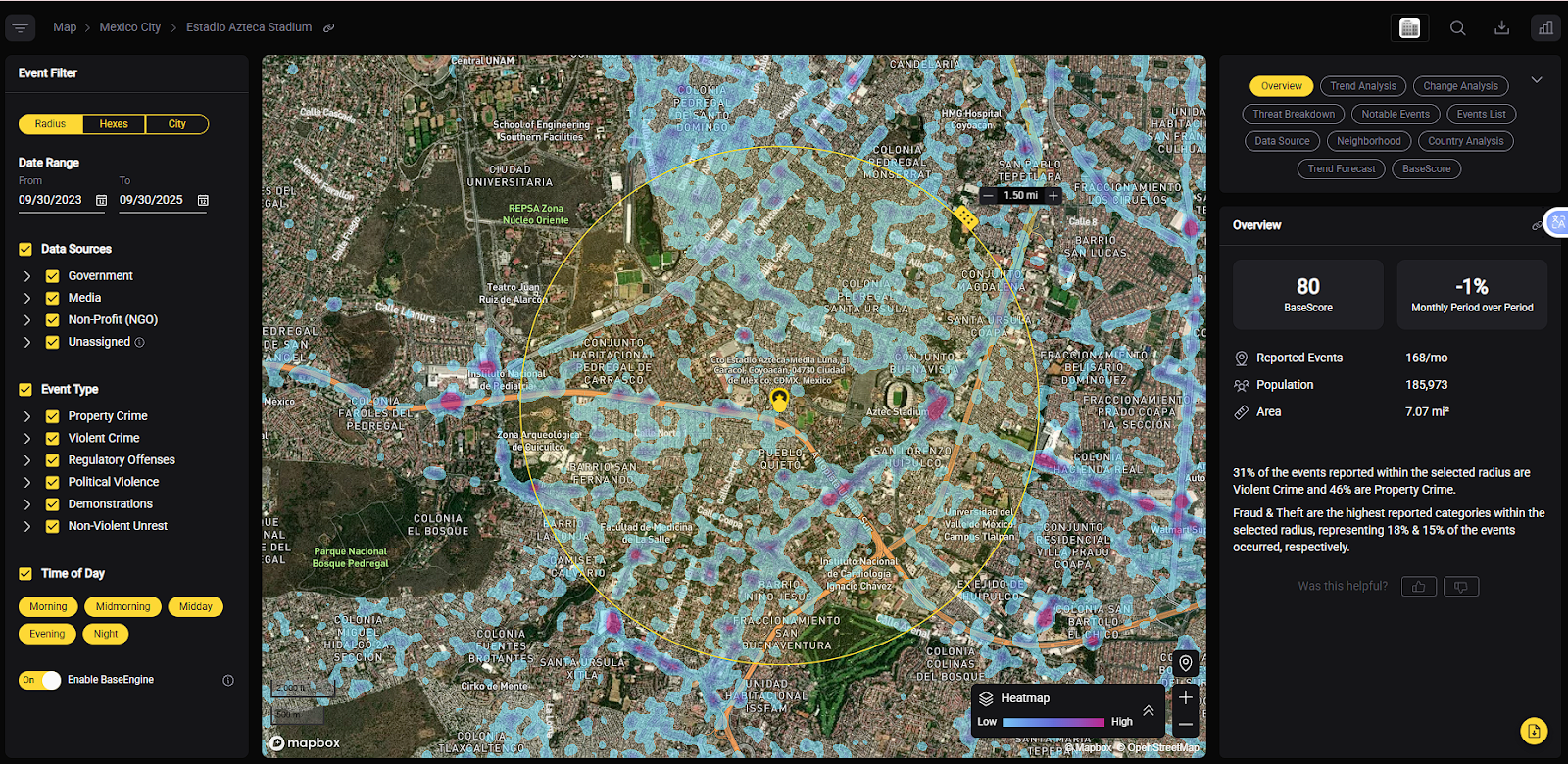
Hotspot Identification Geospatial analysis identifies four critical risk zones:
- Zone 1 (Tasqueña Metro): High density of fraud and theft; organized pickpocket crews operate in crowded platforms (High Confidence).
- Zone 2 (Calzada de Tlalpan): Heavy pedestrian traffic facilitates opportunistic theft; theft from vehicle is concentrated here.
- Zone 3 (Residential Neighborhoods): Poorly lit streets with high rates of harassment and simple assault.
- Zone 4 (Stadium Perimeter): Pre-match arrival periods see criminal elements positioning for operations; theft from vehicle peaks during event days.
7.2 Terrorism & Extremism
While the provided assessment focuses primarily on criminal and civil unrest, the threat of Transnational Criminal Organizations (TCOs) presents a specific security dynamic. Mexico City operates under the territorial control of organizations like CJNG and Sinaloa Cartel remnants.
Risk Assessment TCOs are assessed as unlikely to conduct overt violent attacks during the tournament due to the risk of federal intervention and international scrutiny disrupting business operations (High Confidence). However, indirect threats exist:
- Kidnapping: High-net-worth attendees represent lucrative targets for kidnapping for ransom (High Confidence).
- Infiltration: There is a medium confidence risk of corrupt security personnel providing intelligence on VIP movements to criminal networks.
7.3 Activist & Protest Activity
Base Operations data documents limited peaceful protest activity (28 incidents in 24 months). However, specific drivers exist for the World Cup period.
Primary Drivers:
- Housing Rights: Activists have documented forced evictions near stadium zones, creating potential for demonstrations (Medium Confidence).
- Anti-U.S. Sentiment: The tri-national format and political tensions may trigger demonstrations during matches involving the U.S. team, likely concentrated near Embassy locations rather than the stadium (Medium Confidence).
- Labor & Environment: Disruptions related to construction or environmental impact are assessed as Low to Medium confidence risks.
7.4 Cyber & Information Risks
The dominance of fraud incidents (1,307 events) suggests sophisticated organized operations (High Confidence).
Prevalent Tactics:
- Card Skimming: High risk of ATM skimming and card cloning at commercial areas near the stadium and metro stations.
- Digital Fraud: SIM swap attacks targeting tourists and phishing operations impersonating FIFA or travel services are anticipated.
- Infrastructure: Mexico City's cellular networks experience capacity degradation during mass gatherings, requiring dedicated communications infrastructure (Medium Confidence).
7. Threat Actor Profiles
Organized Crime Groups (TCOs) While homicide rates in the capital are lower than in border regions, TCOs maintain a presence. Their World Cup strategy is expected to focus on "quiet" revenue generation—extortion of local vendors and potential kidnapping—rather than high-profile violence that attracts heat. The infiltration of private security and local police remains a critical vulnerability for executive protection planning.
Opportunistic Criminal Networks Street-level theft rings operate with high organization.
- Tactics: Teams use distraction tactics and advance reconnaissance to identify high-value targets (luxury watches, devices).
- Vehicle Crimes: Theft from vehicle operations average under 90 seconds from breach to escape, utilizing fence networks to launder stolen goods.
- Targeting: These groups will view the World Cup as a time-limited opportunity for maximum returns, specifically targeting international visitors.
8. Key Takeaways
9.1 Corporate Security Director - Executive Briefing
Estadio Azteca presents a Very High threat environment where standard business travel protocols are insufficient. The BaseScore of 80 indicates persistent, high-frequency criminal activity.
Decision Framework & Mitigation:
- Go/No-Go: Proceed only if armored vehicle transportation (B4-level minimum) is secured and a dedicated protective detail with local operations experience is deployed.
- Transportation: Avoid the Tasqueña Metro Station entirely due to its High BaseScore (79) and status as a crime hotspot.
- Lodging: Select lodging within 2 km of the stadium to eliminate extended ground transportation exposure, or utilize secured corridors.
- Egress: Plan for rapid egress; robbery threats increase by 80% during the post-match window (6:00 PM - 10:00 PM).
9.2 Security Analyst - Intelligence Integration
Immediate Actions:
- Monitoring: Add Estadio Azteca to monthly threat monitoring cycles in Base Operations to track trend escalations.
- Briefing Materials: Utilize Base Operations data to provide specific, quantifiable threat briefings (e.g., "Theft from vehicle averages 42 incidents per month") rather than generic warnings.
- Visual Intelligence: Request hex map visualizations showing crime density and specific incident plotting for robbery and kidnapping to inform route planning.
- Vendor Vetting: Vet all local service providers through multiple independent sources, assuming potential penetration by TCO intelligence networks.
9. Appendices
Appendix A: Acronyms & Abbreviations
- ALS: Advanced Life Support
- AICM: Mexico City International Airport
- AIFA: Felipe Ángeles International Airport
- BLS: Basic Life Support
- CJNG: Jalisco New Generation Cartel
- EMT: Emergency Medical Technician
- EP: Executive Protection
- FIFA: Fédération Internationale de Football Association
- HNW: High Net Worth
- IMSI: International Mobile Subscriber Identity
- TCO: Transnational Criminal Organization
- VIP: Very Important Person
- VPN: Virtual Private Network
Appendix B: Key Contacts
- U.S. Embassy Mexico City: Regional Security Office (RSO).
- Mexican Federal Police: Emergency 911.
- Cruz Roja Mexicana (Red Cross): Ambulance 065.
- FIFA 2026 World Cup Security Coordination Center: Contact info pending release.
- Base Operations: Platform support for real-time intelligence.
Appendix C: Methodology
Data Sources:
- Primary: Base Operations validated threat intelligence platform (Sep 30, 2023 - Sep 30, 2025). Aggregates data from Mexican federal/state law enforcement, commercial security intelligence, and verified reporting.
- Secondary: Research reports providing historical context, terrorism assessment, and infrastructure evaluation.
Confidence Levels:
- High: Supported by Base Operations validated data or official reporting.
- Medium: Supported by single credible source or logical extrapolation.
- Low: Based on unverified reporting or significant assumptions.
Appendix D: Data Limitations
Base Operations data current Data Coverage Period dates. Cyber threats not captured in Base Operations metrics. Private security incidents may be underreported. Historical patterns may not predict novel threat vectors. This assessment represents analysis current as of the Date Assessment Prepared. Threat conditions may evolve rapidly. Continuous monitoring through Base Operations and coordination with law enforcement partners is essential for maintaining situational awareness throughout the tournament period.
REFERENCES
- Base Operations. (2025). Estadio Azteca Stadium Radius BaseScore Analysis, October 2023 – September 2025. Internal validated threat intelligence database.
- Base Operations. (2025). Estadio Azteca Stadium Radius Event Count by Threat Category, October 2023 – September 2025. Internal validated threat intelligence database.
- Base Operations. (2025). Estadio Azteca Stadium Radius Monthly Event Trend Analysis, October 2023 – September 2025. Internal validated threat intelligence database.
- Base Operations. (2025). Estadio Azteca Stadium Radius Time of Day Breakdown, October 2023 – September 2025. Internal validated threat intelligence database.
- Base Operations. (2025). Estadio Azteca Stadium Radius Average Events by Month of Year, October 2023 – September 2025. Internal validated threat intelligence database.
- Base Operations. (2025). Estadio Azteca Stadium Radius Monthly Crime Trend Forecast, October 2023 – September 2025. Internal validated threat intelligence database.
- Base Operations. (2025). Mexico City BaseScore Analysis, October 2023 – September 2025. Internal validated threat intelligence database.
- Base Operations. (2025). Mexico City Event Count by Threat Category, October 2023 – September 2025. Internal validated threat intelligence database.
- Associated Press via ESPN. (April 8, 2018). "FIFA to evaluate risk of violence if Mexico co-hosts 2026 World Cup." ESPN.com. Retrieved October 22, 2025, from https://www.espn.com/soccer/fifa-world-cup/story/3445179/fifa-to-evaluate-risk-of-violence-if-mexico-co-hosts-2026-world-cup
- Woodford, I. (August 25, 2025). "'We get nothing': residents fight back as Mexico builds big for 2026 World Cup." The Guardian. Retrieved October 22, 2025, from https://www.theguardian.com/world/2025/aug/25/mexico-city-world-cup-2026-residents-opposition
- Asharq Al-Awsat (AFP). (May 8, 2025). "Mexico City Prepares to Welcome Millions for 2026 World Cup." Asharq Al-Awsat. Retrieved October 22, 2025, from https://english.aawsat.com/mexico-city-prepares-welcome-millions-2026-world-cup
- NDTV (Agence France-Presse). (October 22, 2025). "Amid Drug Violence in Mexico, Security Firms On Alert For World Cup 2026." NDTV World News. Retrieved October 22, 2025, from https://www.ndtv.com/world-news/amid-drug-violence-in-mexico-security-firms-on-alert-for-world-cup-2026
- Mexico News Daily. (July 21, 2025). "As anti-gentrification sentiment grows, a second Mexico City march targets World Cup speculation." Mexico News Daily. Retrieved October 22, 2025, from https://mexiconewsdaily.com/news/anti-gentrification-mexico-city-march-world-cup/
- Rodriguez, C. (August 2023). "Mexican soccer fan shot outside of a stadium in Tijuana after a Liga MX match dies." Associated Press. Retrieved October 22, 2025, from https://apnews.com/article/mexico-soccer-fan-death-tijuana-8c1f9d3e5a4b6c2d1f8e7a9b0c3d2e1f
- CBS News (Associated Press). (March 7, 2022). "Massive brawl at soccer game leaves 26 injured, three critically: 'The darkest day for Mexican soccer'." CBS News. Retrieved October 22, 2025, from https://www.cbsnews.com/news/mexico-soccer-game-brawl-queretaro-liga-mx/
- Lemos, R. (September 26, 2025). "Prep is Underway, But 2026 FIFA World Cup Poses Significant Cyber Challenges." Dark Reading. Retrieved October 22, 2025, from https://www.darkreading.com/cyber-risk/2026-fifa-world-cup-significant-cyber-challenges
- Unmanned Airspace. (August 6, 2025). "Canada, Mexico and US form trilateral effort to protect FIFA World Cup from drone threats." Unmanned Airspace. Retrieved October 22, 2025, from https://www.unmannedairspace.info/latest-news-and-information/canada-mexico-us-trilateral-drone-protection-world-cup/
- ETS Risk Management. (2025). "FIFA 2026 World Cup Security in the Americas." Retrieved October 22, 2025, from https://www.ets-riskmanagement.com/fifa-2026-in-the-americas/
- Times of India. (October 22, 2025). "Electric shock car handles, wheels with pepper spray: Mexico's security firms prepare for 2026 FIFA World Cup." Times of India. Retrieved October 22, 2025, from https://timesofindia.indiatimes.com/sports/football/top-stories/electric-shock-car-handles-wheels-with-pepper-spray-mexicos-security-firms-prepare-for-2026-fifa-world-cup/articleshow/124733808.cms
- FIFA. (2025). "Estadio Azteca Mexico City to host opening match of FIFA World Cup 2026." Retrieved October 22, 2025, from https://www.fifa.com/en/tournaments/mens/worldcup/canadamexicousa2026/articles/estadio-azteca-mexico-city-host-opening-match-world-cup-2026
- Sporting News. (2025). "Estadio Azteca schedule, seat map, hotels, parking, bags & more for World Cup in Mexico City." Retrieved October 22, 2025, from https://www.sportingnews.com/us/soccer/news/estadio-azteca-schedule-seat-map-hotels-parking-bags-world-cup-mexico-city/29676622c8ea83ab6fada6b4
- U.S. Department of State. (2025). "Travel Advisory - United Mexican States." Retrieved October 22, 2025, from https://travel.state.gov/en/international-travel/travel-advisories/mexico.html
- Human Rights Watch. (2025). "World Report 2025: Mexico." Retrieved October 22, 2025, from https://www.hrw.org/world-report/2025/country-chapters/mexico
- U.S. Mission to Mexico. (2025). "Demonstration Alert: Protests in Mexico City." Retrieved October 22, 2025, from https://mx.usembassy.gov/demonstration-alert-protests-in-mexico-city/
- CD Migrante. (2025). "Mexico United 2026: Championing Labor and Human Rights." Retrieved October 22, 2025, from https://cdmigrante.org/special-initiatives/mexico-united-2026/
- iGaming Today. (2025). "UN Warns of Potential Surge in Illegal Betting Ahead of 2026 FIFA World Cup." Retrieved October 22, 2025, from https://www.igamingtoday.com/un-warns-of-potential-surge-in-illegal-betting-ahead-of-2026-fifa-world-cup/
- Dataminr. (2025). "Preparing for the 2026 World Cup: Security Challenges and How to Tackle Them." Retrieved October 22, 2025, from https://www.dataminr.com/resources/blog/preparing-for-the-2026-world-cup-security-challenges-and-how-to-tackle-them/
- Science Media Centre. (2025). "Most sites in North America that will host the 2026 World Cup are at high risk of extreme heat." Retrieved October 22, 2025, from https://sciencemediacentre.es/en/most-sites-north-america-will-host-2026-world-cup-are-high-risk-extreme-heat
- Mexico Business News. (2025). "2026 World Cup Planning Highlights Health Risks." Retrieved October 22, 2025, from https://mexicobusiness.news/health/news/2026-world-cup-planning-highlights-health-risks
- CHEST Physician. (2025). "Medical preparedness and critical care for the 2026 FIFA World Cup." Retrieved October 22, 2025, from https://www.chestphysician.org/medical-preparedness-and-critical-care-for-the-2026-fifa-world-cup/
- Once Noticias. (2025). "Tlalpan está entre los municipios con más feminicidios; implementan programa de prevención." Retrieved October 22, 2025, from https://oncenoticias.digital/reportajes-especiales/tlalpan-esta-entre-los-municipios-con-mas-feminicidios-implementan-programa-de-prevencion/135728/
- Baker Institute. (2025). "Mexico Country Outlook 2025." Retrieved October 22, 2025, from https://www.bakerinstitute.org/mco
- CSIS. (2025). "USMCA Review 2026." Retrieved October 22, 2025, from https://www.csis.org/analysis/usmca-review-2026
- PBS NewsHour. (2025). "US-Canada-Mexico joint World Cup goes from unity to acrimony thanks to tariffs and '51st state' threats." Retrieved October 22, 2025, from https://www.pbs.org/newshour/politics/us-canada-mexico-joint-world-cup-goes-from-unity-to-acrimony-thanks-to-tariffs-and-51st-state-threats
- Amnesty International. (2025). "World Cup 2026: Growing threats to human rights set to undermine FIFA's responsibilities." Retrieved October 22, 2025, from https://www.amnesty.org.uk/press-releases/world-cup-2026-growing-threats-human-rights-set-undermine-fifas-responsibilities-one
- ITDP. (2021). "Mexico City Public Transit Resilience." Retrieved October 22, 2025, from https://itdp.org/wp-content/uploads/2021/09/MexicoCityPublicTransitST33092021.pdf
- Wikipedia. (2025). "Mexico City Metro overpass collapse." Retrieved October 22, 2025, from https://en.wikipedia.org/wiki/Mexico_City_Metro_overpass_collapse
Takeaways
Corporate Security Director - Executive Briefing
Estadio Azteca presents a Very High threat environment where standard business travel protocols are insufficient. The BaseScore of 80 indicates persistent, high-frequency criminal activity.
Decision Framework & Mitigation:
- Go/No-Go: Proceed only if armored vehicle transportation (B4-level minimum) is secured and a dedicated protective detail with local operations experience is deployed.
- Transportation: Avoid the Tasqueña Metro Station entirely due to its High BaseScore (79) and status as a crime hotspot.
- Lodging: Select lodging within 2 km of the stadium to eliminate extended ground transportation exposure, or utilize secured corridors.
- Egress: Plan for rapid egress; robbery threats increase by 80% during the post-match window (6:00 PM - 10:00 PM).
Security Analyst - Intelligence Integration
Immediate Actions:
- Monitoring: Add Estadio Azteca to monthly threat monitoring cycles in Base Operations to track trend escalations.
- Briefing Materials: Utilize Base Operations data to provide specific, quantifiable threat briefings (e.g., "Theft from vehicle averages 42 incidents per month") rather than generic warnings.
- Visual Intelligence: Request hex map visualizations showing crime density and specific incident plotting for robbery and kidnapping to inform route planning.
- Vendor Vetting: Vet all local service providers through multiple independent sources, assuming potential penetration by TCO intelligence networks.