Gillette Stadium (Foxborough, Massachusetts) FIFA World Cup 26 Threat Assessment
Security threat assessment for matches hosted at Gillette Stadium (Massachusetts, USA) during the FIFA World Cup 26. Threat assessment based on two years of historical crime and unrest data within 5 miles of venue and 1.5 miles of nearby transit hub.
OVERVIEW
- Date Assessment Prepared: November 12, 2025
- Data Coverage Period: September 30, 2023 – September 30, 2025
- Stadium Location: Gillette Stadium (Temporarily renamed Boston Stadium for the tournament)
- Transit Hub Location: Foxboro Station / MBTA South Station
- Host City: Foxborough, Massachusetts (Greater Boston Area), United States
Methodology Disclaimer This assessment integrates Base Operations quantitative threat data with qualitative intelligence from open sources collected via deep research AI agents. Confidence levels reflect source reliability: High (government/Base Operations verified data), Medium (multiple corroborating sources), Low (single source/extrapolated). AI agents can provide incorrect or misleading information. To ensure the accuracy of stadium threat assessment, analyze the latest data in Base Operations.
1. EXECUTIVE SUMMARY
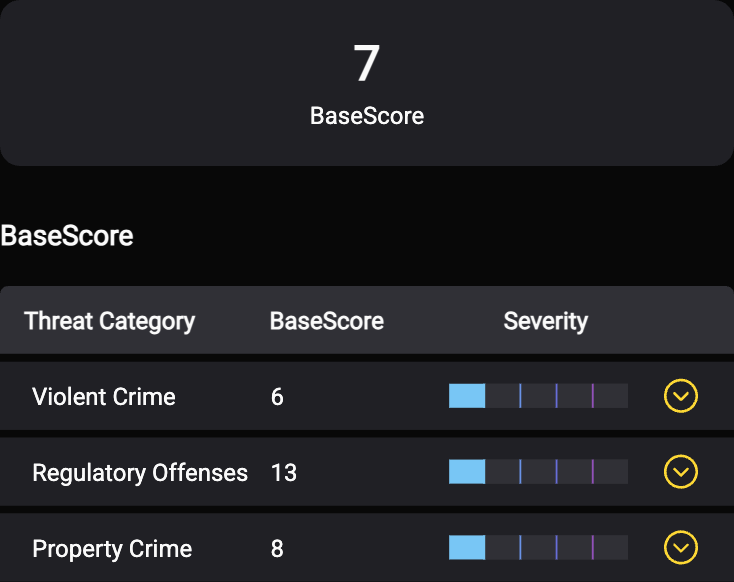
Gillette Stadium presents a VERY LOW BaseScore Risk Tier (BaseScore: 7) based on historical crime patterns recorded within a 5-mile radius over the October 2023–September 2025 coverage period. The associated Foxboro MBTA Commuter Rail Station also presents a VERY LOW BaseScore Risk Tier (BaseScore: 7). While Foxborough's ambient crime environment is among the lowest of any FIFA 2026 host venue, the qualitative and geopolitical risk picture is substantially elevated.
The convergence of a high-profile international tournament, constrained single-corridor access, active regional protest networks, and the overlay of America's Semiquincentennial (July 4, 2026) creates a complex security environment requiring an enhanced protective posture.
Base Operations indicates an overall BaseScore of 7, placing both the stadium perimeter and transit hub in the VERY LOW Risk Tier (0–20) based on historical data. Total recorded incidents within the stadium radius: approximately 21 events over the two-year data coverage period. The transit hub recorded only 2 incidents over the same period, both aggravated assaults occurring at night.
Top Threats:
- Activist Route Blockades — Route 1 / Route 140 Corridor (High Confidence): The publicly designated Route 140 Egress route and the single-corridor dependency on Route 1 create predictable targets for activist blockade operations capable of achieving maximum logistical disruption with minimal personnel.
- Domestic Violent Extremism — NSC-131 and HVE Actors (Medium Confidence): NSC-131 maintains an established New England operational presence with documented tactics focused on public visibility. Highway overpasses along primary VIP travel routes present opportunities for targeted harassment and projectile incidents.
- Cyber-Kinetic Failure of MBTA Foxboro Station Systems (Medium Confidence): The tight construction deadline for Foxboro Station's new digital control systems, combined with documented MBTA cybersecurity training gaps (43% failure rate), creates a credible cyber-kinetic risk during the initial matches.
- Transnational Organized Crime — Burglary/Theft Targeting VIP Accommodations (Medium Confidence): The July 2025 ICE arrest of a multi-state Romanian burglary ring operating in Dedham and Norwood, MA confirms active TOC presence in the immediate Metro-West region.
- Terrorism / Mass Casualty Event Targeting Crowd Concentrations (Medium Confidence): The Boston Marathon Bombing establishes that this specific regional environment has been successfully targeted by IED-based attacks in unprotected public spaces.
Strategic Takeaways: The primary security risk at Gillette Stadium is not endemic local crime — it is the structural vulnerability created by constrained transportation infrastructure, a documented regional protest and activist ecosystem, and the elevated cyber risk profile of the MBTA Foxboro Station improvements project. Security planning must account for these asymmetric and qualitative threat vectors operating independently of the low baseline crime environment. The Semiquincentennial overlay on July 4, 2026 will simultaneously draw law enforcement resources to Boston, creating significant resourcing constraints for matches scheduled around or after that date.
2. EVENT SNAPSHOT
Event Scope & Significance The FIFA World Cup 2026 will take place from June 11 through July 19, 2026. Gillette Stadium in Foxborough, MA (capacity: 65,878) has been designated as a quarter-final host venue. The quarter-final designation elevates the venue's VIP profile significantly — knock-out stage matches historically attract heads of state, senior government officials, C-suite corporate executives from FIFA sponsor organizations, and prominent international media delegations. The concentration of high-net-worth individuals over a 39-day period — combined with corporate hospitality activations at Patriot Place — creates a sustained target environment for both physical and cyber threat actors (High Confidence).
Political Context: The tournament period directly coincides with America's Semiquincentennial — the 250th anniversary of the signing of the Declaration of Independence on July 4, 2026. Boston is the designated national focal point for these celebrations, and Massachusetts law enforcement resources will face concurrent demands from both the FIFA security apparatus and large-scale patriotic events. This dual resourcing pressure represents one of the most consequential planning constraints for the tournament period (High Confidence).
Match Timing: The combination of evening kickoffs with the documented nighttime concentration of violent crime at the transit hub (100% of recorded incidents) creates a specific risk window during post-match dispersal periods — particularly for late-evening matches.
VIP Profile
- High Confidence: Heads of state, senior government officials, C-suite corporate executives from FIFA sponsor organizations, and prominent international media delegations.
- Medium Confidence: International business leaders and diplomatic delegations leveraging the quarter-final stage for relationship development.
- Elevated Risk: VIP executives with publicly known ties to defense contractors, financial institutions with Israeli exposure, or contentious government policy positions represent specific declared targets for regional activist groups.
3. AREA & INFRASTRUCTURE OVERVIEW
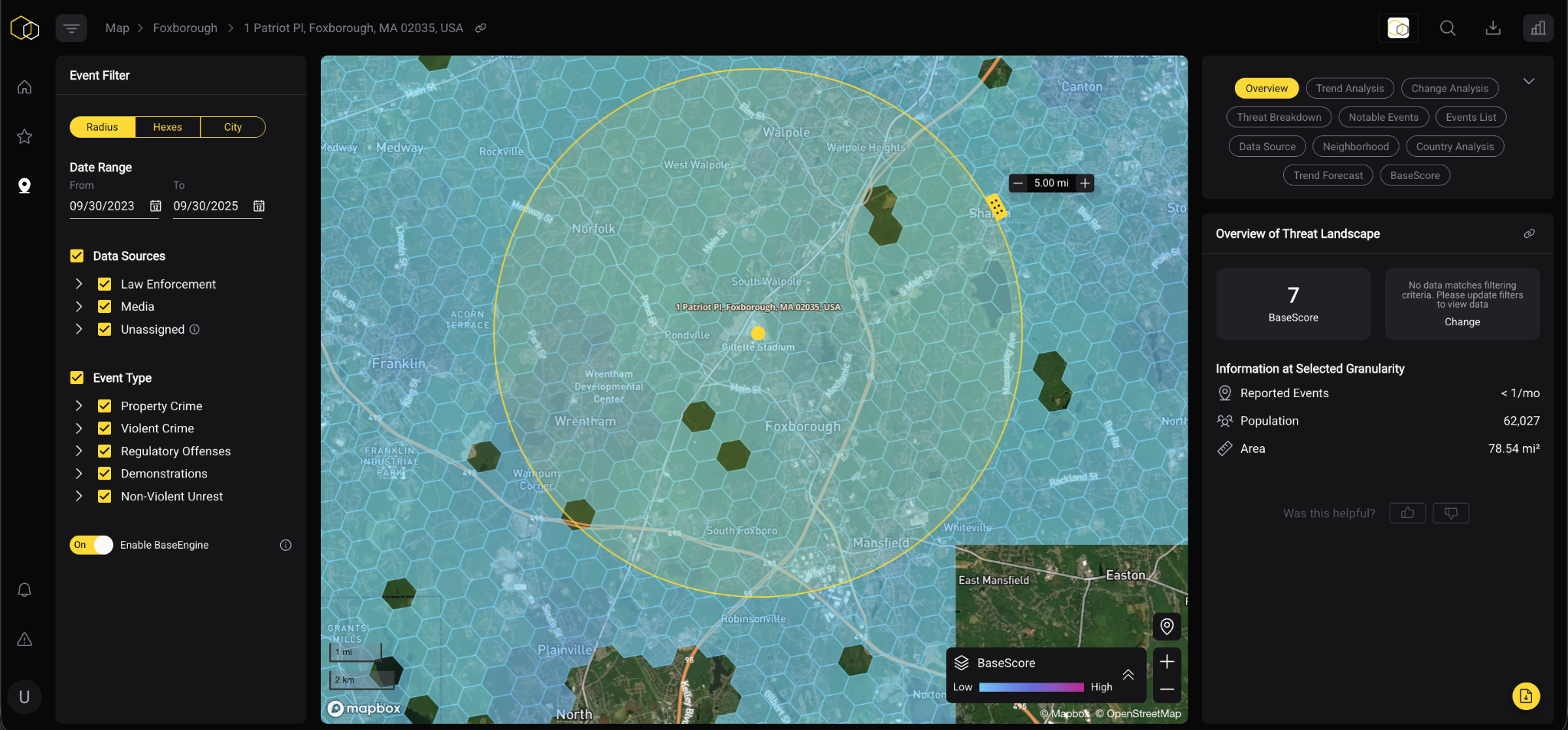
Geographic Context Gillette Stadium is situated in the suburban town of Foxborough, Norfolk County, Massachusetts, approximately 22–29 miles southwest of Boston and 18–25 miles northeast of Providence, Rhode Island. The stadium complex anchors the Patriot Place retail and entertainment development, set within a broad suburban environment of dispersed residential neighborhoods, light commercial corridors, and open land. This relative geographic isolation limits ambient crime exposure — as confirmed by the BaseScore of 7 — but concentrates all logistical and protective dependencies onto a severely constrained road network.
Transportation Infrastructure
- Foxboro MBTA Commuter Rail Station (Primary Transit Hub): Located approximately 0.3 miles from Gillette Stadium's main entrance. The MBTA is executing a $35 million infrastructure improvement project — including new ADA-accessible platforms — with completion projected to coincide narrowly with the June 2026 event start (Medium Confidence). This tight operational timeline, combined with the station's new and largely untested digital control systems, elevates the risk of operational failure during the initial matches.
- Route 1 (Critical Chokepoint): Foxborough police have historically restricted traffic flow almost entirely to Route 1 during large events to prevent congestion in surrounding residential areas. This creates a single primary corridor handling upwards of 45,000 vehicles on match days.
- Route 140 Egress (VIP Corridor): A publicly detailed egress route directing premium seating and VIP traffic behind Patriot Place South Marketplace. The public designation of this route makes it a predictable target for activist blockade operations (High Confidence).
- Air Access: T.F. Green Airport (Providence, RI) approximately 25 miles southwest, or Boston Logan International Airport (BOS) approximately 20 miles northeast.
Critical Infrastructure Vulnerabilities
- The Lighthouse at Gillette Stadium: A 22-story (218 feet / 66 meters) structure with a 360-degree observation deck providing commanding sightlines over the stadium bowl, Patriot Place, and all primary approach routes. Its height and rental availability create potential for hostile pre-event surveillance, intelligence collection on security posture, and monitoring of VIP ingress/egress patterns (Medium Confidence). Comprehensive counter-surveillance protocols must incorporate regular sweeps and monitoring of this structure.
- Stadium Renovation (2023): The $250 million renovation added expanded hospitality spaces including the Cross Insurance Club, 550+ concession points of sale, and upgraded premium areas. These enhancements increase VIP concentration in defined hospitality zones, creating localized density risks.
- Screening Technology: An AI-powered weapons detection system (Evolv Express) was installed in 2022 to improve throughput screening at entry gates. The venue holds GBAC STAR accreditation for infectious disease prevention protocols (High Confidence).
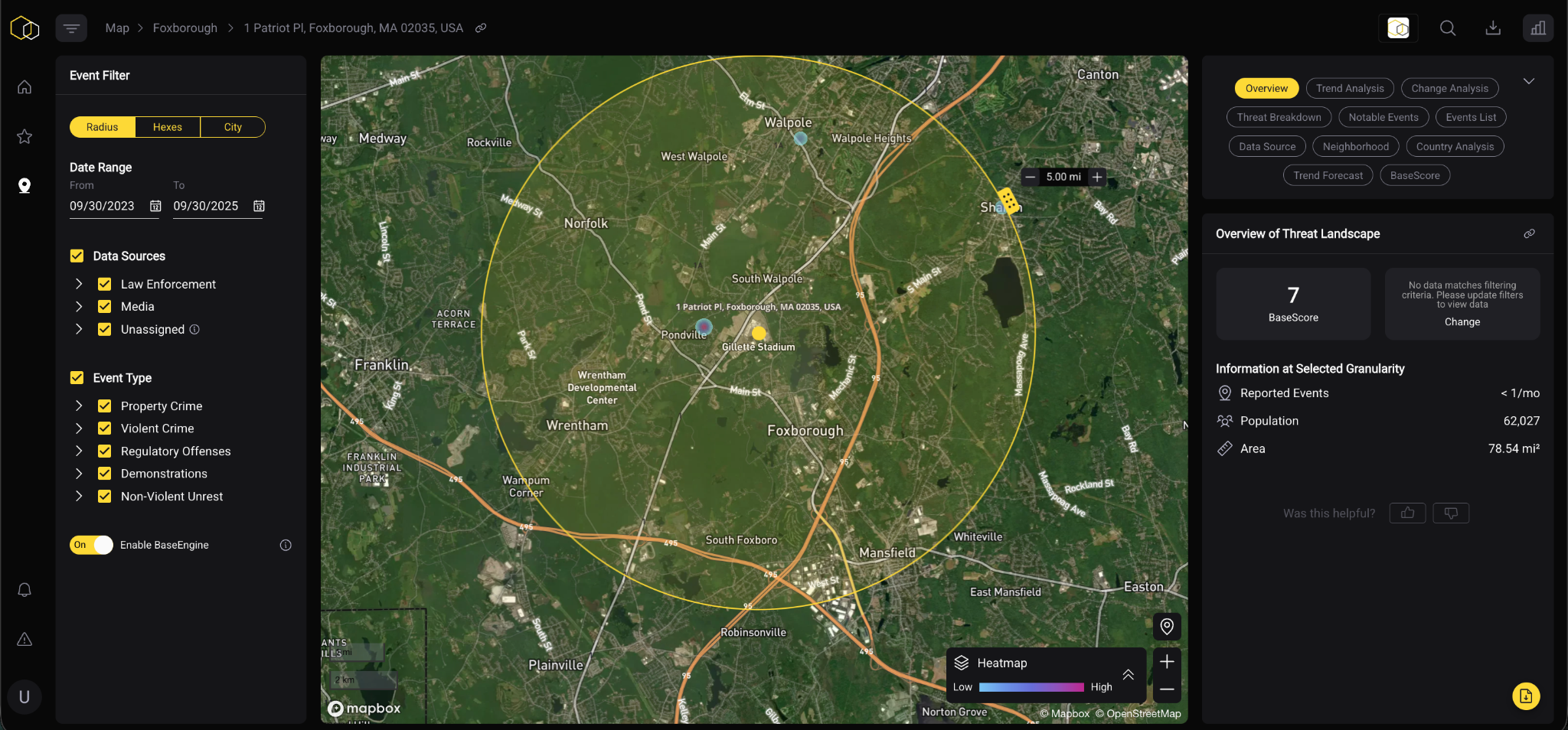
Base Operations Geospatial Analysis Base Operations validated threat intelligence confirms that the immediate Foxborough environment is an extremely low-crime geography. The 21 recorded incidents over two years within the stadium radius average fewer than 1 incident per month across the entire catchment area. The transit hub recorded only 2 incidents over the same period. These figures are consistent with Foxborough's municipal crime statistics, which show violent crime at approximately 59 per 100,000 residents — well below national averages (Medium Confidence).
4. HISTORICAL INCIDENT REVIEW
Past security incidents at Gillette Stadium and in the wider region provide critical intelligence for World Cup 2026 planning.
Security Failures & Challenges
- 2010 Security Overhaul (Medium Confidence): Foxborough Police and Massachusetts State Police collaborated to revamp the stadium's security plan following a high number of detentions during a major game. This precedent established the multi-agency coordination framework that will underpin World Cup security operations.
- June 2024 Transit Hub Violence (High Confidence): Base Operations recorded a single violent crime cluster within the transit hub vicinity — two aggravated assault incidents, both occurring at night. The monthly event trend confirms this as an isolated spike against an otherwise near-zero baseline.
- Stadium Radius Protest Activity (High Confidence): The 5-mile stadium radius recorded approximately 13 protest-related events (peaceful demonstrations, non-violent unrest, political violence) over the data coverage period, with a notable concentration in February–March 2025 — consistent with national mobilization patterns around political transitions.
Regional Precedents
- 2013 Boston Marathon Bombing (High Confidence): The defining regional security precedent. The attack utilized improvised explosive devices (IEDs) concealed in backpacks placed in dense, unprotected public areas — a tactic directly applicable to the unprotected crowd flows expected along Route 1, at the Foxboro MBTA Station, and in Fan Zones. The subsequent investigation required nine days of processing across 12 city blocks, generating more than 3,500 pieces of evidence. This event fundamentally shaped the Massachusetts security architecture and directly informs current World Cup planning.
- July 2025 Romanian Burglary Ring (Medium Confidence): U.S. Immigration and Customs Enforcement arrested a Romanian female burglary ring operating across Dedham and Norwood, MA — municipalities within the greater Metro-West region adjacent to Foxborough. The ring was assessed to be operating across multiple states, confirming the presence of active transnational organized crime in the stadium's regional operating environment.
- October 2025 Boston Pro-Palestinian Demonstration (High Confidence): The protest escalated into road blockades, the deployment of smoke devices and flares, and multiple arrests — establishing a documented recent precedent for protest-to-disruption escalation in the Massachusetts environment.
Base Operations Historical Pattern No homicides, vehicle thefts, or weapons-related incidents were recorded in Base Operations data within either the stadium or transit hub radii during the data coverage period. The threat profile is dominated by protest/unrest activity (~62% of all recorded incidents), not violent crime.
5. CURRENT THREAT LANDSCAPE
5.1 Crime Trends & Opportunistic Threats
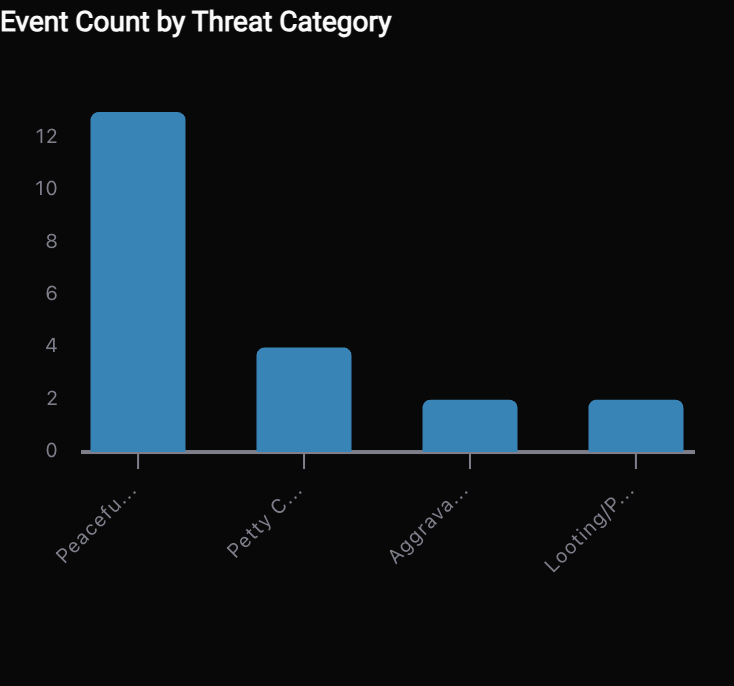
Base Operations validated threat intelligence covering October 2023 through September 2025 identifies approximately 21 recorded incidents within a 5-mile radius of Gillette Stadium. This represents an exceptionally low incident rate, averaging fewer than 1 incident per month across the entire radius. The transit hub recorded only 2 incidents within its 1.5-mile radius over the same period, both aggravated assaults occurring at night in June 2024.
Quantitative Analysis
- Dominant Category — Protest/Unrest: Peaceful protest and demonstration events account for approximately 13 of the 21 recorded incidents (~62%) within the stadium's 5-mile radius, making unrest the single dominant threat category by volume.
- Property Crime: Petty crime accounts for approximately 4 incidents, with looting/property crime accounting for approximately 2 additional events. Boston-wide data indicates a 4% increase in total property crime and an 8% increase in larceny in 2024 compared to 2023 (Medium Confidence).
- Violent Crime: Aggravated assault represents approximately 2 of the 21 recorded stadium-radius incidents (~10%). At the transit hub, both recorded incidents are aggravated assaults, all occurring at night.
Temporal Patterns
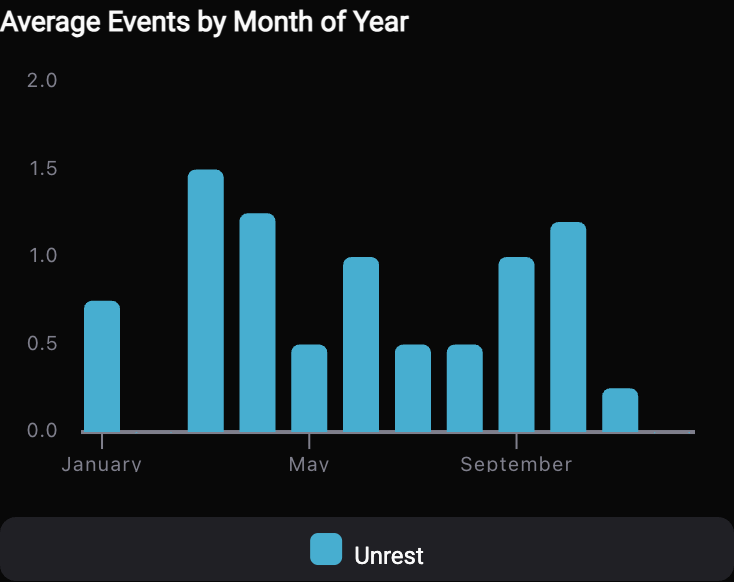
- Seasonal Concentration: Unrest events show seasonal concentration in February, March, and June. June — the opening month of the World Cup — carries a historically elevated unrest average of approximately 1 event per month.
- Time of Day: The time-of-day breakdown shows 100% of categorized violent crime at the transit hub occurred during nighttime hours, indicating post-event dispersal and late-night crowd management as the primary violent crime risk window (High Confidence).
- Operational Alignment: The monthly event trend confirms protest activity is not uniformly distributed: spikes are recorded in September 2023, May–June 2024, and a sustained elevated period from January through March 2025, followed by isolated incidents in mid-2025.
5.2 Terrorism & Extremism
The terrorism threat landscape for the World Cup at Gillette Stadium is shaped by the 2013 Boston Marathon Bombing precedent and the persistent threat of domestic violent extremism in the New England region.
International Terrorism
The 2025 Homeland Threat Assessment identifies the U.S. homeland as facing complex threats from Foreign Terrorist Organizations (FTOs) and Homegrown Violent Extremists (HVEs), with key capabilities including IED deployment, active shooter tactics, and cyberattacks against critical infrastructure (High Confidence). The $625 million in federal security funding across all U.S. venues is expected to harden the stadium perimeter, likely shifting threat intent toward softer targets: unprotected crowd flows along Route 1, the newly constructed Foxboro MBTA Station, and Fan Zones (High Confidence). No specific credible plot targeting Gillette Stadium has been publicly disclosed as of the date of this assessment.
Domestic Violent Extremism
- NSC-131 (Nationalist Social Club-131): A neo-Nazi organization with established regional presence in New England. Documented patterns of utilizing transportation infrastructure — including highway overpasses — for banner deployment and propaganda display. Highway overpasses along primary VIP travel routes (Route 1, I-95, I-495) present opportunities for targeted harassment, banner deployment, or the throwing of projectiles onto motorcades (Medium Confidence).
- Regional Precedent: A Massachusetts man pleaded guilty to threatening bomb attacks on synagogues, confirming the presence of active domestic extremist actors willing to escalate to planned violence (Medium Confidence).
5.3 Activist & Protest Activity
Massachusetts hosts highly organized activist ecosystems with documented capacity for large-scale, rapidly mobilized protest operations.
Anticipated Activist Groups
- Palestinian Youth Movement / BDS Boston / Jewish Voice for Peace: These groups target entities perceived as linked to contentious geopolitical positions — corporate sponsors with ties to defense, technology, finance, or Israeli policy are assessed as specific focus targets (High Confidence).
- Democratic Socialists of America (DSA) / ACLU of Massachusetts: Organized advocacy groups with established mobilization infrastructure in the Greater Boston area.
- Mobilization Capacity: The May 2025 "No Kings" rally in Boston Common drew over 100,000 demonstrators, confirming the region's capacity for large-scale protest operations (High Confidence).
Target Assessment: The most strategically effective protest tactic available at Gillette Stadium is a physical blockade of the Route 1 corridor or the Route 140 Egress — requiring minimal personnel to achieve maximum logistical disruption and global media exposure. Security planners should treat Route 1 and Route 140 as having a non-trivial probability of activist interdiction on high-visibility match days, particularly the quarter-final (High Confidence). FIFA's institutional stance that it "cannot solve geopolitical problems" effectively shifts activist targeting from FIFA itself toward corporate sponsors and diplomatic delegations in attendance (Medium Confidence).
5.4 Cyber & Information Risks
The digital threat to the World Cup at Gillette Stadium is ELEVATED due to a convergence of infrastructure expansion, institutional vulnerabilities, and the documented targeting of major sporting events by cyber actors.
MBTA Cyber-Kinetic Risk
- Institutional Vulnerability: A 2025 Massachusetts state assessment identified that 43% of a sampled subset of MBTA employees had failed to complete annual cybersecurity awareness training (High Confidence).
- Operational Risk: This institutional vulnerability, combined with the tight construction deadline for Foxboro Station's new digital control systems, creates a credible cyber-kinetic risk: a ransomware or denial-of-service attack targeting station signal management or digital ticketing could immobilize the commuter rail network post-match, trapping tens of thousands of attendees in Foxborough and generating a secondary crowd control crisis compounded by Route 1 saturation.
Stadium Digital Attack Surface
- The Kraft Group is executing a major digital infrastructure upgrade — including a WiFi refresh, 1,800+ wireless access points, mobile point-of-sale terminals, and increased IoT device density — substantially expanding the stadium's digital attack surface.
- The FBI Boston Division has documented recent increases in ransomware, critical infrastructure attacks, and supply chain intrusions (High Confidence).
Phishing & Social Engineering
- A documented historical threat vector for FIFA World Cup events is the distribution of malware disguised as official tournament documents (Medium Confidence).
- All VIP and corporate communications related to accreditation, scheduling, and logistics must be treated as potential phishing targets.
6. THREAT ACTOR PROFILES
1. Geopolitical and Domestic Activist Groups (Palestinian Youth Movement, BDS Boston, DSA, ACLU)
- Risk Level: HIGH for disruption; LOW for violence.
- Modus Operandi: Well-organized, well-resourced, and operationally sophisticated. Primary intent is visibility and disruption rather than violence. The most consequential tactic available is a physical blockade of the Route 1 and Route 140 corridors.
- Targeting: VIP executives with publicly known ties to defense contractors, financial institutions with Israeli exposure, or contentious government policy positions represent specific declared targets (High Confidence).
2. White Nationalist/Supremacist DVEs (NSC-131)
- Risk Level: MEDIUM for harassment; LOW for mass-casualty operations.
- Modus Operandi: Established New England operational presence with documented tactics focused on public visibility — highway overpass banners and propaganda deployment.
- Capabilities: Current capability for mass-casualty operations is assessed as low. Primary risk to VIPs is targeted harassment, banner drops creating momentary distraction during motorcade transit, and potential projectile incidents from overpass positions (Medium Confidence).
3. Transnational Organized Crime (Romanian Burglary Networks)
- Risk Level: MEDIUM for property crime; LOW for physical harm.
- Modus Operandi: The concentration of law enforcement resources at Gillette Stadium on match days creates a predictable enforcement gap in surrounding residential neighborhoods and VIP hotel corridors. TOC groups will likely exploit this resource shift to target high-value residences and hotel suites where affluent visitors and executives are sequestered (Medium Confidence).
- Regional Precedent: July 2025 ICE arrest of a multi-state Romanian burglary ring operating in Dedham and Norwood, MA.
4. Cyber Threat Actors (State-Sponsored and Criminal)
- Risk Level: HIGH for digital infrastructure; MEDIUM for kinetic disruption.
- Modus Operandi: Will target FIFA 2026 infrastructure in Massachusetts, with particular focus on vendor supply chains (ticketing, hospitality, logistics IT), MBTA transit control systems, and VIP communications networks.
- Capabilities: The expanded digital attack surface created by the Kraft Group's infrastructure upgrade amplifies exposure. The New England healthcare sector's documented susceptibility to complex data breaches suggests a regional digital ecosystem with uneven cybersecurity maturity (Medium Confidence).
7. KEY TAKEAWAYS
7.1 For Corporate Security Directors
- Baseline Context: The BaseScore of 7 places both the stadium and transit hub in the VERY LOW risk tier by ambient crime standards. However, the qualitative risk vectors — activist networks, infrastructure constraints, cyber vulnerabilities — operate independently of ambient crime levels and are not captured in the BaseScore.
- Transportation is the Primary VIP Vulnerability: Treat Route 1 and Route 140 Egress as potentially compromised on high-visibility match days. All executive protective plans must include pre-cleared aerial exfiltration options (helicopter) and avoid reliance on the MBTA Foxboro Station for primary VIP transport. Contingency planning should assume up to 90-minute ground transit delays on match days.
- Resource Competition — July 4, 2026: The Semiquincentennial will simultaneously draw law enforcement resources to Boston and across Massachusetts. Matches scheduled around or after July 4 should carry an elevated protective posture assumption due to reduced public safety response capacity and heightened DVE interest in symbolic national targets.
- Insider Threat and Accommodations Security: The match-day law enforcement surge at Gillette will likely create protective voids in surrounding VIP hotel areas. Coordinate with local law enforcement in advance to ensure adequate coverage of non-stadium executive accommodations. Brief VIP principals on virtual kidnapping awareness and establish duress communication protocols.
- Digital Hygiene: All VIP-associated devices, communications platforms, and accreditation data should be treated as potential phishing targets for the duration of the operational window. Implement isolated, hardened communication networks for all sensitive movement and planning data.
7.2 For Security Analysts
- Intelligence Baseline: The Base Operations baseline for both the stadium (5-mile radius) and transit hub (1.5-mile radius) is near-zero monthly crime activity — approximately 1 incident per month across the entire 5-mile stadium catchment. An increase to 3 or more incidents per month within the stadium radius for two consecutive months should trigger an elevated monitoring alert.
- Unrest Monitoring is the Priority Indicator: Peaceful protest and unrest activity represents the dominant recorded threat category (~62% of stadium-radius events). Monitoring focus should prioritize activist mobilization indicators — not crime statistics. Track social media mobilization by PYM, BDS Boston, DSA, and related organizations for any announced actions targeting World Cup sponsors, diplomatic delegations, or Route 1/Route 140 access points during match windows.
- June Risk Window: Base Operations data confirms June carries one of the higher unrest averages of the year (~1 event/month) and the only meaningful crime average in the stadium vicinity. The transit hub's only recorded violent incidents also occurred in June 2024. This convergence validates June as the highest-risk month — coinciding directly with the tournament's opening matches.
- Nighttime Post-Event Window: The transit hub's time-of-day data confirms 100% of recorded violent crime occurred at night. Post-match dispersal periods — particularly late-evening kickoffs — represent the highest-risk windows for violent incidents near the transit hub.
- MBTA Cyber Monitoring: Integrate MBTA Foxboro Station operational status into your real-time monitoring dashboard. Any reported system anomalies, signal failures, or IT incidents at Foxboro Station on match days should immediately trigger implementation of ground transport contingency plans.
8. APPENDICES
Acronyms & Abbreviations
- ACLU: American Civil Liberties Union
- BDS: Boycott, Divestment, and Sanctions
- CISA: Cybersecurity and Infrastructure Security Agency
- DDoS: Distributed Denial of Service
- DHS: Department of Homeland Security
- DSA: Democratic Socialists of America
- DVE: Domestic Violent Extremist
- FBI: Federal Bureau of Investigation
- FTO: Foreign Terrorist Organization
- GBAC: Global Biorisk Advisory Council
- HVE: Homegrown Violent Extremist
- ICE: U.S. Immigration and Customs Enforcement
- IED: Improvised Explosive Device
- IoT: Internet of Things
- MBTA: Massachusetts Bay Transportation Authority
- MEMA: Massachusetts Emergency Management Agency
- NSC-131: Nationalist Social Club-131
- OCR: Office for Civil Rights
- PYM: Palestinian Youth Movement
- TOC: Transnational Organized Crime
- VBIED: Vehicle-Borne Improvised Explosive Device
- VIP: Very Important Person
Key Contacts
- Massachusetts State Police: Emergency dispatch
- Foxborough Police Department: Non-emergency dispatch via Norfolk County
- FBI Boston Field Office: Public tip line / duty officer
- MBTA Transit Police: Emergency line
- Massachusetts Emergency Management Agency (MEMA): State operations center
- Nearest Trauma Center: Brigham and Women's Hospital (Boston) / Norwood Hospital
- FIFA Security Operations Center (Boston): To be designated
Methodology
This report aggregates data from Base Operations, open-source intelligence (OSINT), and historical incident reviews. The stadium analysis uses a 5-mile radius centered on 1 Patriot Place, Foxborough, MA 02035 (Lat: 42.0909°, Lon: -71.2643°). The transit hub analysis uses a 1.5-mile radius centered on the Foxboro MBTA Commuter Rail Station (Lat: 42.0950°, Lon: -71.2615°). Risk scores are calculated based on the frequency and severity of incidents within defined geospatial boundaries.
Data Limitations
Base Operations data current through the Data Coverage Period (October 2023 – September 2025). Cyber threats not captured in Base Operations metrics. Private security incidents may be underreported. Historical patterns may not predict novel threat vectors. This assessment represents analysis current as of April 10, 2026. Threat conditions may evolve rapidly. Continuous monitoring through Base Operations and coordination with law enforcement partners is essential for maintaining situational awareness throughout the tournament period.
9. REFERENCES
Base Operations Validated Threat Data
- Base Operations. "Gillette Stadium (1 Patriot Pl) 5-Mile Radius BaseScore Analysis." Validated threat intelligence covering October 1, 2023 through September 30, 2025.
- Base Operations. "Gillette Stadium (1 Patriot Pl) 5-Mile Radius Event Count by Threat Category." Total incident counts by category for October 1, 2023 through September 30, 2025.
- Base Operations. "Gillette Stadium (1 Patriot Pl) 5-Mile Radius Average Events by Month of Year."
- Base Operations. "Gillette Stadium (1 Patriot Pl) 5-Mile Radius Monthly Event Trend – Event Count & Average."
- Base Operations. "Foxboro MBTA Station 1.5-Mile Radius BaseScore Analysis."
- Base Operations. "Foxboro MBTA Station 1.5-Mile Radius Event Count by Threat Category."
- Base Operations. "Foxboro MBTA Station 1.5-Mile Radius Average Events by Month of Year."
- Base Operations. "Foxboro MBTA Station 1.5-Mile Radius Monthly Event Trend – Event Count & Average."
- Base Operations. "Foxboro MBTA Station 1.5-Mile Radius Time of Day Breakdown – Primary Categories."
- Base Operations. "Foxboro MBTA Station 1.5-Mile Radius Monthly Crime Trend Forecast."
World Cup 2026 Specific Intelligence
- Boston Soccer 2026 Corp. "Expression of Interest – Procurement."
- DHS. "2025 Homeland Threat Assessment."
- White House. "FIFA World Cup 2026 Task Force."
- Mass.gov. "FIFA World Cup Boston 26 Capability Readiness and Development Work Group."
- MBTA. "Foxboro Station Improvements."
- Mass.gov. "Massachusetts Bay Transportation Authority – Finding 6 (Cybersecurity)."
- FBI Boston. "FBI Boston Urges Cybersecurity Awareness."
- Anadolu Agency. "FIFA 'cannot solve geopolitical problems,' chief says amid calls for sanctions on Israel."
- Capital Analytics Associates. "Is Boston ready for the 2026 World Cup?"
- Coliseum Online. "Gillette Stadium security set to 'Evolve'."
- Restech. "The FIFA World Cup & A History of Cybercrimes."
- InformationWeek. "The Kraft Group CIO Talks Gillette Stadium Updates and FIFA World Cup Prep."
- LSU NCBRT. "Past World Cup Threats."
Historical and Regional Context
- FBI. "Boston Marathon Bombing."
- National Policing Institute. "After Action Report for the Response to the 2013 Boston Marathon Bombings."
- CBS News Boston. "Organizers say 100,000 people gather at Boston 'No Kings' rally."
- DHS ICE. "ICE Arrests Female Burglary Ring in Massachusetts."
- AP News. "ICE crackdowns intensify across Boston."
- AP News. "Pro-Palestinian protesters arrested in Boston after clash with police."
- ACLED. "United States and Canada Overview: May 2025."
- Wikipedia. "Nationalist Social Club-131."
- Wikipedia. "Pro-Palestine protests at Massachusetts Institute of Technology."
- Fox 61. "Police say only one route to Elton John concert at Gillette Stadium."
- New England Patriots. "Route 140 Egress: Ground Footage."
- Gillette Stadium. "Overview."
- MBTA. "Destinations: Gillette Stadium."
- Boston.gov. "All Districts Part One Crime 10 Year Overview (2024 Data)."
- Meet Boston. "America's 250th Anniversary in Boston."
- WeatherSpark. "July Weather in Foxborough, Massachusetts."
- Massachusetts Department of Public Health. "Infectious Disease Control and Prevention Overview."
Takeaways
Takeaways
For Corporate Security Directors
- Baseline Context: The BaseScore of 7 places both the stadium and transit hub in the VERY LOW risk tier. However, qualitative risk vectors — activist networks, infrastructure constraints, cyber vulnerabilities — operate independently of ambient crime levels and are not captured in the BaseScore.
- Transportation is the Primary VIP Vulnerability: Treat Route 1 and Route 140 Egress as potentially compromised on high-visibility match days. All executive protective plans must include pre-cleared aerial exfiltration options (helicopter). Contingency planning should assume up to 90-minute ground transit delays on match days.
- Resource Competition — July 4, 2026: The Semiquincentennial will simultaneously draw law enforcement resources to Boston. Matches scheduled around or after July 4 should carry an elevated protective posture assumption.
- Insider Threat and Accommodations Security: The match-day law enforcement surge will create protective voids in surrounding VIP hotel areas. Brief VIP principals on virtual kidnapping awareness and establish duress communication protocols.
- Digital Hygiene: Implement isolated, hardened communication networks for all sensitive movement and planning data.
For Security Analysts
- Intelligence Baseline: An increase to 3 or more incidents per month within the stadium radius for two consecutive months should trigger an elevated monitoring alert.
- Unrest Monitoring is the Priority Indicator: Peaceful protest and unrest activity represents ~62% of stadium-radius events. Track social media mobilization by PYM, BDS Boston, DSA, and related organizations for announced actions targeting World Cup sponsors or Route 1/Route 140 access points.
- June Risk Window: Base Operations data confirms June as the highest-risk month — coinciding directly with the tournament's opening matches.
- Nighttime Post-Event Window: 100% of recorded violent crime at the transit hub occurred at night. Post-match dispersal periods represent the highest-risk windows.
- MBTA Cyber Monitoring: Any reported system anomalies at Foxboro Station on match days should immediately trigger ground transport contingency plans.