Super Bowl LX Threat Assessment
Security threat assessment for Super Bowl LX at Levi's Stadium (Santa Clara, California, USA). Threat assessment based on two years of historical crime and unrest data within 1.5 miles of venue and 0.5 miles of nearby transit hub.
OVERVIEW
- Date Assessment Prepared: January 27, 2026
- Data Coverage Period: October 2023 – September 2025
- Stadium Location: Levi's Stadium
- Transit Hub Location: Santa Clara Great America Station
- Host City: Santa Clara, California, United States
- Event: Super Bowl LX (New England Patriots vs. Seattle Seahawks)
- Event Date: February 8, 2026
Methodology Disclaimer This assessment integrates Base Operations quantitative threat data with qualitative intelligence from open sources collected via deep research AI agents. Confidence levels reflect source reliability: High (government/Base Operations verified data), Medium (multiple corroborating sources), Low (single source/extrapolated). AI agents can provide incorrect or misleading information. To ensure up to date accuracy of stadium threat assessment, analyze the latest data in Base Operations.
1. EXECUTIVE SUMMARY
Levi's Stadium presents an elevated and complex security environment for Super Bowl LX on February 8, 2026. The security landscape is characterized by a convergence of high-velocity threat vectors that distinguish this event from previous National Special Security Events (NSSEs). The Department of Homeland Security has applied the standard SEAR-1 (Special Event Assessment Rating), but the operational reality in Santa Clara is defined by three intersecting crises: the post-New Orleans counter-terrorism posture, the hyper-politicization of the event due to immigration enforcement rhetoric, and a critical vulnerability in the digital identity infrastructure of the ticketing ecosystem.
The attack on January 1, 2025, in New Orleans, where a vehicle-ramming incident claimed 14 lives, has necessitated a fundamental restructuring of perimeter security for all mass gatherings in 2026. This "shadow of New Orleans" has forced federal planners to expand the "hard zone" significantly further from the venue than in previous years.
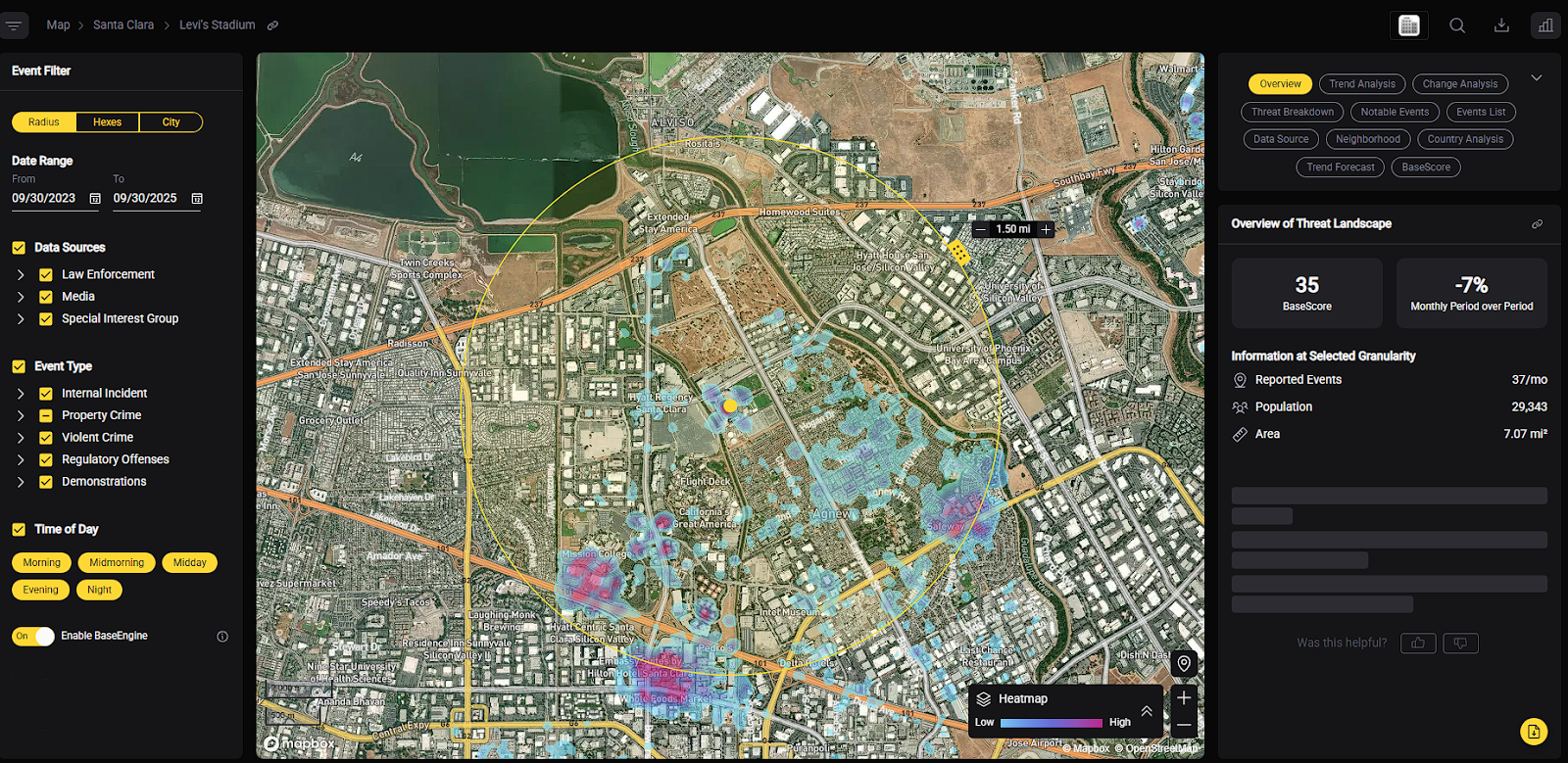
Base Operations indicates an overall BaseScore of 35, placing the stadium perimeter in the LOW Risk Tier (20-40) based on historical data. The Santa Clara Great America Station registers a BaseScore of 36 (LOW Risk Tier). The station will be closed for Super Bowl LX, forcing pedestrian detours through surface streets.
Top Threats:
- Cyber Espionage/Fraud (Critical Confidence): The Ticketmaster/Snowflake data breach has exposed 560+ million customer records. Attackers are actively weaponizing Super Bowl ticket holder data for spear-phishing and extortion schemes.
- Vehicle-Related Crime (High Confidence): Represents 42% of all incidents, specifically targeting unattended vehicles in parking lots and commercial zones.
- Civil Disturbance/Protest (High Confidence): DHS Secretary Noem's public statements regarding ICE presence at the event, combined with Bad Bunny's halftime performance, has mobilized both activist groups (Rapid Response Network, MoveOn) and counter-protesters (Turning Point USA).
- Vehicle Ramming Attack (Medium Confidence, Catastrophic Impact): Post-New Orleans threat posture elevates this concern despite expanded road closures.
- Transit Hub Vulnerability (High Confidence): The primary rail terminus shows a 31% risk elevation compared to the stadium perimeter.
Strategic Takeaways: Security Directors must adopt a posture of "Digital Paranoia and Physical Agility." Trust no digital communication without out-of-band verification. The primary risks to personnel are digital compromise via the Ticketmaster breach and operational disruption via protest activity or transport gridlock. The discrepancy between the generally manageable violent crime rate and the aggressive property crime rate necessitates a security posture focused on asset protection, secure transport, and situational awareness.
2. EVENT SNAPSHOT
Event Scope & Significance Super Bowl LX will take place on February 8, 2026 at Levi's Stadium. As the premier annual American sporting event, the Super Bowl consistently draws 100,000+ visitors to the host city and commands a global television audience exceeding 100 million viewers. The New England Patriots face the Seattle Seahawks in a rematch of Super Bowl XLIX (2015), which ended with a bench-clearing brawl following Malcolm Butler's last-minute interception.
The venue previously hosted Super Bowl 50 in 2016, establishing a precedent for multi-agency federal coordination (FBI, DHS, NORAD). Road closures for Super Bowl LX began January 26, 2026, with Stars and Stripes Drive closed through February 22. Tasman Drive closes January 28 through February 10.
Political Context: This event has become a flashpoint in America's "culture war." The selection of Puerto Rican artist Bad Bunny as the halftime performer—who has previously suspended touring in the continental United States citing fears of ICE raids at his concerts—has drawn adversarial response from the federal executive branch. DHS Secretary Kristi Noem's public declaration that ICE agents will be "all over" the venue has triggered mobilization of activist groups ranging from the "Rapid Response Network" in Santa Clara to national organizations like MoveOn.
Kickoff Time: 3:30 PM PST, allowing for hours of pre-game tailgating and elevated intoxication levels by the 3rd quarter.
VIP Profile
- High Confidence: Senior government officials, Fortune 500 CEOs, NFL ownership groups, celebrity entertainment figures.
- Medium Confidence: Silicon Valley technology executives and international business leaders leveraging the event for relationship development.
- Elevated Risk: VIPs whose information was compromised in the Ticketmaster/Snowflake breach are primary targets for sophisticated spear-phishing campaigns.
3. AREA & INFRASTRUCTURE OVERVIEW
Geographic Context Levi's Stadium is located in Santa Clara, approximately 40 miles south of San Francisco. The venue is situated within the flight path of San Jose International Airport (SJC), a constraint that prevented the construction of a roof, directly contributing to environmental exposure vulnerabilities. The immediate 1.5-mile radius includes the Great America theme park, the Santa Clara Convention Center, and high-density technology campuses.
Transportation Infrastructure
- Primary Roadways: US Highway 101 serves as the principal north-south corridor. It experiences severe congestion during events. Tasman Drive and Great America Parkway are the primary surface streets for access.
- Transit Hub: The Santa Clara Great America Station (VTA Light Rail) is the primary public transit node.
- Coordinates: 37.3928°N, 121.9745°W.
- Risk Profile: This station is a singular point of failure for mass transit. Limited ingress/egress capacity creates crowd crush vulnerabilities and chokepoints susceptible to protest blockades.
Super Bowl LX Status: The station is CLOSED for the event. Pedestrians and rail passengers are being detoured to alternative stops (Lick Mill) and forced to walk via Agnew Road and Lafayette Street.
Road Closures for Super Bowl LX
- Stars and Stripes Drive: Closed from January 26 through February 22. Creates secure logistical zone for law enforcement staging.
- Tasman Drive: Closed to through traffic from January 28 to February 10. Primary artery north of stadium.
- Great America Parkway: Closed on Game Day (February 8).
- San Tomas Aquino Creek Trail: Closed to pedestrians and cyclists to prevent unauthorized approach from the creek bed.
These closures are enforced by concrete K-rails and heavy vehicle barriers. While they secure the immediate stadium footprint, they force all vehicular drop-offs to occur at a significant distance, requiring VIPs to walk through "soft" zones to reach the checkpoints.
Critical Infrastructure Vulnerabilities
- US-101/Tasman Drive Interchange: A single primary merge point vulnerable to traffic blockades and protest activity.
- Stadium Parking: Large surface lots serve as the primary target zone for vehicle crimes.
Screening Technology: The stadium utilizes the Qylatron Entry Experience Solution—automated pods using radar and chemical sensors to scan bags and people without physical pat-downs. The system can screen 600 guests per hour per unit but creates a single point of failure if software is compromised.
4. HISTORICAL INCIDENT REVIEW
Past security incidents at Levi's Stadium and in the wider region provide critical intelligence for Super Bowl LX planning.
Security Failures & Challenges
- Super Bowl XLIX Brawl (2015): The New England Patriots vs. Seattle Seahawks matchup ended in a bench-clearing fight after Malcolm Butler's interception. Seahawks linebacker Bruce Irvin was ejected for throwing a punch at Rob Gronkowski. This history has been mythologized by both fan bases, creating lingering resentment and elevated potential for fan-on-fan violence.
- 2025 New Orleans Vehicle Attack (High Confidence): On January 1, 2025, Shamsud-Din Jabbar drove a rented Ford F-150 into a crowd on Bourbon Street, killing 14 people. An ISIS flag was found in the vehicle. This attack has fundamentally restructured perimeter security for all 2026 mass gatherings and is the primary tactical reference point for Super Bowl LX threat modeling.
- 2023 Gold Cup Stabbing (High Confidence): A spectator was critically stabbed during a Mexico vs. Qatar match at Levi's Stadium. The assailant bypassed metal detectors with a concealed knife. This incident highlighted significant gaps in screening efficacy during high-volume ingress and the volatility of rival fan bases.
- 2022 Activist Pitch Intrusion (High Confidence): Direct Action Everywhere activists breached perimeter security and deployed smoke flares on the field. This demonstrates the vulnerability of the venue to determined political actors seeking global media exposure.
2016 Parking Lot Assault (High Confidence): A fatal assault occurred in a stadium parking lot. The California Court of Appeal ruled the attack "unforeseen," legally establishing that venue security cannot guarantee safety in parking areas—reinforcing the need for private executive protection in these zones.
5. CURRENT THREAT LANDSCAPE
5.1 Crime Trends & Opportunistic Threats
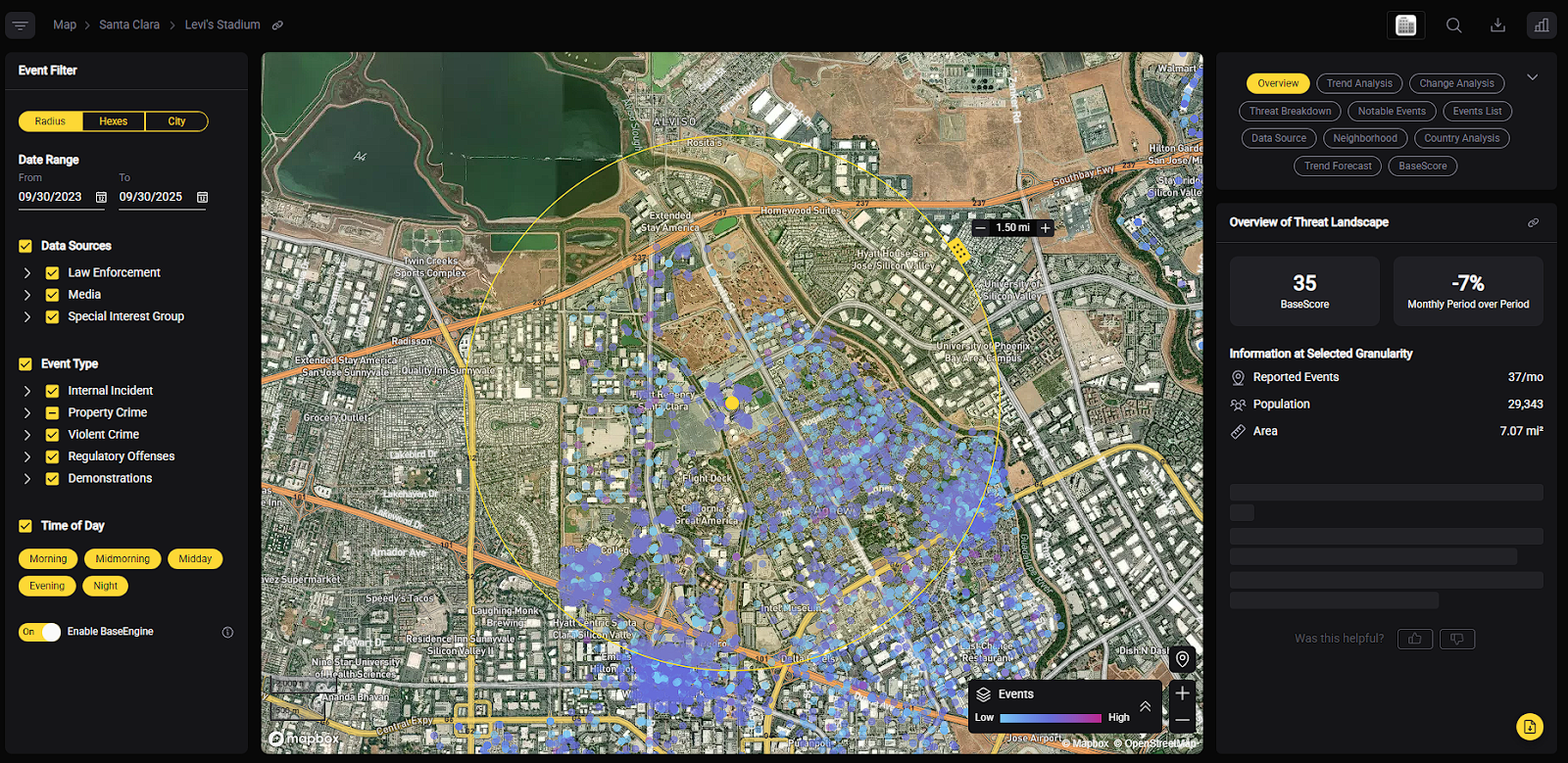
Base Operations provides validated, standardized, and actionable threat intelligence updated monthly. Data covering the period from October 2023 to September 2025 identifies a distinct pattern of property-focused crime.
Quantitative Analysis
- Total Incidents: 1,752 documented within the 1.5-mile radius.
- Property Crime Dominance: 1,477 incidents (85% of total).
- Violent Crime Levels: 143 incidents (8% of total). No homicides or robberies were recorded in the assessment period.
Temporal Patterns
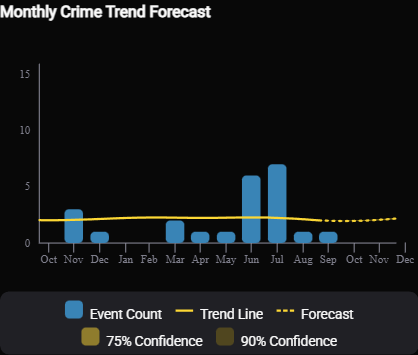
- Seasonal Peak: March consistently represents the highest risk month (Average 83 incidents).
- Tournament Window: June and July average 71 incidents monthly. While this is a 15% reduction from the March peak, it remains a medium-risk period compared to the annual minimum in September (65 incidents).
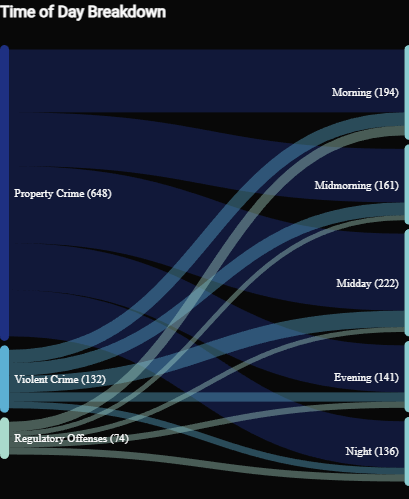
- Time of Day: The afternoon window (2:00 PM – 6:00 PM) presents the highest threat exposure, accounting for 174 property crimes and 37 violent crimes over the reporting period. This directly correlates with the likely timing of afternoon matches.
Vehicle Crime: The Primary Threat Vector Vehicle-related offenses constitute 42% of all recorded incidents (743 total).
- Theft from Vehicle: 710 incidents.
- Methodology: Organized groups target parking areas, utilizing surveillance to identify high-value targets (rentals, luxury cars) and executing "smash-and-grab" thefts in under 90 seconds.
- Hotspots: General parking lots, hotel parking facilities, and surface streets near the Great America theme park.
5.2 Terrorism & Extremism
The terrorism threat landscape for Super Bowl LX is dominated by the resurgence of vehicle-as-a-weapon tactics and the persistent threat of lone-actor extremism.
Post-New Orleans Threat Paradigm
The January 1, 2025, attack in New Orleans serves as the primary tactical reference point for current threat modeling.
- Tactical Analysis: The attacker used a readily available rental vehicle, requiring no specialized training or acquisition of controlled materials. An ISIS flag was found in the vehicle, confirming the continued influence of foreign terrorist organization propaganda on domestic actors. Jabbar was heavily armed with a .308 AR-10 rifle and pipe bombs (which were not used), indicating a "complex coordinated attack" (CCA) intent.
- Implications for Super Bowl LX: The expanded road closures (Stars and Stripes Drive, Tasman Drive, Great America Parkway) are direct mitigation strategies to prevent vehicle-borne attacks. However, this creates a displacement effect: attackers may target the perimeter of road closures, where fans are disembarking from rideshares or walking from distant parking lots. These "outer ring" locations are the new soft targets.
Unmanned Aerial Systems (UAS) / Drone Threats
- The FAA has established a "No Drone Zone" and Temporary Flight Restriction (TFR) over Santa Clara.
- Commercial drones can be modified to drop small IEDs or chemical irritants.
- A drone swarm could halt the game, causing panic and mass evacuation into unsecured parking lots.
- DHS Science & Technology Directorate has deployed specific jamming and detection technologies.
Domestic Violent Extremism (DVE)
The threat from DVEs is elevated due to the "Sanctuary State" vs. "Federal Enforcement" dynamic.
- Target Selection: DVEs are less likely to target the hardened stadium bowl and more likely to target infrastructure (power substations, fiber optic lines) or "soft" targets such as team hotels or media centers.
- Accelerationist Groups: Both white supremacist and anarchist accelerationist groups may view the Super Bowl as an opportunity to spark broader conflict.
5.3 Activist & Protest Activity
Super Bowl LX is a high-probability target for disruptive activism due to the convergence of political flashpoints.
The "Bad Bunny" / ICE Flashpoint
The selection of Puerto Rican artist Bad Bunny as the halftime performer has served as a catalyst for conflict between the federal administration and activist groups.
- The Catalyst: Bad Bunny has previously suspended touring in the continental United States, citing fears that his concerts would be used as "hubs" for ICE raids targeting his Hispanic fanbase. This statement politicized his selection by the NFL, transforming the halftime show into a symbolic proxy war over immigration policy.
- Federal Response: DHS Secretary Kristi Noem stated ICE would be "all over" the venue. Advisor Corey Lewandowski publicly stated: "We will find you. We will apprehend you. We will put you in a detention facility, and we will deport you." This rhetoric significantly elevates the risk of confrontation at the venue.
Activist Mobilization
- MoveOn: Has commenced aerial protests, flying banners with "NFL: No ICE at the 2026 Super Bowl!" over Levi's Stadium during preceding 49ers games.
- Santa Clara County Rapid Response Network (RRN): Distributing "whistle kits" and conducting "Know Your Rights" training. Deploying "legal observers" to film law enforcement interactions. Has established a 24/7 "Migra Watch" hotline to report ICE activity, creating a decentralized intelligence network that allows protesters to "swarm" arrest locations.
Counter-Protest Movement: Turning Point USA
- TPUSA has announced plans to host a rival "All American Halftime Show" in response to Bad Bunny's selection.
- The presence of TPUSA affiliates (likely wearing distinctive political apparel) in the same vicinity as "No ICE" protesters creates high probability of verbal and physical confrontation in "soft zones"—parking lots, transit hubs, and hotel lobbies.
"Stop Cop City" Connection
While primarily Atlanta-based, the "Stop Cop City" movement has demonstrated capacity for national coordination. The intense militarization of Super Bowl security makes it a symbolic target for anti-police anarchists aligned with this ideology.
Impact: The primary risk to executives is logistic disruption. A coordinated blockade at the Lick Mill detour route or main interchanges could delay VIP motorcades and force static exposure in unsecured zones.
5.4 Cyber & Information Risks
The digital threat to Super Bowl LX is CRITICAL. Unlike physical threats which are probabilistic, the digital threat is deterministic: a massive amount of attendee data is already in the hands of malicious actors.
The Ticketmaster / Snowflake Data Breach
- Scope: Over 560 million customer records exfiltrated by threat group "ShinyHunters" and affiliates.
- Data Fields: Full names, physical addresses, email addresses, phone numbers, and encrypted credit card details.
- Weaponization: The specific subset of "Super Bowl Ticket Holders" is a premium commodity on dark web forums.
Spear-Phishing Kill Chain
Security Directors must anticipate highly sophisticated phishing campaigns. Because attackers have actual ticket purchase data, they can craft emails indistinguishable from legitimate NFL or Ticketmaster communications:
- The Lure: "Security Alert: Your Super Bowl LX Suite access credentials have been flagged. Please re-verify your identity to prevent ticket cancellation."
- The Hook: User clicks link to spoofed login page.
- The Payload: Credential harvesting or malware download.
- The Impact: Access to corporate email, banking apps, and real-time location data.
AI-Driven Disinformation and Deepfakes
- High risk of AI-generated audio or video circulating on game day (e.g., deepfake of Santa Clara Police Chief ordering evacuation).
- Betting market manipulation via deepfakes of player injuries.
Infrastructure and Supply Chain Risks
- Third-party vendors (concessions, cleaning, logistics) often lack equivalent cybersecurity hardening.
- Ransomware groups may target critical infrastructure (ticketing scanners, lighting control) seeking high-profile payout.
6. THREAT ACTOR PROFILES
1. Organized Retail Crime (ORC) Networks
- Risk Level: HIGH for property; MEDIUM for confrontation.
- Modus Operandi: Sophisticated, multi-person teams employing countersurveillance and fencing networks. They specifically target high-density events to plunder vehicles and unattended assets.
- Capabilities: These groups are often armed and may resort to violence if cornered. They exploit the "smash-and-grab" tactic, clearing effective voids from vehicles in seconds. Criminal crews from Oakland penetrate stadium parking lots using signal jammers to disable alarms.
- Indicators: Loitering in parking zones, vehicles with obscured plates, and spotters watching for VIP arrivals.
2. Opportunistic Criminal Networks
- Risk Level: MEDIUM for theft; LOW for physical harm.
- Modus Operandi: Pickpocketing and distraction theft targeting distracted crowds at transit hubs and gate queues.
- Capabilities: Teams of 2-5 individuals using "stalls" or staged arguments to distract targets while accomplices remove wallets or phones.
- Targeting: High congestion areas like the Great America Station detour routes and stadium entry bottlenecks.
3. Cyber Threat Actors ("ShinyHunters" / Affiliated Groups)
- Risk Level: CRITICAL for digital security; HIGH for financial/reputational harm.
- Modus Operandi: Weaponizing Ticketmaster/Snowflake breach data to conduct targeted spear-phishing campaigns against known Super Bowl ticket holders.
- Capabilities: Access to PII of 560+ million users, including names, addresses, partial credit card numbers, and purchase histories.
- Targeting: High-net-worth individuals, VIP suite holders, corporate executives.
4. Political Activist Groups
- Risk Level: MEDIUM for disruption; LOW for physical harm to VIPs.
- Actors:
- MoveOn / Rapid Response Network: "No ICE" protest coalition. Aerial banners, "whistle kits," legal observers.
- Turning Point USA: Conservative counter-protest. "All American Halftime Show" rival event.
- Modus Operandi: Protest blockades at ingress points, filming of law enforcement, potential for confrontation between opposing groups.
- Impact: Logistical disruption to VIP movements; risk of incidental involvement in civil disturbance.
5. Domestic Violent Extremists
- Risk Level: MEDIUM for infrastructure attack; LOW for direct VIP targeting.
- Modus Operandi: May target infrastructure (power, communications) rather than hardened stadium. May seek to exploit political tensions to spark broader conflict.
Regional Precedent: 2017 Pier 39 ISIS-inspired plot (disrupted); 2019 Gilroy Garlic Festival shooting (far-right ideology).
7. KEY TAKEAWAYS
7.1 For Corporate Security Directors
- Harden Executive Transport: Given that 42% of incidents are vehicle-related, utilize armored transport or vehicles with enhanced security glass. Ensure vehicles are never left unattended in general parking. The road closures force drop-offs at significant distance from the venue.
- Protest Avoidance: Intelligence indicates distinct gathering points for RRN activists (monitoring ICE) and TPUSA counter-protesters. Executive protection teams must advance ingress routes to ensure principals do not inadvertently cross picket lines or enforcement zones.
- Time Movements Strategically: The 2:00 PM – 6:00 PM window carries the highest crime risk. For the 3:30 PM kickoff, prioritize expedited ingress and utilize VIP club access post-match to delay egress until the risk curve flattens.
7.2 For Security Analysts
- Monitor Protest Activity: Track RRN hotline activity ("Migra Watch") and social media for rumored ICE detentions that could trigger protest swarms at detour routes.
- Focus on "Zone 1" (Parking): This is the primary kinetic threat zone. Security details should maintain a visible presence during the entire duration of the match.
- Watch the "Last Mile": The road closures have extended the transition distance from vehicle to venue gate. This extended exposure increases vulnerability to pickpocketing, distraction theft, and protest encounters.
- Intelligence Discrepancies: Be aware of the divergence between the area's general Low/Medium risk score and the High risk specific to the transit hub and protest zones.
- Phishing Surge Expected: Brief principals on the specific threat of Super Bowl-themed phishing emails leveraging Ticketmaster breach data.
8. APPENDICES
Acronyms & Abbreviations
- APT: Advanced Persistent Threat
- CCA: Complex Coordinated Attack
- DHS: Department of Homeland Security
- DVE: Domestic Violent Extremist
- EMS: Emergency Medical Services
- FAA: Federal Aviation Administration
- FBI: Federal Bureau of Investigation
- ICE: Immigration and Customs Enforcement
- IED: Improvised Explosive Device
- NSSE: National Special Security Event
- ORC: Organized Retail Crime
- PII: Personally Identifying Information
- RRN: Rapid Response Network
- SEAR: Special Event Assessment Rating
- TFR: Temporary Flight Restriction
- TPUSA: Turning Point USA
- UAS: Unmanned Aerial System
- VBIED: Vehicle-Borne Improvised Explosive Device
- VTA: Santa Clara Valley Transportation Authority
Key Contacts
- FBI Joint Operations Center: Super Bowl LX Operations
- DHS: San Francisco Field Office
- Santa Clara Police Department: Watch Commander / Special Events Coordinator
- California Highway Patrol: Golden Gate Division
- Medical: Santa Clara County EMS Agency; Kaiser Permanente Santa Clara ED
- Venue: Levi's Stadium Security Operations Center (SOC)
Methodology
This report aggregates data from Base Operations, open-source intelligence (OSINT), and historical incident reviews. Risk scores are calculated based on the frequency and severity of incidents within defined geospatial boundaries (1.5-mile radius for the stadium; 0.5-mile for the transit hub).
Data Limitations
Crime reporting data may be subject to underreporting, particularly for property crimes. Political context assessments are based on open-source intelligence and may evolve rapidly as the event approaches.
9. REFERENCES
Base Operations Validated Threat Data
- Base Operations. "Levi's Stadium radius – BaseScore Analysis." Validated threat intelligence covering October 1, 2023 through September 30, 2025.
- Base Operations. "Levi's Stadium radius – Event Count by Threat Category." Total incident counts by category for October 1, 2023 through September 30, 2025.
- Base Operations. "Levi's Stadium radius – Monthly Event Trend – Event Count & Average." Time-series analysis of monthly incident patterns.
- Base Operations. "Levi's Stadium radius – Time of Day Breakdown – Primary categories."
- Base Operations. "Levi's Stadium radius – Average Events by Month of Year – Month of Year."
- Base Operations. "Levi's Stadium radius – Percent Change Analysis."
- Base Operations. "Levi's Stadium radius – Monthly Crime Trend Forecast."
- Base Operations. "Santa Clara Great America Station radius – BaseScore Analysis."
- Base Operations. "Santa Clara Great America Station radius – Monthly Event Trend."
- Base Operations. "Santa Clara Great America Station radius – Average Events by Month of Year."
Super Bowl LX Specific Intelligence
- Department of Homeland Security. "Special Event Assessment Rating (SEAR) Events Fact Sheet." 2026.
- Wikipedia. "2025 New Orleans truck attack." January 2025.
- SFGATE. "Plane with URL banner spotted over Levi's Stadium before 49ers-Rams." January 2026.
- Out Magazine. "Trump adviser says that ICE agents will be at Bad Bunny's Super Bowl." January 2026.
- SOCRadar. "Overview of the Snowflake Breach: Threat Actor Offers Data of Cloud Company's Customers." 2025.
- Fox News. "Ticketmaster data breach exposes 560 million customers' data, IT group says." 2024.
- City of Santa Clara. "Super Bowl LX Phase II and III Road Closures and Transportation Impacts." January 2026.
- SFGATE. "Santa Clara: Road Near Levi's Stadium Closing A Month Ahead Of Super Bowl." January 2026.
- Evrim Agaci. "Turning Point USA Plans Rival Super Bowl Halftime Show." January 2026.
- Hungarian Conservative. "Super Bowl LX Halftime Show Sparks New Clash in America's Culture Wars." January 2026.
- Peninsula Press. "Santa Clara County Rapid Response Network Formulating Super Bowl Plan for Immigrants Targeted by ICE During the Event." December 2025.
- NFL.com. "Patriots, Seahawks involved in late-game skirmish." February 2015.
- DroneXL. "Super Bowl LX: FAA Grounds Drones Hard." January 2026.
- Mimecast. "Cybersecurity Predictions 2026: Olympic-level threats & AI arms races." 2026.
Historical and Regional Context
- ABC7 News KGO San Francisco. "Santa Clara police ask for public's help identifying suspects from Levi's Stadium September brawl." October 2023.
- ABC7 News KGO San Francisco. "Man describes being stabbed during massive fight at Levi's Stadium soccer game." July 2023.
- CBS News / Associated Press. "Animal rights protester tackled during 49ers game files police report for assault." October 2022.
- AP News. "61 indicted in Georgia on racketeering charges connected to 'Stop Cop City' movement." 2023.
- SFGATE. "These Bay Area cities recorded a noticeable dip in crime in 2025." January 2026.
- Santa Clara Police Department. Nixle and eNotify alert systems.
- California Highway Patrol. Organized Retail Crime Task Force operational reporting.
- FAA. "Super Bowl LX: What General Aviation Pilots Need to Know." January 2026.
- DHS Science and Technology. "2025 S&T Year in Review." 2025.
- Ticketmaster. "Ticketmaster Data Security Incident." 2024.
- Cloud Security Alliance. "Unpacking the 2024 Snowflake Data Breach." 2025.
Takeaways
For Corporate Security Directors
- Harden Executive Transport: Given that 42% of incidents are vehicle-related, utilize armored transport or vehicles with enhanced security glass. Ensure vehicles are never left unattended in general parking. The road closures force drop-offs at significant distance from the venue.
- Protest Avoidance: Intelligence indicates distinct gathering points for RRN activists (monitoring ICE) and TPUSA counter-protesters. Executive protection teams must advance ingress routes to ensure principals do not inadvertently cross picket lines or enforcement zones.
- Time Movements Strategically: The 2:00 PM – 6:00 PM window carries the highest crime risk. For the 3:30 PM kickoff, prioritize expedited ingress and utilize VIP club access post-match to delay egress until the risk curve flattens.
For Security Analysts
- Monitor Protest Activity: Track RRN hotline activity ("Migra Watch") and social media for rumored ICE detentions that could trigger protest swarms at detour routes.
- Focus on "Zone 1" (Parking): This is the primary kinetic threat zone. Security details should maintain a visible presence during the entire duration of the match.
- Watch the "Last Mile": The road closures have extended the transition distance from vehicle to venue gate. This extended exposure increases vulnerability to pickpocketing, distraction theft, and protest encounters.
- Intelligence Discrepancies: Be aware of the divergence between the area's general Low/Medium risk score and the High risk specific to the transit hub and protest zones.
- Phishing Surge Expected: Brief principals on the specific threat of Super Bowl-themed phishing emails leveraging Ticketmaster breach data.