
Security Risk Assessment Methodology: The Complete Framework Guide
Learn security risk assessment methodology with our complete guide covering 7 steps, 5 methods compared, risk scoring matrices, and framework selection for NIST, ISO, and FAIR.

What Is a Security Risk Assessment Methodology?
A security risk assessment methodology is a documented, repeatable framework for identifying assets, threats, and vulnerabilities, then calculating and prioritizing risk to produce a defensible treatment plan.
It differs from a security audit (which checks compliance against a fixed standard), a compliance checklist (which verifies whether controls exist), and a vulnerability scan (which detects technical weaknesses in isolation). A methodology ties all three together using a consistent formula: Risk = Threat x Vulnerability x Consequence. Threat is the source or event capable of causing harm. Vulnerability is the weakness a threat can exploit. Consequence is the impact if the threat materializes. The output of a properly executed methodology is not a pass/fail score. It's a prioritized risk register and a risk treatment plan that tells security leaders exactly where to act first.
Without a documented methodology, assessments become inconsistent by design. One example: a financial institution's assessments each required a full week and multiple analysts, with manual data collection that varied by region and analysis too coarse to distinguish risk between neighborhoods in the same city. The security team at a Fortune 100 pharmaceutical company describes the same failure mode a different way: a single risk score applied across an entire country "isn't getting the full picture."
Why Methodology Matters More Than Tools
Tools alone can't substitute for a documented process. A vulnerability scanner finds technical weaknesses. It doesn't evaluate whether a loading dock lacks access control, whether a facility sits near a documented pattern of after-hours burglaries, or whether an employee is a predictable target on a fixed commute. Ad hoc assessments and pure scanning tools consistently miss these process-level, human, and physical vulnerabilities because nothing forces the assessor to look for them systematically.
The UK's National Cyber Security Centre frames sound risk management around a core principle: the process must be documented, reproducible, and defensible under scrutiny, not just accurate for a single point-in-time review. When methodology isn't documented, organizations default to what practitioners describe as a custom risk model trap. The security team at the Fortune 100 pharmaceutical company built its own proprietary blended score from multiple vendor feeds, then found itself unable to answer a basic question: what weight does each underlying vendor score carry? Without documented methodology, the model becomes unauditable the moment the person who built it moves on.
The same team described a second failure: regional offices reporting on different scales, so that a lead in one area and a vendor in Europe report on things differently and the scores simply don't talk to each other. Under time pressure, undocumented processes fail fastest. A security analyst at a Fortune 500 financial services firm described corporate America's pace bluntly: getting asked for a threat update while still pulling the underlying data together. A documented methodology turns that scramble into a repeatable five-minute lookup instead of an hours-long one.
The 5 Core Components of Any Security Risk Assessment Methodology
Every security risk assessment methodology, regardless of framework, rests on five core components:
- Asset Identification. Catalog what needs protection: people, facilities, physical infrastructure, sensitive data, and reputation. A Fortune 10 company managing return-to-office safety across 500+ office locations started here, mapping every site before analyzing a single threat.
- Threat Identification. Catalog the threat sources capable of causing harm: adversarial actors, environmental hazards, and insider threats. For the same Fortune 10 program, this meant analyzing commuter routes and transit safety and local crime patterns feeding into each location.
- Vulnerability Analysis. Identify the specific weaknesses each threat could exploit, from unsecured perimeters to predictable executive travel patterns. This is where generic, city-level risk scores fail: a program that assigns one score to an entire metro area can't show which of five office sites is actually exposed.
- Likelihood and Impact Estimation. Likelihood is the probability a threat event occurs within a defined period. Impact is the severity of the consequence if it does. Combined, they produce a risk score that can be ranked and compared across locations.
- Risk Treatment and Documentation. Decide how to respond: accept, mitigate, transfer, or avoid, then record the decision, its rationale, and the residual risk in a risk register.
A structured walkthrough of these components in practice looks like this: map the facility portfolio, establish baseline risk per site, identify the highest-risk facilities, layer in location-specific crime pattern analysis, then use the result to build evidence-based resource allocation recommendations. Each component produces a distinct output.
The 7-Step Security Risk Assessment Process
The five components describe what a methodology must cover. The seven-step process below is what a practitioner actually executes, in order, on a real assignment.
- Define Scope and Objectives. Set the boundaries: which assets, locations, and threat categories are in scope, and what decision the assessment supports. A Fortune 500 company's event security team defined scope explicitly as primary venues, backup sites, executive accommodations, transportation hubs, and entertainment venues before analyzing any of them.
- Build Asset Inventory. Catalog every asset in scope with enough detail to compare across them. The same team built a custom labeling system to organize event-related sites by type and risk level, a structure that made every later step faster.
- Identify Threats and Threat Actors. Research the threat landscape relevant to each asset: local crime databases, historical incident patterns, and known threat actor behavior. This step fails quietly when data sources overlap unnoticed. A security analyst at a Fortune 500 healthcare organization described pulling from a single municipal police data file with "no real way to know if these are conflated numbers," duplicate reports counted as separate incidents, inflating apparent threat levels.
- Assess Vulnerabilities and Predisposing Conditions. A predisposing condition is a circumstance that increases the likelihood or severity of a threat event even without a specific vulnerability present, for example, a facility in a high-turnover retail corridor with weak lighting after dark. The event security team logged incidents manually at this stage before automating the process.
- Determine Likelihood and Impact. Calculate threat scores for each asset using the vulnerability and predisposing-condition data gathered in steps 3 and 4.
- Calculate Risk Score and Prioritize. Rank assets so resources go to the highest-risk sites first. The event security program used this step to run venue comparisons in under 30 minutes instead of building spreadsheets by hand.
- Develop Risk Treatment Plan and Document Residual Risk. Decide on treatment for each prioritized risk and document what risk remains afterward. Residual risk is the risk that persists after controls are applied. This step produced security briefings and proactive identification of emerging risks for the event program.
Before adopting a documented process, that team spent two to three days per location on assessment. After, the same work took six to eight hours. The team's own read on the failure mode this process eliminates: spending more time building spreadsheets and comparing threats than actually securing events. Without documented steps, ad hoc processes cost even more. A security analyst at the Fortune 500 financial services firm summarized the alternative directly: getting to a point where routine requests stop being "a wild goose chase" is the difference between hours of searching and five minutes of lookup.
The 5 Primary Security Risk Assessment Methodologies Compared
Five approaches account for most of what practitioners mean by "risk assessment methodology." Each defines and prioritizes risk differently.
Qualitative methodology rates risk using descriptive scales such as High, Medium, and Low, based on expert judgment. It's fast to implement and requires no historical loss data, but its output is subjective and hard to compare across assessors.
Quantitative methodology assigns dollar values to risk using formulas like Annualized Loss Expectancy. It produces defensible financial output but requires years of clean historical data most organizations don't have. A security leader at a global job search platform put it directly: a model built on one or two years of data isn't mature enough to trust yet. Most practitioners want three to five years minimum before leaning on quantitative output for high-stakes decisions.
Semi-Quantitative methodology bridges the two, using numeric scales (1-5 or 1-10) that translate into risk categories. It's the most common real-world approach among mature security programs. The security team at the Fortune 100 pharmaceutical company runs a proprietary blended model this way, plugging in weighted scores from multiple vendors, though the team acknowledges the complexity cost of maintaining vendor-by-vendor weighting as data sources change.
Asset-Based methodology starts from what needs protecting and works outward to threats and vulnerabilities. It suits organizations with clearly bounded, high-value assets.
Threat-Based methodology starts from known adversary behavior and works backward to determine which assets and vulnerabilities matter most. It suits organizations facing a defined, well-characterized threat actor population.
A note on terminology: some practitioner training references the "5 C's of risk assessment" (Context, Consequences, Controls, Criteria, Communication). This is an informal mnemonic, not a formal standard published by NIST, ISO, or any recognized standards body, and shouldn't be treated as a substitute for a documented framework.
The Major Security Risk Assessment Frameworks and Standards
NIST SP 800-30 (Guide for Conducting Risk Assessments) is the risk assessment component of the broader NIST Risk Management Framework (RMF). It's the default choice for U.S. federal agencies and contractors, and its likelihood/impact scoring structure, detailed in Appendix I, underlies much of the semi-quantitative approach used across the private sector.
ISO/IEC 27005 provides risk management guidance aligned to the ISO/IEC 27001 information security management system standard. Organizations already certified to, or pursuing, ISO 27001 typically adopt 27005 for consistency across their compliance program.
FAIR (Factor Analysis of Information Risk), maintained by the FAIR Institute, is a quantitative model built around loss-exceedance curves, expressing risk in financial terms rather than descriptive ratings. Large financial institutions favor FAIR because it maps directly to underwriting and capital-allocation decisions. That mapping takes time to mature: the security leader at the global job search platform noted their organization still wants a couple more years of feeding the model before it fully supports underwriting decisions.
OCTAVE Allegro, developed by Carnegie Mellon's CERT/CC, is a self-directed methodology emphasizing operational resilience. Unlike FAIR, it doesn't require heavy consultant dependency, making it accessible to security teams without dedicated quantitative risk analysts.
None of these frameworks require exclusive use. Many programs blend NIST SP 800-30 for structure with FAIR for high-stakes financial reporting, using each framework where it's strongest rather than forcing one model to cover every use case.
Which Framework Should You Use?
- Federal agency or contractor: NIST SP 800-30 / RMF, typically mandatory for compliance.
- ISO 27001-certified or pursuing certification: ISO/IEC 27005 for consistency.
- Financial institution or board-level financial risk reporting: FAIR, once historical data supports it.
- Security team without dedicated quantitative analysts: OCTAVE Allegro.
- Critical infrastructure operator: CISA THIRA (Threat and Hazard Identification and Risk Assessment).
Qualitative vs. Quantitative vs. Semi-Quantitative Risk Assessment
The comparison above shows what each approach is for. Here's how the three numeric approaches actually work, mechanically, applied to the same scenario: unauthorized access to a corporate facility.
Qualitative: An assessor rates the risk High, Medium, or Low based on judgment and available context. For unauthorized facility access with no badge-reader logging and a history of tailgating incidents, a qualitative assessment might land at High. The rating is fast to produce but depends entirely on the assessor's calibration, and vague labels create real organizational friction. A security leader at the Fortune 500 financial services firm described the fallout from using "worst" and "best" language in a report: stakeholders reading "worst risk level" assumed something closer to imminent catastrophe than the data supported. The team now uses "scored higher risk" instead, deliberately avoiding superlatives that overstate the finding.
Quantitative: An assessor calculates Annualized Loss Expectancy: ALE = Annual Rate of Occurrence (ARO) x Single Loss Expectancy (SLE). If unauthorized access incidents occur twice per year (ARO = 2) with an average loss of $50,000 per incident (SLE), ALE = $100,000. This produces a defensible, board-ready dollar figure, but the number is only as reliable as the historical data behind it. Quantitative output often implies more precision than the underlying data supports, especially with fewer than three years of clean loss history. Treat a single quantitative figure as an estimate range, not a fact.
Semi-Quantitative: An assessor scores Likelihood at 4 (occurs more than once a year) and Impact at 3 (moderate operational disruption) on 1-5 scales, producing a Risk Score of 12, landing in the "Monitor" treatment zone. This approach captures more nuance than a qualitative label without requiring the loss-history depth quantitative analysis demands.
Whichever approach a program uses, the number only creates value once stakeholders understand what it means. A security analyst at the Fortune 500 healthcare organization named this directly: one of the biggest adoption hurdles isn't the data itself, it's getting stakeholders comfortable with what the numbers actually correlate to.
Physical Security Risk Assessment Methodology
Physical security risk assessment methodology diverges from information security risk assessment in three ways: scope, threat actor types, and data collection methods. Where an information security assessment analyzes digital attack surfaces, a physical security assessment analyzes tangible ones, adversarial actors, environmental hazards, and insider threats, and requires on-site data collection rather than network scanning.
ASIS International, the leading professional body for physical security practitioners, publishes security risk assessment guidance that most corporate programs use as a baseline standard, covering site audit methodology, personnel security, and physical protection system design. A physical security site audit typically covers four components:
- Perimeter assessment: fencing, lighting, natural surveillance, and vehicle access points.
- Access control review: badge systems, visitor management, and tailgating exposure.
- Surveillance coverage analysis: camera placement, blind spots, and monitoring staffing.
- Threat and crime data integration: local crime patterns, historical incident trends, and geopolitical context layered onto the physical site.
That fourth component is where most manual assessments fall short, and where street-level threat data changes outcomes. When a Fortune 500 company's executive protection team ran a location analysis on a new executive residence, a 0.5-mile radius crime pattern review surfaced a cluster of residential burglaries the original site design had missed entirely. The result: glass-break sensors added to upper floors and enhanced perimeter gate access control, changes made before, not after, an incident. What previously took roughly five hours of manual research took thirty minutes.
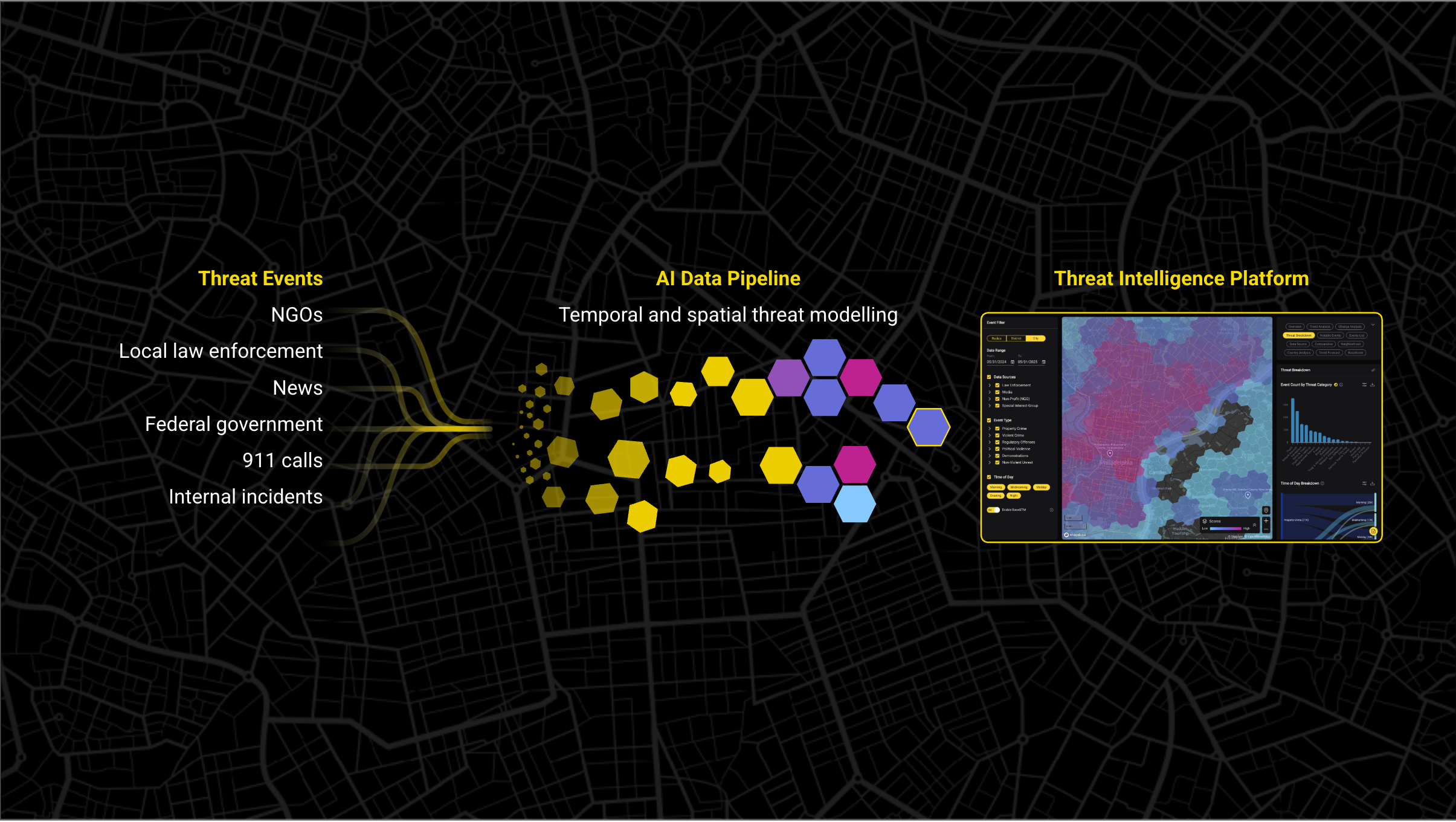
At portfolio scale, the same principle holds. A global financial institution managing $5 trillion in assets across 247 offices used Base Operations to run radius-based, hyperlocal threat assessments across five candidate locations, standardizing scores with BaseScore™ to compare risk levels and crime type breakdowns relevant to each property's specific use, cutting assessment time roughly five-fold. For event security specifically, the same data-driven approach produces detailed crime pattern analysis by location, time, and type, visual heatmaps identifying exact hotspots, and evidence-based recommendations rather than generic guidance.
Physical security also carries a data complexity problem information security doesn't face: multi-jurisdictional reporting. A security team at a Fortune 500 utility company described the problem directly: a single location might have incident reports filed with city police, state police, transit police, or federal agencies, and threat platforms that pull only from the primary local source miss critical incidents as a result. A comprehensive physical security methodology has to account for that fragmentation explicitly, not assume one source tells the whole story.
See it on your own footprint. Base Operations turns the site audit workflow above, perimeter, access control, and crime data integration, into a report security teams can run in minutes instead of days, with street-level BaseScore data and API access to feed it directly into existing risk models.
How to Conduct a Security Risk Assessment: Step-by-Step
Here's how the process above plays out on an actual assignment: a corporate campus with 500 employees across three buildings, evaluating whether current security controls match current risk.
Step 1: Scope the campus. The practitioner defines what's in scope, all three buildings, the shared parking structure, and the perimeter, and what decision the assessment supports (budget request, insurance renewal, post-incident review). Output: a one-page scope document circulated to stakeholders before fieldwork begins.
Step 2: Inventory the assets. Walk each building and log people, equipment, data centers, and high-value areas. A structured facility-portfolio approach, mapping every asset before scoring any of them, mirrors what larger security programs do at scale: map the entire portfolio first, then assess baseline risk per site.
Step 3: Pull the local threat picture. Layer local crime data, incident history, and any prior security reports onto each building's address. This is where campus-specific risk, one building near a high-traffic retail corridor, another isolated near a parking structure, becomes visible instead of assumed uniform across the campus.
Step 4: Audit physical controls. Walk the perimeter, badge system, camera coverage, and lighting for each building against the vulnerabilities the threat data suggests are relevant.
Step 5: Score and rank. Apply the 5x5 risk matrix (below) to each building, ranking them from highest to lowest risk score.
Step 6: Recommend treatment. For each risk above the organization's acceptance threshold, propose a specific control, budget estimate, and owner.
Step 7: Document and brief. Compile findings into a briefing deck for security leadership, including trend analysis so recommendations don't read as one-off findings.
Deployed well, this cycle can run in under 24 hours once the underlying data and labeling structure exist, versus the multi-day timelines common with manual, building-by-building research.
Security Risk Assessment Checklist
- Scope document defining assets, locations, and the decision the assessment supports
- Complete asset inventory with criticality ratings
- Local crime, incident, and geopolitical data pulled for each location
- Physical control audit: perimeter, access control, surveillance
- Likelihood and impact ratings applied using a defined scale
- Risk scores calculated and ranked in a risk register
- Treatment plan with owner and timeline for each priority risk
- Residual risk documented with re-evaluation date
- Findings briefed to leadership with supporting trend data
Risk Scoring: How to Build and Use a Risk Matrix
A 5x5 risk matrix plots Likelihood (1-5) against Impact (1-5) to produce a Risk Score from 1 to 25. NIST SP 800-30 Appendix I is the standard reference for anchoring these scales in concrete, defensible terms rather than leaving "High" or "Low" open to interpretation.
Likelihood scale (frequency-anchored): 1. Rare: less than once every 5 years 2. Unlikely: once every 2-5 years 3. Possible: once per year 4. Likely: more than once per year 5. Almost Certain: monthly or more frequent
Impact scale (severity-anchored): 1. Negligible: no injury, minimal financial loss 2. Minor: first-aid injury, limited operational disruption 3. Moderate: injury requiring treatment, moderate financial loss, local media attention 4. Major: serious injury, significant financial loss, regional media attention 5. Catastrophic: loss of life, severe financial loss, national media attention
Undefined scales cause real organizational problems. The earlier example of "worst" and "best" language, and the reaction it caused, illustrates why anchor definitions matter more than the label itself: a score of 4 (Likely) means something concrete and defensible. "Worst" does not.
Treatment zones: - Accept (1-6): Low enough to accept without additional controls; still document the decision. - Monitor (7-12): Track for change; no immediate action required. - Mitigate (13-19): Requires active controls to reduce likelihood or impact. - Escalate (20-25): Requires immediate leadership attention and resourcing.
Standardized scoring is what makes cross-location comparison possible in the first place. The global financial institution used exactly this kind of standardized scoring to compare risk levels across office locations in different neighborhoods, something raw crime counts or unstructured field notes can't do consistently.
Risk Treatment Strategies: Accept, Mitigate, Transfer, Avoid
Every identified risk gets one of four treatment decisions.
Accept: The organization accepts the risk as-is, typically because the cost of treatment exceeds the potential loss, or the risk falls within Accept-zone scoring. Example: a facility with a Risk Score of 4 for minor vandalism risk in a low-crime area might be accepted without additional controls.
Mitigate: The organization reduces likelihood or impact through added controls. When a threat data review of a new executive residence surfaced a residential burglary cluster within half a mile, the response was direct mitigation: glass-break sensors on previously unmonitored upper floors and enhanced perimeter gate access control.
Transfer: The organization shifts financial responsibility for the risk, typically through insurance, contractual risk-sharing, or a third-party vendor. A global third-party logistics provider running 400+ supply chain routes used route-level risk data to redirect exposure and, in the process, turned demonstrable route security into a competitive differentiator cited directly in customer RFPs, a transfer-adjacent example of risk information changing not just controls but business terms.
Avoid: The organization eliminates the risk entirely by not undertaking the activity: closing a facility, canceling an event, or declining to operate in a given location.
The most common audit failure in risk treatment isn't a wrong decision. It's an undocumented one. Organizations frequently "accept" risks without recording the rationale, an expiration date, or the compensating controls that justified acceptance. When an auditor asks why a risk was accepted eighteen months ago, "we decided it was fine" is not a defensible answer.
Residual risk is what remains after treatment. No control eliminates risk completely, so every mitigated risk needs a new score reflecting the post-treatment state, and that new score needs its own re-evaluation date.
Two terms often get conflated: risk tolerance is the degree of risk variation an organization is willing to accept for a specific objective. Risk appetite is the broader amount and type of risk an organization is willing to pursue in service of its overall strategy. Appetite sets the boundary; tolerance sets the day-to-day operating range within it.
Integrating Threat Intelligence Into Your Risk Assessment
Most published risk assessment guidance treats threat identification as a one-time research step: gather what's known about a threat landscape, plug it into the matrix, move on. That's a static, checklist-based assessment. An intelligence-driven assessment treats threat data as a continuously updated input that changes the likelihood side of the risk equation as conditions change, not just at the next scheduled review.
The distinction matters most in likelihood scoring. Real-world threat data, crime statistics, geopolitical developments, incident history, and geospatial pattern analysis, directly changes what "Likely" means for a given location. Frameworks like MITRE ATT&CK formalize this for adversary-centric assessments in cybersecurity; physical security assessments need an equivalent discipline built on crime and unrest data rather than attack technique catalogs.
The practical payoff is targeting. When precision replaces guesswork, security investment shifts from broad, costly coverage everywhere to targeted spending where the data shows it's needed. A Fortune 10 company's return-to-office program used detailed crime and unrest data on commuter routes and office proximity to make exactly that shift: precision measurement of risk levels enabling investment in specific routes and locations rather than blanket measures applied company-wide.
Dynamic assessment also changes operational tempo, not through real-time alerting (Base Operations does not push live alerts; BaseScore updates monthly, with unrest data refreshed bi-weekly), but through on-demand analytics that let teams reassess quickly when conditions warrant it. A Fortune 500 event security team used on-demand risk analytics to support same-day venue changes when needed, and to continuously identify emerging risks rather than waiting for the next scheduled review cycle. A global logistics provider applied the same principle to 400+ supply chain routes, adjusting routes as monthly threat data shifted rather than locking in a route plan for the year.
This is also why security leaders increasingly track global events as part of their operational routine, not out of general interest but because geopolitical developments directly change travel risk calculations and executive protection decisions in near-term, practical ways. For critical infrastructure operators specifically, CISA's THIRA process formalizes this same threat-and-hazard integration at the jurisdictional level.
Common Mistakes in Security Risk Assessment Methodology
Six mistakes account for most of the operational damage in poorly run security risk assessment programs:
- Treating assessment as a one-time event. A security team at a Fortune 500 pharmaceutical company focused on women's health described its own travel risk process before fixing this: reactive handoffs with no systematic workflow, rather than a proactive process. Consequence: emerging threats go undetected between review cycles. Correction: build a continuous process with scheduled reviews and defined triggers for off-cycle reassessment.
- Calling a vulnerability scan a risk assessment. A scan finds technical weaknesses; it says nothing about threat likelihood, business impact, or physical and human vulnerabilities. Consequence: leadership makes decisions believing a full risk picture exists when only a partial technical inventory does.
- Using uncalibrated risk scales with no anchor definitions. A security leader at the Fortune 500 financial services firm described the fallout directly: undefined severity language like "worst" causes stakeholders to assume a crisis is imminent when the underlying data doesn't support that read. Correction: anchor every scale level in concrete, defensible terms (see the 5x5 matrix above).
- Collecting partial data and treating it as complete. A single location can have incident reports filed across city police, state police, transit police, and federal agencies, and a threat platform pulling only from the primary local source can miss critical incidents outright. Correction: confirm data source coverage before trusting a threat profile as complete.
- Ignoring physical and human threat vectors in favor of IT-only scope. The security team at the Fortune 100 pharmaceutical company flagged the same failure at a geographic level: a single blanket risk score applied across an entire country obscures the block-by-block variation that actually determines risk. Correction: score at the granularity the decision requires, not the granularity that's easiest to produce.
- Accepting risks indefinitely with no re-evaluation date. This is the single most common finding in security program audits. Correction: every accepted risk needs a documented rationale, compensating controls if any, and an expiration date that forces re-assessment.
Security Risk Assessment Methodology for Regulated Industries
Methodology requirements shift by regulatory environment. Four sectors carry the most specific obligations.
Healthcare: HIPAA's Security Risk Analysis requirement mandates a documented, periodic risk assessment covering the confidentiality, integrity, and availability of protected health information. A Fortune 500 healthcare organization's move toward location-based threat assessment for its facilities reflects a broader pattern in the sector: physical security risk increasingly gets evaluated alongside data security risk rather than in isolation.
Financial Services: SOX internal control requirements and PCI DSS both carry risk assessment obligations, SOX at the financial reporting control level, PCI DSS specifically for cardholder data environments. Banking regulators additionally expect documented, board-reviewed risk assessment processes as part of safety-and-soundness examinations. The global financial institution managing $5 trillion in assets across 247 offices and 77,000 employees operates at a scale where regulatory-compliant, standardized site assessment methodology isn't optional. It's the only way to produce comparable results across that many locations.
Federal/Government: NIST RMF and FISMA make NIST SP 800-30-based risk assessment mandatory for federal information systems. Federal contractors handling government data typically inherit these requirements contractually.
Critical Infrastructure: CISA's Threat and Hazard Identification and Risk Assessment (THIRA) process is the standard for state, local, and critical infrastructure risk assessment, built specifically to align jurisdictions on a common methodology for prioritizing preparedness investment.
Minimum methodology requirements differ, but the underlying discipline doesn't: documented process, defined scales, and a defensible paper trail from threat identification to treatment decision.
Tools and Software That Support Risk Assessment Methodology
Tools support methodology; they don't replace it. Five categories cover most of what security and risk programs use:
GRC platforms (RSA Archer, ServiceNow IRM, LogicGate Risk Cloud) centralize risk registers, control tracking, and audit workflows across an enterprise risk program.
Quantitative risk tools (RiskLens) implement the FAIR methodology directly, automating loss-exceedance curve calculation for organizations running quantitative programs.
Vulnerability data inputs (Tenable.sc, Rapid7 InsightVM) feed technical vulnerability scan data into the broader risk methodology: one input among several, not a substitute for the full process.
Physical security platforms provide the street-level threat data, crime and unrest patterns, geospatial analysis, that physical security methodology depends on. Base Operations sits in this category: BaseScore standardizes risk comparison across locations, the API lets security teams pull threat data directly into their own risk models, and periodic location monitoring supports the location-specific analysis the methodology sections above describe. One financial institution's business intelligence team used the Base Operations API to ingest crime data and change-detection metrics directly into its internal risk models, incorporating street-level intelligence alongside its existing scoring mechanisms rather than replacing them. A global logistics provider used report automation on the same category of platform to support a fourfold increase in assessment capacity without a proportional headcount increase.
Third-party and vendor risk tools (SecurityScorecard, UpGuard) assess risk introduced by vendors and supply chain partners, a distinct discipline from internal asset risk but one that feeds the same risk register.
Choosing tools by category, rather than chasing a single platform that claims to do everything, keeps the methodology in charge of the process instead of the tool. Security operations platforms built for alert triage solve a different problem than GRC or physical security intelligence platforms: they're built for the volume and noise of access-control and sensor alerts, not for the trend-level risk scoring this guide covers.
Frequently Asked Questions
What is the difference between a security risk assessment and a threat assessment?
A security risk assessment evaluates the full risk equation, threats, vulnerabilities, and consequences, to produce a prioritized risk register and treatment plan. A threat assessment is narrower: it identifies and characterizes threat sources and threat events without analyzing organizational vulnerabilities or calculating a risk score. Threat assessment answers "what could happen." Risk assessment answers "how likely is it, how bad would it be, and what should we do about it." In practice, a threat assessment is one input feeding a broader risk assessment process, not a substitute for one. Organizations that stop at threat assessment often mistake a threat catalog for a complete risk picture, missing the vulnerability and consequence analysis that actually drives resource allocation decisions.
What are the 5 C's of risk assessment?
The 5 C's, Context, Consequences, Controls, Criteria, and Communication, are an informal mnemonic used in some practitioner training programs, not a formal standard published by NIST, ISO, or any recognized standards body. Context means understanding the operating environment; Consequences covers potential impact severity; Controls addresses existing safeguards; Criteria defines risk acceptance thresholds; Communication ensures findings reach decision-makers in a usable format. It's a reasonable memory aid for structuring a conversation about risk, but it isn't detailed enough to run an actual assessment against. Practitioners building a defensible, auditable methodology should anchor to an established framework, NIST SP 800-30 or ISO/IEC 27005, rather than treating the 5 C's as a methodology substitute.
What is the difference between qualitative and quantitative risk assessment?
Qualitative risk assessment rates risk using descriptive scales, High, Medium, Low, based on expert judgment. It's fast and requires no historical loss data, but its output is subjective and depends on the assessor's calibration. Quantitative risk assessment expresses risk in dollar terms using formulas like Annualized Loss Expectancy (ALE = Annual Rate of Occurrence x Single Loss Expectancy), producing board-ready financial figures, but it requires several years of clean historical loss data to be reliable. Most mature programs land on semi-quantitative scoring, numeric scales that translate to categories, as a practical middle ground. The right choice depends less on preference and more on how much historical data the organization actually has.
How often should a security risk assessment be conducted?
Conduct a formal security risk assessment at least annually, with quarterly reviews for high-risk sites or business units. Reassess immediately after material changes: a new facility, a security incident, a reorganization, a new regulatory requirement, or a documented shift in the local threat landscape. Between formal cycles, programs with access to regularly updated threat data (monthly or bi-weekly, depending on the source) can flag when a location's risk profile has changed enough to warrant an off-cycle review, without waiting for the next scheduled assessment. The organizations that get burned aren't the ones with imperfect data. They're the ones that treat assessment as a once-a-year compliance exercise and miss everything that changes in between.
What does a security risk assessment methodology template include?
A complete template includes: scope definition and assessment objectives, an asset inventory with criticality ratings, a threat source identification checklist, a vulnerability assessment worksheet, likelihood and impact rating scales with concrete anchor definitions (not just labels), a 5x5 risk scoring matrix, a risk register with columns for threat, vulnerability, likelihood, impact, risk score, treatment decision, and responsible owner, a risk treatment plan with documented acceptance rationale and re-evaluation dates, and an executive summary format for leadership briefing. The templates that hold up under audit share one feature: pre-defined scale anchors, so two different assessors rating the same facility land on the same score instead of two different ones.
How do you calculate a risk score in a security risk assessment?
In a semi-quantitative approach, plot Likelihood (1-5) against Impact (1-5) on a risk matrix to produce a Risk Score from 1 to 25, then sort into treatment zones: Accept (1-6), Monitor (7-12), Mitigate (13-19), Escalate (20-25). For a quantitative figure, use Annualized Loss Expectancy: ALE = ARO (Annual Rate of Occurrence) x SLE (Single Loss Expectancy). If unauthorized facility access occurs twice a year (ARO = 2) with an average $50,000 loss per incident (SLE), ALE = $100,000. The matrix score is faster to produce and easier to compare across many locations; the ALE figure is what finance and board audiences expect for budget justification.
What is residual risk and how is it managed?
Residual risk is the risk that remains after treatment controls are applied. No mitigation eliminates risk entirely, so every treated risk needs its own post-treatment score, not the original inherent-risk score. Managing it requires four things: calculating the post-treatment risk score using the same matrix applied to the original risk, documenting the acceptance rationale and any compensating controls, setting a re-evaluation date (typically six to twelve months out), and monitoring for changes that would invalidate the acceptance decision. Accepting residual risk indefinitely, with no documented rationale or expiration date, is one of the most common findings in security program audits.
How does physical security risk assessment differ from cybersecurity risk assessment?
Physical security risk assessment addresses tangible threats, adversarial actors, environmental hazards, insider threats, and requires on-site data collection: perimeter walkthroughs, access control review, surveillance coverage analysis, and integration of local crime and geopolitical data. Cybersecurity risk assessment focuses on digital attack surfaces, network vulnerabilities, and data protection controls, typically assessed remotely through scanning and configuration review. Physical assessments have to account for geographic variability that cyber assessments don't: risk can differ block by block, not just building by building, and depends on multi-jurisdictional law enforcement data that no single source fully captures. One executive protection case makes the point concretely: a 0.5-mile radius crime pattern review surfaced a burglary cluster near a new executive residence that a standard physical walkthrough alone had missed.
Build a Defensible Methodology, Not Just a Score
A documented methodology, applied consistently, is what turns a security program from reactive to strategic. Base Operations gives physical security teams the street-level threat data, standardized BaseScore, and API access needed to run that methodology at scale, across five locations or five thousand. Request a demo to see how a real assessment workflow runs on your own footprint.

Takeaways

Join 1100+ security leaders getting new ideas on how to better protect their people and assets.


.png)