How to Conduct a Physical Security Threat Assessment (Step-by-Step)
A physical security threat assessment is a structured evaluation that applies the Threat-Vulnerability-Asset (TVA) model to identify who or what could cause harm, where defenses are weakest, and what the organization stands to lose. This step-by-step guide covers the complete 8-step process from scoping through documentation, including risk scoring frameworks, site inspection checklists, and industry-specific considerations.

How to Conduct a Physical Security Threat Assessment (Step-by-Step)
A physical security threat assessment is a structured evaluation of the threats, vulnerabilities, and potential consequences facing a facility, campus, or portfolio of locations. Unlike a basic security checklist, a physical security threat assessment applies the Threat-Vulnerability-Asset (TVA) model to systematically identify who or what could cause harm, where defenses are weakest, and what the organization stands to lose. Understanding how to conduct a physical security threat assessment is essential for any organization that needs to move beyond reactive incident response and toward proactive, data-driven risk management. The process combines threat identification, vulnerability analysis, and consequence evaluation into a prioritized action plan that protects people, assets, and operations.
Definition: A physical security threat assessment is a systematic process that identifies credible threats to an organization's physical environment, evaluates vulnerabilities in existing security controls, and quantifies the potential impact of a successful attack or incident using the Likelihood x Impact framework.
Security professionals across industries recognize the need for this structured approach. As one military security leader put it, teams often lack "granular, quality data to confidently assess site threats and compare risk across locations." A well-executed threat assessment solves that problem by establishing a measurable baseline, enabling consistent comparison across sites, and giving leadership the data they need to allocate resources where risk is highest.
Physical Security Threat Assessment vs. Physical Security Audit: Key Differences
Security teams frequently conflate threat assessments, vulnerability assessments, and security audits. These are distinct processes with different objectives, outputs, and triggers.
A physical security vulnerability assessment is a focused evaluation that identifies specific weaknesses in existing physical security controls, such as gaps in camera coverage, poorly lit access points, or outdated lock hardware. It answers the question "where are we exposed?" without necessarily evaluating who might exploit those weaknesses or how likely an attack is.
A threat assessment goes further. It evaluates the threat landscape (who would target this facility and why), maps vulnerabilities against those specific threats, and scores risk based on both likelihood and consequence. A security audit, by contrast, checks whether existing policies and procedures comply with internal standards or regulatory requirements. Audits are compliance-driven; threat assessments are risk-driven.
The difference matters in practice. A regional credit union with 30+ branches discovered that district-level data could not reveal granular threat variations between individual branches. Their previous approach applied one-size-fits-all security across every location. Shifting to a threat-assessment approach with branch-level risk scoring allowed prescriptive resource allocation based on actual conditions at each site.
One retail security leader described the distinction as layered decision-making: "There's probably some filtering of, like, we don't wanna put a store here at all because the violence is too high...then there's another layer below that." That multi-tiered risk framework is the hallmark of threat assessment thinking, not the binary pass/fail logic of an audit.
Why Physical Security Threat Assessments Are Critical
Skipping a structured threat assessment does not just leave an organization underprotected. It creates specific, measurable consequences.
Legal and regulatory exposure. Organizations subject to HIPAA must implement physical safeguards for facilities containing protected health information. ISO 27001 requires physical and environmental security controls as part of information security management. OSHA's General Duty Clause holds employers responsible for providing a workplace free from recognized hazards. Failing to conduct a documented threat assessment can constitute negligence in litigation, void insurance coverage, or trigger regulatory penalties.
Reactive security costs more. A Fortune 500 travel company learned this during CEO residence security planning. Without localized threat intelligence, the original security design missed glass break sensors on upper floors and adequate perimeter gate access control. A nearby residential break-in underscored the value of incorporating localized threat intelligence into planning. The cost of retrofitting after an incident always exceeds the cost of identifying the vulnerability in advance.
People and assets are at stake. A large discount retailer with 16,000+ locations conducted an internal assessment that revealed a critical insight: the spike in store incidents directly correlated with increasing crime rates in the surrounding neighborhood. Without that assessment, security was deployed uniformly, leaving high-risk locations underprotected. After implementing assessment-driven allocation, the retailer achieved a 75% incident reduction over six months.
Business continuity and financial impact. A regional credit union saved $180,000 annually by shifting from uniform security deployments to data-driven resource allocation informed by threat assessment findings. Multi-jurisdictional environments add further complexity. As one utility security professional noted, a single facility may fall under the jurisdiction of transit police, state police, and local departments simultaneously. Without systematic assessment, incident data from overlapping agencies falls through the cracks.
How to Conduct a Physical Security Threat Assessment (8-Step Process)
The Threat-Vulnerability-Asset (TVA) model is a structured framework that evaluates three interdependent dimensions: the threats an organization faces, the vulnerabilities in its defenses, and the value of the assets at risk. The following eight steps operationalize the TVA model into a repeatable assessment process.
Step 1: Define Scope, Objectives, and Stakeholders
Every assessment begins with a clear scope document. Define what is being assessed, why, and who will participate.
Geographic scope. Determine whether the assessment covers a single facility, a campus, a regional portfolio, or an entire global footprint. A large healthcare organization with 400,000+ employees across 1,100+ zip codes and four geographic districts found that "prior to Base Operations, our threat assessment process lacked standardization. Each region had different methods for determining high-risk areas." The scope must be explicit enough to prevent this inconsistency.
Asset and process scope. Identify which assets, systems, and business processes are in scope. A Fortune 500 technology company conducting event security assessments had to scope primary venues, backup sites, executive accommodations, transportation hubs, and entertainment venues simultaneously. Narrow scope misses interconnected risks; overly broad scope wastes resources.
Objectives. Align the assessment to a specific business outcome: regulatory compliance, risk reduction for a new facility, post-incident review, or annual program refresh. One retail chain processes 4,000 potential sites annually and applies multiple risk frameworks for asset footprint analysis depending on the decision at hand.
Cross-functional team. Assemble representatives from security, facilities, IT, HR, legal, and an executive sponsor who can authorize remediation spending. Document the scope, objectives, and team roster before any site visit begins.
Step 2: Gather Pre-Assessment Intelligence
Before stepping foot on site, build a comprehensive intelligence picture of the facility's threat environment. This step is where most organizations underinvest, and where the highest-value insights often surface.
Internal records. Pull prior incident reports, existing security policies, access control logs, emergency response plans, and any previous assessment findings. Review patterns in incident frequency, type, and timing.
External threat intelligence. Gather local crime statistics from sources like FBI Uniform Crime Reporting (UCR) data, DHS/CISA advisories, and local law enforcement reports. A Fortune 500 travel company used 0.5-mile radius threat analysis during an executive residence security review and discovered "what manual research would have missed: a cluster of residential burglaries within a half-mile of the CEO's new residence." That intelligence reshaped the entire security design.
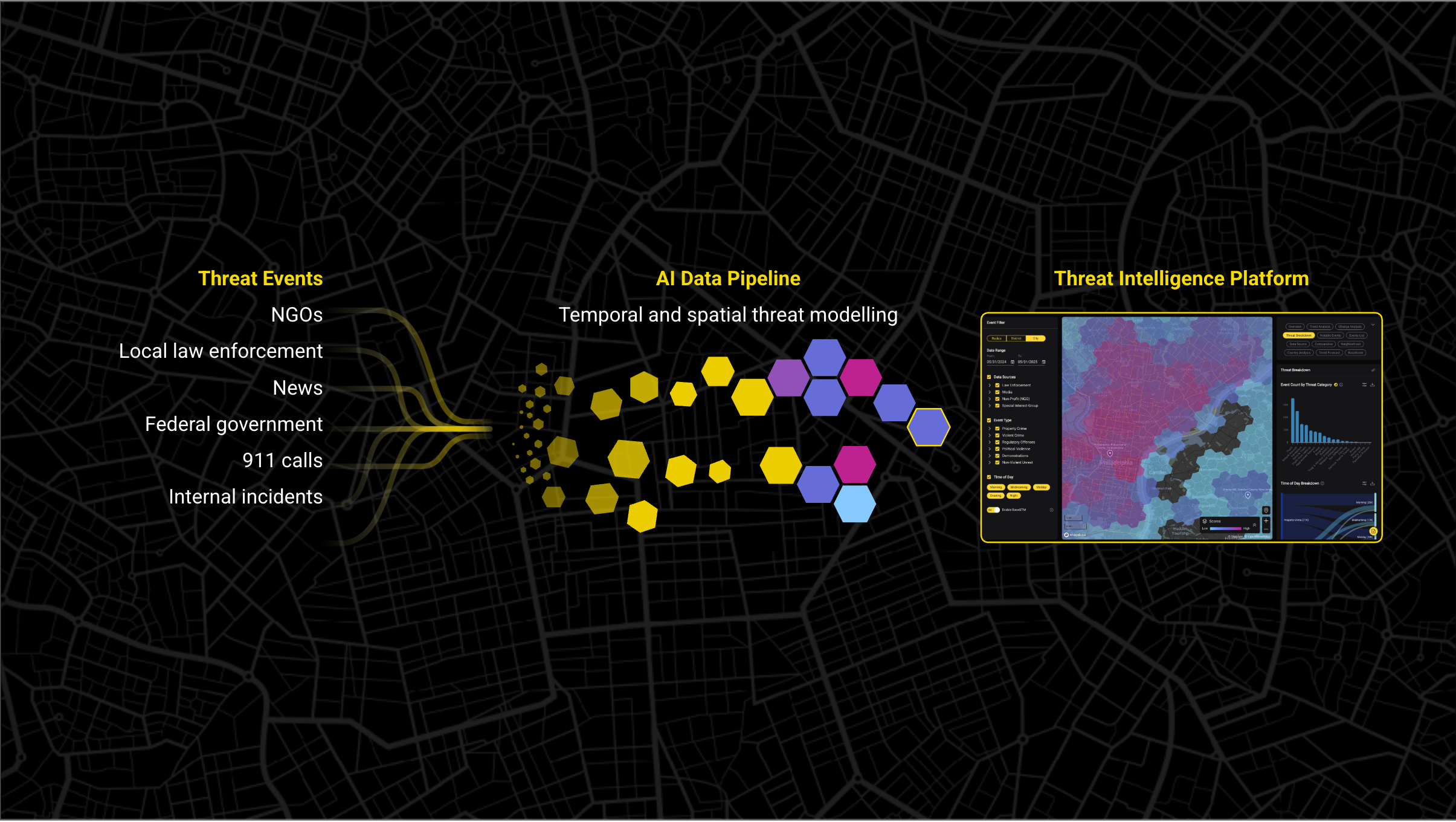
Hyperlocal data matters. A large discount retailer mapped external crime data within a 0.1-mile radius of their stores and discovered a direct correlation between neighborhood crime patterns and in-store incidents. That level of granularity is invisible without structured intelligence gathering.
Account for data quality. One security professional at a major entertainment company warned that "police data notoriously changes from month to month. They may skip March, and then all of a sudden in April, they'll include April and March together." Cross-reference multiple sources and flag gaps in reporting periods.
OSINT reconnaissance. Review what is publicly visible about the facility: satellite imagery, social media exposure, publicly available building layouts, and any prior media coverage of incidents at or near the location.
Step 3: Conduct the Physical Site Inspection
The site inspection translates intelligence into observed reality. Walk every domain of the facility using a structured checklist, and conduct inspections at multiple times of day. What appears secure during business hours may not be secure after 6 PM or on weekends.
One event security assessment confirmed that "evening hours present nearly twice the risk compared to other times of day." A credit union discovered that two branches located just 1.7 miles apart showed a 23-point difference in risk scoring.
During a Fortune 500 executive residence assessment, the site inspection identified the need for glass break sensors on upper floors (previously overlooked in the original design) and enhanced perimeter gate access control. Structured inspection caught what assumption-based planning missed.
Step 4: Audit Physical Security Systems
With the site inspection complete, evaluate the performance and integration of specific security technologies.
Access control systems. Review card-based, biometric, and PIN systems. Are credentials current? Can terminated employee badges still grant access? Do all sensitive areas require multi-factor authentication?
Surveillance. Map camera coverage against the facility footprint. Identify blind spots, verify recording quality meets evidentiary standards, and confirm monitoring protocols. Who watches the feeds, and when?
Intrusion detection and alarms. Test alarm response times. Verify that alarm triggers are appropriately calibrated and that the security operations center (SOC) has clear escalation procedures.
System integration. The critical question: do these systems work together? Does a bypassed access point trigger an alarm? Does the SOC receive a camera feed when an intrusion sensor activates? One utility company security professional noted that assessors must verify whether monitoring accounts for multi-jurisdictional data, since "you have Amtrak police there. Sometimes there could be state police, MTA police."
A regional credit union used system audit findings to drive differentiated deployment: branches with high property crime received enhanced surveillance and alarms, while branches with elevated violent crime received priority for guard force expansion.
Step 5: Identify Threats and Threat Actors
Build a threat inventory tailored to the organization's location, industry, and operations. Generic threat lists produce generic assessments. The goal is specificity.
External criminal threats. Theft, burglary, robbery, vandalism, arson. A large discount retailer's threat identification process revealed that "property crimes clustered in specific zones" with "timing patterns showing peak risk hours and days for different threat types." Temporal and spatial patterns matter as much as threat categories.
Targeted threats. For organizations with high-profile executives or valuable intellectual property, assess threats from motivated adversaries through executive protection travel risk assessment. A Fortune 500 travel company identified "rising incidents of high-net-worth residential burglaries in the Seattle area," a threat tailored to the asset type and the threat actor profile.
Workplace violence and active shooter. Assess behavioral indicators, reporting mechanisms, and physical design features that could mitigate or exacerbate an active threat scenario.
Natural hazards. Floods, earthquakes, severe weather, and wildfire exposure based on geographic location.
Terrorism and civil unrest. Particularly relevant for facilities near government buildings, transportation hubs, or event venues.
Cyber-physical convergence. Physical access that enables network intrusion, such as badge cloning to access server rooms or rogue device deployment on network switches.
One utility security professional emphasized that "utility companies want to know about substation attacks, not just general crime trends." Threat identification must be industry-specific, not generic.
Step 6: Assess Insider Threats
An insider threat in the context of physical security is any risk posed by individuals who have legitimate access to an organization's facilities, systems, or information and who may use that access, intentionally or unintentionally, to cause harm. Insiders are uniquely dangerous because they bypass most perimeter controls entirely.
Apply the principle of least privilege. Review whether employees have access only to the areas and systems their roles require. Identify individuals with disproportionate physical access, particularly those with master keys, override credentials, or unsupervised access to high-value areas.
Identify surveillance gaps. Map areas where employees work unsupervised or where camera coverage is limited. Assess segregation of duties for sensitive processes (cash handling, inventory management, data access).
Behavioral indicators. Coordinate with HR and legal to establish protocols for identifying and responding to behavioral warning signs. Insider threat programs must be cross-functional; security alone lacks the context to interpret behavioral changes.
A regional credit union's previous approach deployed "one-size-fits-all security" with identical access controls everywhere regardless of actual local risk. That lack of differentiation created insider vulnerability by failing to apply tighter controls where the risk profile demanded them.
Step 7: Score and Prioritize Risks Using a Risk Matrix
With threats identified and vulnerabilities documented, score each risk to determine priority. Use a 5x5 risk matrix that evaluates likelihood (1-5) against consequence (1-5) to produce a composite risk score.
Likelihood scale:
- 1 (Rare): Less than once per 5 years
- 2 (Unlikely): Once per 2-5 years
- 3 (Possible): Once per 1-2 years
- 4 (Likely): Multiple times per year
- 5 (Almost Certain): Monthly or more frequent
Consequence scale:
- 1 (Negligible): Minor property damage, no injuries
- 2 (Minor): Limited financial loss, minor injuries
- 3 (Moderate): Significant financial loss, serious injuries, operational disruption
- 4 (Major): Major financial loss, life-threatening injuries, extended operational disruption
- 5 (Catastrophic): Loss of life, existential financial impact, permanent operational damage
Negligible (1)Minor (2)Moderate (3)Major (4)Catastrophic (5)Almost Certain (5)Moderate (5)High (10)High (15)Critical (20)Critical (25)Likely (4)Low (4)Moderate (8)High (12)Critical (16)Critical (20)Possible (3)Low (3)Moderate (6)Moderate (9)High (12)High (15)Unlikely (2)Low (2)Low (4)Moderate (6)Moderate (8)High (10)Rare (1)Low (1)Low (2)Low (3)Low (4)Moderate (5)
Risk tiers and response timelines:
- Critical (15-25): Immediate action required within 24-72 hours. Temporary countermeasures deployed until permanent remediation is complete.
- High (10-14): Action required within 30 days. Formal remediation plan with assigned owner and budget.
- Moderate (5-9): Action required within 90 days. Included in next capital planning cycle.
- Low (1-4): Monitor and review at next scheduled assessment. Document and accept residual risk.
The TVA scoring model combines Probability, Criticality (asset value), and Vulnerability into a composite risk score. Annualized Loss Expectancy (ALE) is a financial metric that estimates the expected monetary loss from a specific threat over one year, calculated as the product of the Single Loss Expectancy and the Annualized Rate of Occurrence. ALE translates security risk into financial language that executives and budget committees understand.
A regional credit union applied this tiered approach: high and very high risk branches (risk score 60+) received tier-one protocols including enhanced guard coverage and advanced detection technology. Medium risk branches (score 40-60) received tier-two protocols. Low-risk branches (below 40) received tier-three protocols.
Step 8: Document Findings and Build the Assessment Report
The assessment report is the deliverable that drives action. Structure it for multiple audiences.
Executive summary. Lead with financial risk exposure and the top three to five findings. Frame vulnerabilities in terms of potential loss, not technical jargon. One security director noted that "one of the biggest hurdles is just getting used to what these numbers actually correlate to and correspond with." Translate risk scores into business impact.
Detailed findings by risk tier. Organize findings from Critical to Low. For each finding, include the identified threat, the specific vulnerability, the risk score, photographic or visual evidence, and the recommended remediation.
Prioritized remediation roadmap. Assign each remediation action an owner, a target completion date, and a budget estimate. Group actions by tier so leadership can authorize critical and high items immediately while scheduling moderate items for the next budget cycle.
Living documentation. The assessment report is not a one-time deliverable. It should be updated after incidents, facility changes, or new threat intelligence. Treat it as a living risk register.
A regional credit union found that when "security recommendations became defensible business cases rather than subjective opinions," executive support for security investments increased. At a large financial institution, data-driven reporting "elevated the security function from a cost center to a strategic advantage."
How Do You Conduct a Threat Assessment?
To conduct a physical security threat assessment, follow this eight-step process grounded in the TVA (Threat-Vulnerability-Asset) model:
- Define scope, objectives, and stakeholders
- Gather pre-assessment intelligence (internal records, external crime data, OSINT)
- Conduct a physical site inspection across all security domains
- Audit physical security systems (access control, surveillance, alarms, integration)
- Identify threats and threat actors specific to your location and industry
- Assess insider threats as a dedicated evaluation
- Score and prioritize risks using a 5x5 likelihood-by-consequence matrix
- Document findings and build a prioritized remediation report
Each step builds on the previous one. The assessment is not complete until findings are documented, scored, and assigned to owners with remediation timelines.
What Are the 5 Steps of Security Risk Assessment?
The five-step security risk assessment framework provides a simplified structure that maps to the broader eight-step physical security threat assessment process:
- Asset identification. Catalog the people, property, information, and processes that require protection. This maps to Step 1 (Define Scope) of the full methodology.
- Threat identification. Determine who or what could cause harm to those assets, including criminal actors, natural hazards, and insider threats. This maps to Steps 5 and 6.
- Vulnerability analysis. Identify weaknesses in existing controls that a threat could exploit. This maps to Steps 3 and 4 (Site Inspection and Systems Audit).
- Risk analysis. Score each threat-vulnerability pair using a Likelihood x Impact framework to determine priority. This maps to Step 7 (Risk Matrix).
- Recommend and implement controls. Develop and execute a remediation plan to reduce risk to an acceptable level. This maps to Step 8 (Assessment Report).
The five-step framework provides the conceptual foundation. The eight-step process adds the operational detail needed to execute a thorough physical security threat assessment.
What Are the 5 D's of Physical Security?
The 5 D's of physical security describe the layered defense strategy that a threat assessment evaluates. Some frameworks use Deter, Detect, Delay, Deny, and Defend; others substitute Respond and Recover for the final two. ASIS International and other professional bodies use slightly different terminology, but the core principle is consistent: effective physical security requires multiple layers, not a single control.
Definition: Defense in depth, or layered security in the physical security context, is a strategy that deploys multiple, overlapping security controls so that if one layer fails, subsequent layers continue to protect the asset.
- Deter. Discourage threat actors from attempting an attack. Controls: visible security personnel, lighting, signage, fencing, and CPTED design principles. A credit union's guard force expansion served as a primary deterrent at high-risk branches.
- Detect. Identify a threat as early as possible. Controls: CCTV, motion sensors, intrusion alarms, glass break sensors, and monitoring protocols. A Fortune 500 executive residence assessment identified the need for glass break sensors on upper floors, filling a detection gap.
- Delay. Slow an attacker's progress to buy response time. Controls: reinforced doors, mantraps, bollards, and turnstiles.
- Deny. Prevent unauthorized access entirely. Controls: biometric access, perimeter gates, vehicle barriers. Enhanced perimeter gate access control at the executive residence served as a denial layer.
- Defend. Neutralize the threat through active response. Controls: security response teams, law enforcement coordination, safe rooms.
A physical security threat assessment evaluates the organization's current maturity across each of these five layers and identifies where gaps exist.
Threat Identification Techniques: Going Beyond the Site Walk
A site walk observes the physical environment. A true threat assessment also probes the human, digital, and intelligence dimensions that a walkthrough alone cannot reveal.
Employee and management interviews. Frontline staff know where the workarounds are: which doors get propped open, which cameras have been broken for months, which policies are routinely ignored. Structure interviews around specific domains: access control practices, incident reporting habits, after-hours procedures, and perceived threats. Ask maintenance and janitorial staff, not just management. They observe the facility at hours when most employees are absent.
OSINT reconnaissance. Assess what an adversary could learn about the facility without ever setting foot on site. Search for satellite imagery showing perimeter layout, social media posts revealing internal operations, publicly filed building permits, and any media coverage of prior incidents. Be aware that publicly available data sources have quality issues. One security professional at a major entertainment company cautioned that "police data notoriously changes from month to month."
Historical incident data analysis. Review internal incident logs, local crime statistics, and intelligence feeds for patterns in frequency, type, location, and timing. A large discount retailer supplemented internal data with external crime analysis to establish "intelligence-driven law enforcement partnerships," sharing threat analysis with local precinct commanders through regular intelligence exchange meetings.
Active testing. With proper authorization and legal clearance, conduct controlled tests: tailgating attempts at access points, social engineering calls to test information disclosure, alarm response timing tests, and badge-cloning simulations. Document findings without disrupting normal operations.
One executive protection professional building a program from scratch emphasized the need to "quickly establish what 'normal' looks like for executive homes, offices, and travel destinations before they can identify anomalies." Intelligence gathering establishes the baseline that makes anomaly detection possible.
Physical Security Threat Assessment Frameworks and Standards
Several established frameworks provide the methodological foundation for conducting physical security threat assessments. Understanding which framework applies to your organization ensures methodological rigor, regulatory alignment, and defensibility.
Definition: CPTED (Crime Prevention Through Environmental Design) is a set of architectural and environmental design principles that reduce crime opportunity through the strategic design of the built environment, including natural surveillance, natural access control, and territorial reinforcement.
A healthcare organization with over 400,000 employees applied framework principles by creating a "quintile-based benchmark system for standardizing responses across regions," ensuring consistent methodology across 1,100+ zip codes.
No single framework covers every dimension. Most organizations combine ASIS PSP.1 as the core assessment methodology with ISO 31000 for enterprise risk integration and CPTED for site-specific design evaluation.
Industry-Specific Considerations for Physical Security Threat Assessments
The assessment process must adapt to the unique threat landscape, regulatory requirements, and operational characteristics of each industry.
Healthcare in practice. A healthcare organization with 400,000+ employees across 1,100+ zip codes acknowledged that "prior to Base Operations, our threat assessment process lacked standardization." With in-home clinician programs sending workers into unfamiliar neighborhoods, the threat assessment had to extend beyond facility walls.
Retail in practice. A discount retailer with 16,000+ locations mapped external crime patterns against store performance data and achieved a 75% incident reduction by directing resources to the locations that needed them most.
Financial services in practice. A regional credit union established tiered security protocols across 30+ branches, with resource allocation driven by risk scoring rather than blanket policies.
Critical infrastructure. A utility company security professional noted that "we've noticed more attacks on substations or gas gate stations," reinforcing that industry-specific threat identification is not optional.
How to Document and Report Your Physical Security Assessment
The assessment report converts findings into funded action.
Use standardized templates. Consistency across reports enables comparison over time and across locations. Include headers for executive summary, methodology, findings by domain, risk scoring, remediation roadmap, and appendices.
Include visual evidence. Photographs of identified vulnerabilities, annotated site maps showing camera coverage gaps, heat maps of incident concentration, and coverage diagrams make abstract risks concrete. One security professional noted that "even if it's, like, one more tagline in a report, it provides us with just that much more punch power" with stakeholders.
Frame for the audience. Executives need financial risk language: potential loss exposure, cost of remediation versus cost of inaction, and return on security investment. A regional credit union found that "security recommendations became defensible business cases rather than subjective opinions" when backed by data. At a financial institution, data-driven reporting "elevated the security function from a cost center to a strategic advantage."
Establish the report as a living document. Update after significant incidents, facility modifications, regulatory changes, or new threat intelligence. Include a section mapping findings to applicable regulations (HIPAA, OSHA, ISO 27001) so compliance teams can reference the assessment during audits.
How Often Should You Conduct a Physical Security Assessment?
Most organizations should conduct a full physical security threat assessment every two to three years at minimum. Regulated industries and high-risk facilities should assess annually. However, the most effective programs are trigger-based rather than calendar-based.
Trigger-based reassessment events:
- Facility changes (renovation, expansion, relocation)
- Significant workforce changes (layoffs, rapid hiring, return-to-office transitions)
- Security incidents at the facility or at comparable facilities nearby
- New threat intelligence indicating elevated risk
- Regulatory changes affecting physical security requirements
- Major technology upgrades or system replacements
Leading organizations go further. A regional credit union conducts quarterly site assessments across 30+ branches. A healthcare organization adds 30 new service areas quarterly, each requiring security protocol establishment. A global third-party logistics provider runs quarterly risk assessments across 400+ supply chain routes.
The assessment is a program, not a project. Build it into the organizational cadence rather than treating it as a one-time event.
In-House vs. Third-Party Physical Security Assessment: Which Is Right for You?
The choice between internal and external assessment teams depends on the organization's risk profile, resources, and the specific goals of the assessment.
The case for external assessors. The primary advantage is the absence of familiarity bias. External teams see the facility the way an adversary does, not the way an employee who walks through the same doors every day does. A Fortune 500 travel company's internal security design missed a cluster of residential burglaries within a half-mile of an executive's new residence. External threat intelligence revealed the pattern that familiarity-based planning overlooked.
The case for internal teams. Internal assessors bring operational familiarity, institutional knowledge, and lower direct cost. A regional credit union demonstrated that a single GSOC analyst can successfully lead assessment programs across 30+ branches when equipped with the right data and tools.
Many organizations combine both: internal teams handle routine monitoring and annual reviews while external consultants conduct comprehensive assessments every two to three years or after significant incidents.
Cyber-Physical Convergence: Why Your Physical Assessment Must Address Digital Vulnerabilities
Modern threat assessments cannot treat physical and cyber security as separate domains. The convergence of physical and digital attack vectors means that a gap in one domain often creates an entry point in the other.
Physical access enabling network intrusion. An attacker who gains physical access to a server room can install rogue devices on network switches, clone badges for persistent access, or directly access unencrypted systems. Badge cloning, tailgating past access control, and social engineering at reception desks are all physical tactics with cyber consequences.
Unsecured IoT and building management systems. HVAC controllers, smart lighting, elevator systems, and building automation platforms increasingly connect to IP networks. Many of these devices ship with default credentials and lack firmware update protocols. An unsecured building management system can serve as a pivot point into the corporate network.
Convergence assessment requirements. During the physical assessment, evaluate whether:
- Server rooms and network closets have access controls commensurate with their criticality
- IoT and BMS devices are segmented from the corporate network
- Physical security systems (cameras, access control panels) are themselves hardened against network-based attacks
- Badge and credential systems have anti-cloning protections
- Visitor and contractor policies account for device introduction risks
NIST SP 800-53 addresses this convergence directly in its Physical and Environmental Protection (PE) control family, which includes requirements for physical access monitoring, visitor control, and information system co-location.
Organizations that assess physical and digital security in isolation leave convergence vulnerabilities unaddressed. A modern physical security threat assessment treats cyber-physical attack paths as a distinct evaluation domain.
How to Build a Recurring Physical Security Assessment Program
A single assessment captures a snapshot. A recurring program builds organizational resilience over time.
Establish a review cadence. Set a baseline schedule (annual or biennial) and supplement with trigger-based reassessments. Integrate assessment milestones into the organization's capital planning and budget cycles so that remediation funding is pre-authorized rather than requested ad hoc.
Conduct after-action reviews (AARs). After any security incident, conduct a structured review that updates the threat model, re-evaluates relevant vulnerabilities, and adjusts the risk register. A large discount retailer "developed a standardized Security Playbook as the core intelligence platform" and "established objective criteria for prioritizing high-risk locations across their portfolio."
Train security staff on updated protocols. Assessment findings are only valuable if frontline personnel understand and implement the changes. Build training into the remediation roadmap with documented completion requirements.
Maintain a living risk register. A healthcare organization began using "historical trends to anticipate seasonal risk fluctuations and adjust protocols accordingly," transforming the assessment from a periodic report into a predictive program. A credit union's security team "now monitors daily, identifying emerging threat patterns and proactively adjusting security postures before incidents occur."
Measure program effectiveness. Track incident rates, response times, assessment completion rates, and remediation closure rates over time. Use these metrics to demonstrate program value to leadership and justify continued investment.
Physical Security Threat Assessment Checklist (Quick Reference)
Use this checklist as a quick-reference guide during any physical security threat assessment. Each domain maps to the corresponding step in the eight-step process.
Frequently Asked Questions About Physical Security Threat Assessments
What is the difference between a threat assessment and a vulnerability assessment?
A physical security threat assessment evaluates who or what might attack an organization, their capabilities, and the likelihood of an attack occurring. A vulnerability assessment focuses specifically on identifying weaknesses in existing security controls that could be exploited. While a threat assessment is proactive and threat-actor-driven, a vulnerability assessment is controls-focused and typically conducted as part of or after a broader threat assessment to identify specific gaps. The threat assessment asks "who is coming?" while the vulnerability assessment asks "where are the holes?"
How long does a physical security threat assessment take?
A small single-site assessment typically requires one day of on-site inspection plus one week for analysis and reporting. Multi-site enterprise assessments spanning dozens or hundreds of locations can take weeks to months depending on scope, complexity, and available resources. With structured threat intelligence platforms, some organizations have reduced per-site assessment time from one week to one day, and individual location assessments from five hours to 30 minutes. Key variables include the number of facilities, geographic spread, regulatory requirements, and whether the assessment includes active testing.
Who should be on the physical security assessment team?
A cross-functional team produces the most comprehensive results. Core members should include the security director or manager, facilities management, IT and cybersecurity representatives, an HR representative for insider threat and workplace violence considerations, legal counsel for regulatory compliance, and an executive sponsor who can authorize remediation spending. For regulated industries, include a compliance officer. External consultants bring the additional benefit of fresh perspective and absence of familiarity bias.
What does a physical security threat assessment report include?
A comprehensive report includes an executive summary with financial risk framing for leadership, detailed findings organized by risk tier (critical, high, moderate, low), photographic and visual evidence including surveillance maps and coverage diagrams, a prioritized remediation roadmap with assigned owners, target dates, and budget estimates, and a section on regulatory alignment for compliance teams. When reports are backed by quantified data, security recommendations become defensible business cases rather than subjective opinions. The report should be treated as a living document that is updated regularly.
How much does a professional physical security assessment cost?
Professional physical security assessments typically range from $2,000 to $20,000 for a single facility, depending on size, complexity, and the depth of analysis required. Internal assessments cost staff time but no external fees. External consultants with specialized certifications such as the ASIS Physical Security Professional (PSP) credential command higher rates but bring methodological rigor and regulatory expertise. Compared to the average cost of a physical security breach, estimated at approximately $100,000, assessments represent a cost-effective risk reduction investment.
Can completing a physical security assessment reduce insurance premiums?
Documented evidence of proactive risk management is increasingly recognized by commercial insurers as a factor in premium calculations. Completing a formal physical security threat assessment demonstrates due diligence and a structured approach to risk reduction, which insurers view favorably when evaluating commercial property and liability policies. A regional credit union saved $180,000 annually through data-driven security allocation, illustrating the broader financial benefits of structured assessment programs. While specific premium reductions vary by carrier and risk profile, organizations that maintain updated assessment documentation are better positioned to negotiate favorable terms.
What is the ASIS Physical Security Professional (PSP) certification and why does it matter for assessments?
The ASIS PSP certification is a globally recognized credential from ASIS International that validates expertise in physical security assessment methodology, including threat identification, vulnerability analysis, and risk scoring. PSP-certified professionals are trained in the ASIS PSP.1 Physical Security Risk Assessment Guideline, which provides a structured, repeatable methodology for conducting assessments. Organizations engaging external assessors should prioritize PSP-certified consultants to ensure methodological rigor and industry-standard practices.
How do you assess physical security for a multi-site organization?
Multi-site assessments require a standardized framework that enables consistent comparison across locations while accounting for local variation. Establish a common risk scoring methodology to rank and prioritize locations. A regional credit union with 30+ branches used a single GSOC analyst to manage assessments across four districts by standardizing the scoring framework. A healthcare organization applied quintile-based benchmarks across 1,100+ zip codes. A global third-party logistics provider scaled from assessing 100 routes to 400+ with the same team by automating baseline data collection. Start with data-driven baseline assessments across all sites, then prioritize in-depth on-site inspections for the highest-risk locations.
What is CPTED and how does it apply to a physical security threat assessment?
CPTED, or Crime Prevention Through Environmental Design, is a set of architectural and environmental design principles that reduce crime opportunity through the strategic design of the built environment. Key CPTED principles include natural surveillance (clear sightlines and adequate lighting), natural access control (landscaping and design features that guide legitimate movement while discouraging unauthorized entry), and territorial reinforcement (design cues that clearly define public versus private space). During a physical security threat assessment, assessors evaluate a facility's alignment with CPTED principles as part of the site inspection, identifying design-based vulnerabilities such as poor lighting, concealment points, or ambiguous boundaries.
How should physical security assessment findings be presented to senior leadership?
Translate technical security findings into business language that executives understand. Lead with financial risk exposure, framing vulnerabilities in terms of potential loss rather than technical severity. Use a tiered priority structure (critical, high, moderate, low) with specific remediation costs and timelines for each tier. Include visual evidence such as heat maps, coverage diagrams, and risk matrices to make abstract threats concrete. One credit union found that when security recommendations were backed by quantified data, they became "defensible business cases rather than subjective opinions." A financial institution's security director "elevated the security function from a cost center to a strategic advantage" by presenting findings with data-driven context.
Physical security threats evolve continuously, and the organizations that assess risk systematically are the ones that prevent incidents rather than respond to them. Whether you are conducting your first assessment or building a recurring program across hundreds of locations, the methodology outlined in this guide provides the structured, repeatable process that turns threat awareness into organizational resilience.
Takeaways

Join 1100+ security leaders getting new ideas on how to better protect their people and assets.